

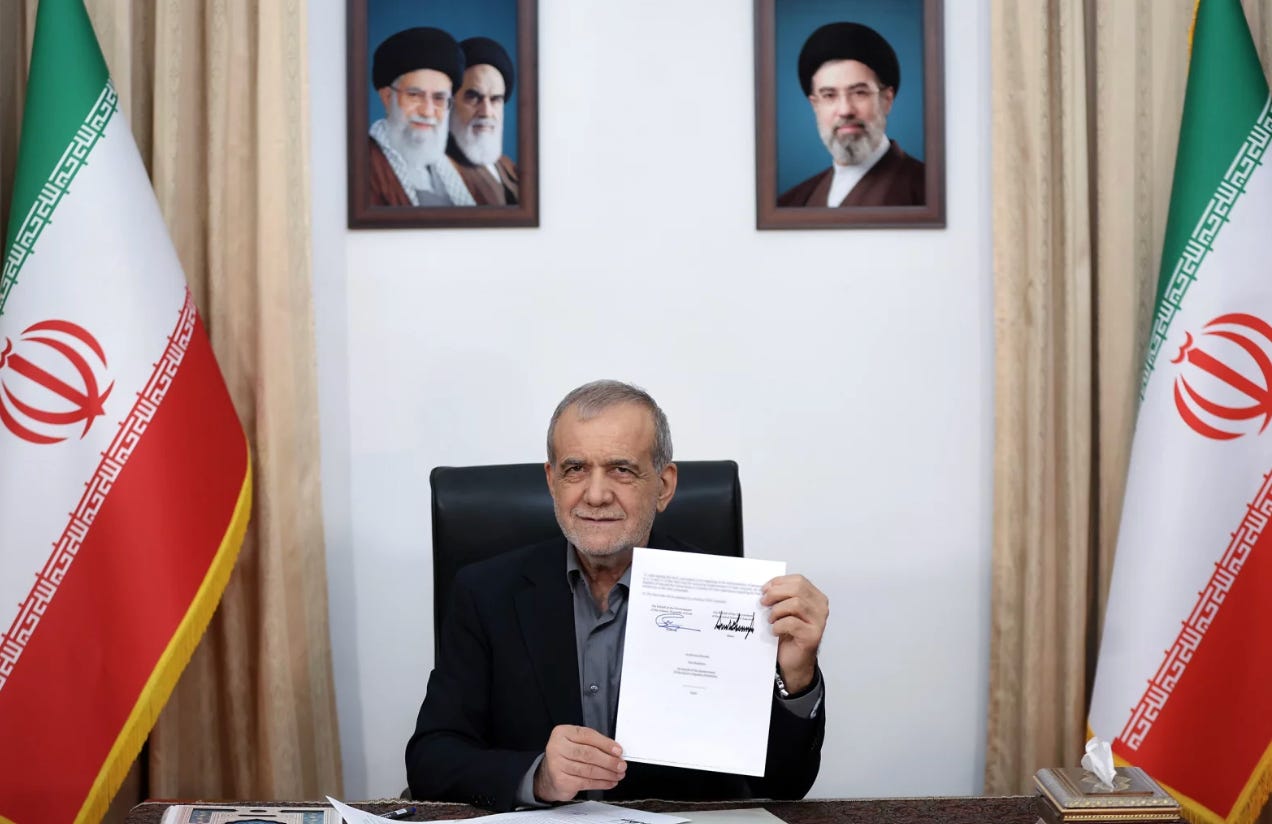
The Trump regime has temporarily lifted oil sanctions on Iran and says that Iran has agreed to allow United Nations nuclear inspectors back into the country. According to The New York Times, however, there remains considerable disagreement about what the two parties have actually agreed to. Vice President J.D. Vance has described the talks as a major breakthrough. Iran, meanwhile, insists that it has made no new commitments regarding inspections and has suggested that any cooperation would simply take place under procedures that already existed.
In other words, the return of inspectors and the easing of sanctions would restore key elements of the Joint Comprehensive Plan of Action, better known as the JCPOA or Iran nuclear deal. That is, of course, the 2015 agreement negotiated under President Obama that Donald tore up in 2018 while promising something stronger, tougher, and more effective.
Instead, after an illegal and unconstitutional war of choice, we appear to be drifting back toward many of the same arrangements Donald once condemned, only at a far greater cost.
Amid the confusion, the mixed messaging, and the competing claims about what was actually accomplished, J.D. Vance offered his own assessment of the negotiations.
Vance: What we told the Iranians yesterday is when you guys engage in what us millennials might call trash talk, you can’t expect the President of the United States not to respond and not to correct the record. So when they say things that aren’t true, the president is going to respond to it. I’m going to respond to it. Americans are going to respond to it. When they make threats that aren’t rooted in reality, they have to accept that the President of the United States is actually going to set the record straight. That’s all that happened. So yes, there was a little bit of threatening, there was a little bit of whining, but at the end of the day, the talks continued and we made great progress.
A little bit of threatening. A little bit of whining.
It certainly does not help that the commander in chief behaves like a prepubescent child, but it is important to remember what we are actually talking about here. This is not playground banter. It is not trash talk. It is not a disagreement between rival sports teams.
Threatening to annihilate another country is not trash talk. Threatening military escalation is not trash talk. Threatening to continue bombing a nation until it submits to your demands is not trash talk.
One of the enduring problems of this administration is that the Trump regime has become almost as unreliable as the people it claims to oppose. It is difficult to take lectures from J.D. Vance about inflammatory rhetoric when Donald himself continues to be the primary source of escalation. The difference is that Donald’s threats are backed by the military power of the United States.
Before we hear any more complaints about the language coming from Iran, it is worth looking at how Donald himself has chosen to communicate.
Fox State TV: President Trump tells Fox News he spoke with Iranian officials overnight and said, “You close it and you won’t have a country.” He went on to tell these officials, “You won’t even make it back to your effing country.”
Now, earlier today, Iran’s President Masoud Pezeshkian said this about Iranian enrichment of uranium.
We will not give up our right to enrichment and they too will be forced to accept it. You all know what the so-called President of the United States was saying. He had made a complete 100 degree turn. He was saying that Iran must surrender unconditionally.
Fox News then reported Donald’s response.
President Trump, during our call, responded directly to those comments by Iranian President Masoud Pezeshkian. President Trump told Fox News,” he better watch his mouth, he better shape up or we’ll take over the rest of the country.”
That is not diplomacy.
That is not statecraft.
That is not the language of a serious leader attempting to stabilize an already volatile situation.
What Donald is suggesting there is that the United States could place troops on the ground in Iran if he does not get his way. Whether he intends to follow through on that threat is almost beside the point. The recklessness of making it in the first place should be obvious.
Speaking from Bürgenstock, Switzerland, Vance attempted to downplay tensions that emerged over the weekend, including renewed fighting in Lebanon, Iran’s declaration that it had once again closed the Strait of Hormuz, and Donald’s increasingly erratic responses.
Vance also revealed that Jared Kushner, a man with no diplomatic training, no foreign policy expertise, and no official role in the United States government, had been involved in developing a process through which the United States and Qatar would oversee unfrozen Iranian funds.
According to Vance, those funds would ultimately be used to purchase American agricultural products.
Vance: As much as I see some of the press misreporting on this, and of course buttressed by what the Iranians are saying or not all Iranians, I want to be clear. There are a lot of Iranians who are telling the truth about what happened yesterday, but you see some social media reporting that gets this wrong. But fundamentally, what Jared and the Qataris and the entire team here in Bürgenstock accomplished is to me a classic Trump deal where if Iranian assets are ever unfrozen, they’re going to go to make American farmers richer and to feed the Iranian people. That’s a very, very good and very classic Trump deal that’s great for our people, great for the people of Iran and fundamentally again, will contribute to this regional security architecture that we’ve built and that we’re going to work very hard to ensure that it endures.
A classic Trump deal.
That phrase deserves some scrutiny.
If by “classic Trump deal” Vance means an arrangement that leaves the other side with most of what it wanted, saddles Americans with enormous costs, and follows a series of catastrophic miscalculations, then yes, this is indeed a classic Trump deal.
Iran appears poised to regain access to resources and opportunities that were restricted before the war. American taxpayers are left paying an extraordinary price. Both countries have suffered unnecessary losses. Thousands have died. Billions have been spent. And after all of it, we appear to be moving back toward components of the very agreement Donald once described as one of the worst deals ever negotiated.
That is not strength.
That is not victory.
And it is certainly not progress.
The administration’s description of the agreement becomes even more difficult to take seriously when one examines the details surrounding sanctions relief.
During an appearance in the Oval Office, Donald was asked about the decision to lift sanctions on Iranian oil and whether there would be any meaningful guarantees that revenue generated from renewed oil sales would not be used to rebuild Iran’s military.
Donald: Well, I’m going to have to find out exactly the status, but if the sanctions go out, money’s going to be put into this country. All that money’s coming back in the form of purchases of food, which they desperately need. They have 91 million people, they can’t feed them. So the money that we lift is going to go to our farmers, largely to our farmers.
A reporter then asked the obvious follow-up question.
Can you ensure that the Iranians won’t use profits from oil sales to rebuild their military?
This was Donalds response:
Well, they’re not supposed to be doing that, so we’ll see. But they’re supposed to use money to buy food for their people because right now their people are very hungry and they’re buying it exclusively from us corn, soybeans. Should be a lot of money. I hope it’s a lot of money.
That answer tells us almost everything we need to know.
Donald appears to believe that telling the Iranian government what it is “supposed” to do somehow constitutes a policy. It does not. It is wishful thinking masquerading as strategy.
The problem, as I have mentioned before, is that the Iranian government is an extremist regime that has repeatedly demonstrated its willingness to prioritize its own survival, military strength, and regional influence over the well-being of its people. If that government is presented with a choice between rebuilding its military capabilities and purchasing American agricultural products, which option do we honestly think it will choose?
The answer seems self-evident.
And there is another layer of irony here that should not be ignored. American farmers would not need this sort of lifeline if Donald had not spent the better part of two years undermining their economic stability in the first place. Now we are supposed to believe that an agreement with Iran will somehow rescue an agricultural sector that his own policies helped damage.
That is not economic planning. It is crisis management for a crisis of his own making.
Meanwhile, the financial costs of this war continue to grow.
According to the Associated Press, by mid-May the conflict had already cost approximately $29 billion. Frankly, that figure strikes me as extraordinarily conservative. Even if we accept it at face value, the costs are staggering. And now the Pentagon is reportedly informing senators that it requires roughly $80 billion in additional funding.
The request has not yet been formally transmitted to Congress by the Office of Management and Budget, but Defense Secretary Pete Hegseth has already begun lobbying lawmakers on Capitol Hill in support of it.
This comes as the White House simultaneously pushes for a Pentagon budget of approximately $1.5 trillion, a figure that would represent an enormous increase over current military spending levels.
That number tells us something important about the priorities of the Trump regime.
When it comes to healthcare, education, social services, disaster relief, environmental protection, and programs that actually improve people’s lives, we are constantly told there is not enough money.
When it comes to war, however, the money somehow materializes.
When it comes to military expansion, there is always another appropriation, another emergency request, another justification for spending billions more.
This administration has repeatedly insisted that strength is measured by military spending. The rest of us understand that strength is measured by whether a government can improve the lives of the people it serves.
The people currently representing the United States in these negotiations are, to put it mildly, spectacularly unqualified for the task.
That reality becomes increasingly difficult to ignore every time they open their mouths.
Jared Kushner, despite having no diplomatic experience and no official government position, continues to play an outsized role in discussions involving some of the most sensitive geopolitical issues in the world.
J.D. Vance, meanwhile, seems determined to reduce international diplomacy to social media discourse, repeatedly framing negotiations between governments as though they were little more than arguments on the internet.
And then there is Donald himself, whose understanding of foreign policy appears to begin and end with threats.
Negotiation, compromise, coalition building, strategic patience, and diplomacy are skills that require discipline, expertise, and knowledge. Donald has spent his entire life substituting intimidation for competence, and he appears genuinely unable to imagine another approach.
That may work when bullying contractors, intimidating employees, or threatening political opponents. It is considerably less effective when dealing with international crises involving hostile governments, military escalation, and nuclear programs.
In closing, I am not necessarily saying that J.D. Vance is the least respected so-called statesman in modern politics. I am saying that the reception he received this week from Qatar’s lead negotiator speaks volumes.
During negotiations in Lake Lucerne, Vance approached the Qatari representative and appeared to extend his hand. The negotiator neither shook it nor made eye contact with him, instead looking past him and continuing on without acknowledgment. It was a small moment, but a revealing one.
That is not how people treat somebody they respect. It is not how people treat somebody they view as an equal participant in serious negotiations. It is certainly not how people treat a diplomat they believe is helping lead a successful peace process.
It is also what happens when diplomacy becomes performative and negotiations become political theater.
The Trump regime wants Americans to believe that it is negotiating from a position of strength. It wants us to believe that every concession is strategic, every contradiction is intentional, and every setback is somehow evidence of success.
The facts tell a different story.
Donald tore up the JCPOA promising something stronger. He launched an illegal and unconstitutional war of choice promising something better. He and his administration repeatedly assured Americans that they had a plan.
Now, after billions of dollars in spending, thousands of lives disrupted or destroyed, and months of instability across the region, we are watching his negotiators struggle to explain what exactly has been achieved.
Perhaps that confusion is the clearest indication of failure.
When the people responsible for a policy cannot consistently explain what they have agreed to, when allies and adversaries offer entirely different descriptions of the same arrangement, and when the administration’s central argument depends on trusting the word of people who have repeatedly misled the public, skepticism is not only justified. It is necessary.
Donald has always relied on threats to get his way. It is the defining feature of his personal life, his business career, and now his foreign policy.
The problem is that threats are not diplomacy.
They are not strategy.
And they are not leadership.
They are simply the preferred tools of a man who knows no other way to exercise power.

Donald J. Trump is still that six year old with potatoes on his head.
Another classic blunder!