

[Transcript edited for clarity, flow and length]
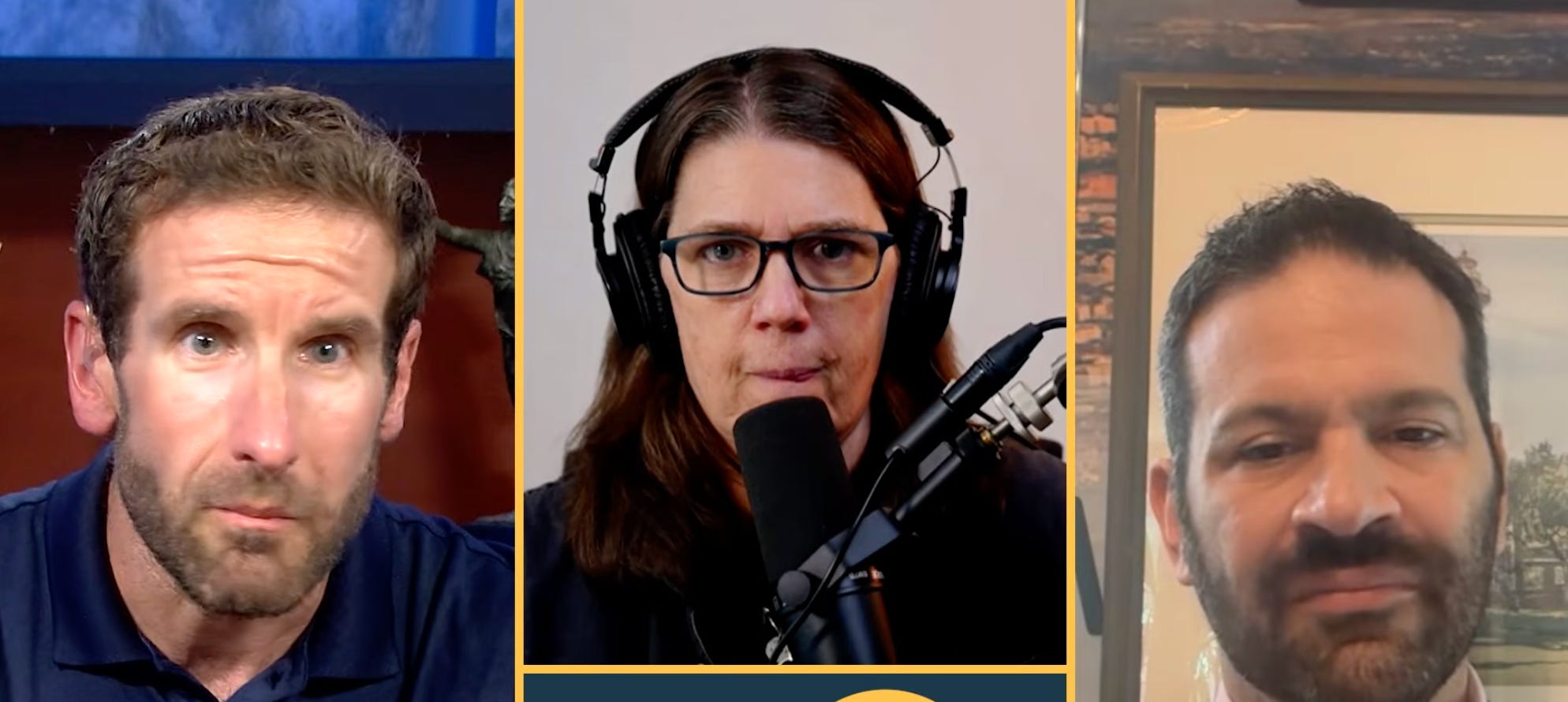
Mary Trump: I joined host Chris Line of Free Thought TV and Mark Dann to talk about my recent appearance at the Reason Reception, hosted by the Congressional Freethought Caucus. We also discussed some really incredible meetings I had with members of Congress who are part of the Congressional Freethought Caucus. It was a fascinating conversation, and we even got to see clips from some of the speakers who addressed the reception. I hope you enjoy it.
Chris Line: We should start by talking about what that experience was like for you, Mary, and what you took away from it. What stood out to you most from those conversations?
Mary Trump: I really didn’t know what to expect going into this. I’d never been to Capitol Hill before. I’d never met with members of Congress in their offices. I’ve certainly met members of Congress before. Jamie Raskin is a very dear friend of ours, so seeing him was a wonderful bonus. But what truly stood out were the substantive conversations we had with Representatives Jared Huffman, Becca Balint, and Mark Pocan.
We were fortunate enough to spend about half an hour each with Representatives Huffman and Balint, and about fifteen minutes with Representative Pocan before he had to leave for a press conference. I honestly didn’t know it was possible to get a member of Congress to sit still for more than a minute. Having the opportunity to talk in depth about why the Congressional Freethought Caucus is important to them and to hear their ideas about reaching people who may not already share our perspective was incredibly valuable.
I also have to say that Mark did a fantastic job making everything happen. The entire event ran remarkably smoothly, and it was organized impeccably.
Chris Line: I’ve participated in several Capitol Hill advocacy days over the years, and this one was particularly well organized. Mark really did a tremendous job. How important do you think these face-to-face conversations are compared to other ways of communicating with members of Congress?
Mary Trump: I think they’re always more meaningful. We’ve all become accustomed to doing interviews, television appearances, and conversations over Zoom, and while that technology certainly allows us to reach more people across different locations, there’s something uniquely powerful about being in the same room with another person.
That’s especially true when you’re talking with members of Congress, who are constantly being pulled in countless directions. They have demands on their time every minute of the day. Being able to sit down with them, have a real conversation, ask thoughtful questions, and listen to substantive answers creates a level of engagement that simply isn’t possible remotely. Mark probably has a much deeper appreciation for that than I do because this was my first experience participating in meetings like these.
Mark Dann: Mary did an excellent job throughout the day. We happened to visit Capitol Hill on an especially busy day. The House schedule was unusually chaotic under Speaker Johnson’s leadership. Votes could happen at almost any moment, and there was a constant sense of managed chaos. On top of that, there always seems to be something coming out of the Trump administration demanding members’ immediate attention.
That’s why these face-to-face conversations matter so much. They create an opportunity to discuss substantive issues, including the importance of separating church and state and the broader challenges facing our democracy. Donald Trump’s psychology has become a major topic of conversation among many members of Congress, and Mary brought a unique perspective to those discussions. She absolutely knocked it out of the park.
Chris Line: Mary was incredibly popular throughout the day. I wasn’t actually present for every meeting, but I did hear a wonderful story. Jamie Raskin was meeting with a basketball team immediately before your meeting. My understanding is that, once he mentioned he’d be meeting with you, the entire basketball team wanted to meet you as well.
Mary Trump: That was such an unexpected and delightful experience. We were waiting in the library outside Jamie’s office when we learned he had been called back to the House floor because, as you mentioned, the schedule was changing constantly. Since he’s on the Judiciary Committee, he had to leave almost immediately.
Although we weren’t able to have the full meeting we’d planned, he came in with the men’s basketball team from Denison University in Ohio. My wife is from Ohio, so that was a fun little bonus. Those young men were incredibly gracious, charming, and kind. It was a completely unexpected surprise, and it’s something I’ll always remember.
I will definitely cherish those photographs, although I do wish they hadn’t made me look even shorter than I actually am.
Chris Line: Speaking of photographs, I had the opportunity to take quite a few that day. One of my favorites came after we visited Congressman Raskin’s office. Even though he had already returned to the floor, we were able to see the Clarence Darrow award we had previously presented to him displayed in his office.
To wrap up this part of the discussion, did those meetings leave you feeling more hopeful or more concerned than when you first arrived? Was there anything that really stood out as a major takeaway?
Mary Trump: They absolutely left me feeling more hopeful.
Simply knowing that there are now thirty-seven members of Congress, all Democrats at this point, who belong to the Congressional Freethought Caucus, and that the caucus continues to grow, is encouraging. Seeing representatives like Jared Huffman openly and proudly identify themselves as nonbelievers and humanists while continuing to win elections gives me hope as well.
What also encouraged me was meeting elected officials who are willing to engage publicly on an issue that, for many years, was considered politically untouchable. These are people who continue raising their voices while thoughtfully considering how to communicate with those who may not initially agree with them or may not yet understand just how dangerous it becomes when organized religion is combined with governmental power.
The Reason Reception itself reinforced that optimism. It served as a thoughtful and inspiring antidote to what increasingly feels like a hostile takeover of our government by white evangelical Christian nationalism.
Chris Line: Our next clip speaks to the broader potential of building common cause with religious communities while recognizing that religious traditions do not have a monopoly on ethics or morality. This comes from Representative Sean Casten of Illinois.
This is what Representative Sean Casten said:
If you talk about ethics, people think you’re talking about their religion. I think there’s power there, and there’s an opportunity there. What I think you challenge us to do, and what we have to challenge ourselves to do, is to speak about ethics and morality in a way that doesn’t fall back on religious texts. It’s really easy to quote from Jefferson’s Bible, with the miraculous parts removed, and talk about the ethical teachings in the Sermon on the Mount, which are concepts shared by every major religion. If we use those touchstones, we can attract people who may think we’re talking only about their religion, but we’re really talking about something much broader. We hold these truths to be self evident, that we’re all created equal and equally entitled to life, liberty, and the pursuit of happiness, regardless of who we worship or whether we worship at all.
What are your thoughts on Representative Casten’s comments about secular values and public policy?
Mary Trump: I think conversations like these help expose just how normalized some of these dangerous trends have become. As you mentioned, the Reason Reception serves as a counterbalance to the National Prayer Breakfast. That alone should prompt people to ask an obvious question: why do we have a National Prayer Breakfast in the first place? Why is there a National Day of Prayer? People are entirely free to pray whenever and wherever they choose without needing the government to sanction or endorse those activities.
I also think it’s incredibly important that we continue identifying the specific religious movements that pose a genuine threat to the American experiment and to our Constitution. Those conversations become even more effective when they include religious people who strongly support the separation of church and state because, frankly, I would assume that describes the overwhelming majority of religious Americans.
By making it clear that religious people do not have a monopoly on ethics or morality, we also create space for people of every faith, and those with no faith at all, to work together toward shared democratic values. Ultimately, if we really think about the purpose of the Congressional Freethought Caucus, every single member of Congress should belong to it, not just Democrats.
Chris Line: That’s such an important point. There really shouldn’t be anyone opposed to the separation of church and state or to protecting everyone’s right to believe, or not believe, as they choose.
Mark Dann: We consistently see that reflected in public opinion. Large majorities of Americans support the separation of church and state. As Mary said, if you’re religious, you should absolutely support those protections because they safeguard your freedom as well.
Some of our strongest partnerships, both in Washington and around the country, are with religious allies who are equally committed to protecting those constitutional principles. We often say that the Congressional Freethought Caucus is the most religiously diverse caucus in Congress. Its members include Buddhists, Jewish members, Episcopalians, Muslims, nonbelievers, and many others.
Representative Casten also touched on something we’ve discussed repeatedly: people are capable of being good on their own. They don’t need to worship a higher power in order to behave ethically.
Mary has spoken about this throughout her work. When life becomes difficult and the stakes are high, standing up for what’s right, even when that means disagreeing with family members or your own community, is extraordinarily difficult. That’s exactly what Representative Casten was describing, and it’s something Mary discussed repeatedly during our meetings on Capitol Hill.
As Maya Angelou famously said, when someone tells you who they are, believe them. Those were exactly the kinds of conversations we found ourselves having throughout the day.
Chris Line: Mary, you’ve spoken often about the intersection between authoritarianism and Christian nationalism, themes that Catherine Stewart has explored extensively in her own work. Do you have any thoughts about what she’s had to say on those issues?
Mary Trump: Absolutely. Catherine Stewart has done extraordinary work, and I recommend her writing to everyone.
Unfortunately, the growing misuse of organized religion to advance an authoritarian political agenda is very much a sign of the times. Obviously, this isn’t happening only in the United States. We’ve seen similar movements emerge in other countries. The difference is that America has traditionally served as a beacon of democracy.
Watching this country increasingly embrace an authoritarian Christian nationalist project similar to what we’ve seen elsewhere is deeply troubling because of the influence the United States has throughout the world. What happens here has consequences far beyond our own borders.
I think this also goes back to something Mark mentioned earlier. We need to find ways for people who have relationships and credibility within communities that someone like me may never reach, particularly in rural areas, to begin having these conversations in ways that aren’t immediately perceived as threatening.
The goal isn’t to attack people’s faith. The goal is to help people understand why combining religion with governmental power is dangerous for everyone, including religious people themselves.
I thought Catherine Stewart’s remarks were outstanding. I only wish she had been there in person because it would have been an honor to meet her.
Chris Line: Our next clip comes from Representative Steve Cohen of Tennessee. He talked about the way religion is often used as a political tool rather than an expression of genuine faith.
This is what Representative Steve Cohen said:
One of the things serving in the legislature has taught me is how religion gets used politically. My father used to say, when we’d watch the Miss America pageant in the 1950s and 1960s, that the first contestant who mentioned God would win. He was always right. People have been using God to win ribbons, crowns, and elections for a very long time. Donald Trump has learned that saying God or gun gets you votes. As I said in committee today, he is totally irreligious and has no understanding of the teachings found in Matthew. Serving in legislatures and in Congress has taught me that many people use religion as a political tool.
Mary, you’ve spoken often about the fact that Donald Trump is not a religious man. Would you expand on that?
Mary Trump: I think Representative Cohen actually made an even more interesting point. He suggested that Donald is irreligious and, because of that irreligiosity, perhaps he ought to belong in the Congressional Freethought Caucus. To which I responded that Donald is entirely devoid of reason, so no, we certainly don’t want him in the caucus, and we definitely don’t want him at the Reason Reception because it would be considerably less enjoyable.
What all of this really exposes is the extent to which the entire enterprise has become a scam. Donald is, frankly, a heathen. He doesn’t believe in any higher power beyond himself. The cynicism displayed by white evangelical leaders like Paula White-Cain and others, who grotesquely lay hands on Donald as though he were some kind of divinely chosen figure, is astonishing.
The argument they make is that it’s perfectly acceptable for this corrupt, philandering, treasonous grifter to wield enormous political power because he is, as they put it, an imperfect vessel. That notion is simply beyond the pale.
Every new scandal that comes to light, every act of corruption that is exposed, and every grift that is uncovered reveals just how morally bankrupt this movement has become. It demonstrates the extraordinary depths of depravity reached by the people who continue to enable and excuse this behavior.
Chris Line: We’ve also reported on the millions of dollars Donald has made selling Trump-branded Bibles, which really illustrates the point you’re making. Our next clip features one of the leaders of the Congressional Freethought Caucus, Representative Jamie Raskin of Maryland.
This is what Representative Jamie Raskin said:
Trump appointed his Religious Liberty Commission, and during one of their press conferences, Lieutenant Governor Dan Patrick announced that the words separation of church and state do not appear in the Constitution. My immediate response was that you know what else doesn’t appear in the Constitution? Christian white nationalism. That’s not in the Constitution either. What is in the Constitution is that Congress shall make no law respecting an establishment of religion or prohibiting the free exercise thereof. That’s the Establishment Clause.
Chris Line: I never get tired of listening to Jamie Raskin speak. He’s one of the strongest defenders of the separation of church and state that we have.
One issue he’s recently addressed involves proposed anti-Sharia legislation. As he continually points out, the same Establishment Clause that protects Americans from Christian nationalism also protects Americans from any attempt to impose Sharia law. Congress doesn’t need separate legislation because the Constitution already provides those protections.
Mary Trump: I could listen to Jamie speak all day. He’s extraordinarily knowledgeable, he understands these issues inside and out, and every time I hear him speak I learn something new.
In addition to his remarkable intellect and his ability to dismantle bad arguments with precision, he’s also incredibly funny. I think that’s further proof that atheists simply have more fun.
I also think Jamie consistently reminds people of something incredibly important. The Constitution already provides the framework necessary to protect religious liberty for everyone. The challenge isn’t creating new constitutional principles. It’s ensuring that the existing ones are respected, defended, and enforced.
Chris Line: We’d be remiss if we didn’t also talk about your keynote address at the Reason Reception. You absolutely captivated everyone in attendance. Let’s watch a brief excerpt before we discuss it further.
This is what Mary said during her keynote address:
If you believe you’re great, as my grandfather believed he was, and as somebody else we’re all familiar with believes he is, then you never have to be good. If you believe, because of predestination, that you’re already saved, then you don’t have to do good. Putting people in positions of power who believe in their own exceptionalism will always lead us down a very dark path. Oppression, whether religious or otherwise, is fundamentally incompatible with democracy. Yet rampant racism, misogyny, and religious bigotry have all been woven into the fabric of this country. You can certainly argue that religious bigotry has fueled the other two.
Mary, why was it so important for you to participate in this event, both by meeting with members of Congress and by delivering the keynote address?
Mary Trump: This issue is profoundly important to me because Christian nationalism and the broader notion of Christian exceptionalism have played an enormous role in bringing our country to this moment.
When you look honestly at American history, religion has repeatedly been used to justify the enslavement of other human beings. It has been used to keep women as second-class citizens and to deny them rights afforded to men. It has been invoked to rationalize discrimination and exclusion in countless forms.
Being invited to speak with members of Congress who understand just how fundamental the separation of church and state is, and who are willing to risk political consequences by defending that principle, was genuinely an honor. Very few people have the opportunity to spend meaningful time on Capitol Hill having substantive conversations like the ones we were fortunate enough to have.
More than anything else, though, this experience reinforced the importance of continuing to educate people. We need to reach more Americans, broaden these conversations, and help people understand why protecting the separation of church and state is essential to preserving American democracy. I was deeply encouraged by the representatives I met and by everyone who spoke during the reception because they are doing exactly that work every day.
Mark Dann: One of the themes you highlighted in your keynote was Norman Vincent Peale and the prosperity gospel. That’s something we pay a great deal of attention to at the Freedom From Religion Foundation because it also plays a significant role in the National Prayer Breakfast. It’s a recurring thread throughout your work as well.
Could you talk a little about your own family’s experience with those ideas and how you see them influencing politics today?
Mary Trump: Absolutely. I grew up in what I describe as a family of knee-jerk Protestants. We occasionally attended church on Easter, and sometimes we went to midnight Mass, but ours was never a particularly religious family.
That changed during the 1940s, when Norman Vincent Peale, the pastor of Marble Collegiate Church in Manhattan, published The Power of Positive Thinking. It became an enormously influential bestseller, and in my view it was essentially a proto-prosperity gospel philosophy.
It convinced people like my grandfather, who was already an extremely wealthy real estate developer, that they deserved everything they had. It reinforced his belief that life is a zero-sum game and that the more money and power you possessed, the better person you were. If you gave anything away, you became worth less while someone else became worth more.
Eventually, that relentless insistence on positivity becomes deeply toxic, particularly for people who are struggling.
I experienced that mentality throughout my life. As I grew older and gained a broader perspective, it became increasingly obvious that the people in my family were using this pseudo-religious philosophy to justify profoundly destructive behavior.
Today we see many of the same ideas elevated by people in positions of political power who promote prosperity gospel figures such as Paula White-Cain. These individuals enrich themselves by exploiting the sincere faith of others, manipulating people’s beliefs while amassing extraordinary wealth and influence.
I find that profoundly disturbing.
Mark Dann: One of the themes you highlighted in your keynote address was Norman Vincent Peale and the prosperity gospel. It’s something we’re very attuned to at the Freedom From Religion Foundation because it also animates much of the National Prayer Breakfast. It seems to be a through line running throughout your work and your family’s history. Could you talk a little about your experience with it growing up and what you’re seeing today in American politics?
Mary Trump: Absolutely. I grew up in what I refer to as a family of knee jerk Protestants. We occasionally went to church on Easter, and sometimes we attended midnight Mass, but we certainly weren’t a deeply religious family.
That changed in the 1940s when Norman Vincent Peale, the pastor of Marble Collegiate Church in Manhattan, published his enormously successful book The Power of Positive Thinking. It was, in my view, proto prosperity gospel nonsense. What it did was convince people like my grandfather, who was already a wealthy and successful real estate developer, that they deserved everything they had. It reinforced a belief he already held, that life is a zero sum game. The more you possess, the better you are. If you give anything away, you become worth less, both metaphorically and literally, while someone else becomes worth more.
It also insisted that people remain positive at all times. Eventually, that kind of positivity becomes toxic because it is profoundly damaging to people who are struggling.
I was subjected to that philosophy my entire life. As I grew older and gained more perspective, it became increasingly obvious that the people in my family were not good people. Their embrace of this pseudo religious ideology simply provided moral cover for behavior that was, in many cases, deeply destructive. It still sets my teeth on edge.
Now we see the United States government elevating figures like Paula White-Cain and other prosperity gospel preachers who enrich themselves by exploiting other people’s naivety, ignorance, and willingness to be manipulated. I find that absolutely despicable.
Mark Dann: You close Too Much and Never Enough with a remarkably powerful image. If I remember correctly, your grandfather repeatedly insisted that everything was wonderful, even while your grandmother was in tremendous physical pain. As a psychologist, could you explain why that kind of forced positivity becomes so powerful and why it becomes even more dangerous when it’s fused with religion?
Mary Trump: I think the attitude that if you’re positive and focus only on the good somehow makes you a better person, while anyone who can’t do that is weaker, may work very well for someone like my grandfather.
Everything really was great for him. Until he reached his eighties, he was almost never sick. He had an extraordinarily successful business, powerful friends, and almost always got his way. Positivity was easy for somebody like that.
But if you’re my father, who struggled terribly with alcoholism, or my grandmother, who suffered from severe osteoporosis, spent long periods in hospitals, and lived with constant pain, that relentless insistence on positivity becomes incredibly destructive. It doesn’t simply become toxic. It shuts down your ability to express what you’re actually experiencing. It becomes a trap.
My grandmother could literally be writhing in pain, and my grandfather would simply respond, “Everything’s great,” which, as I recall, is essentially the final line of my book. That mentality silences everyone else while allowing the person with the power to remain completely in control.
When you apply that same dynamic to religion, especially religion fused with government, the consequences become even more dangerous. Whose voices disappear? Anyone who disagrees. Anyone who is struggling. Anyone who needs help.
Instead, cynical people in positions of authority manipulate deeply held religious beliefs that have already been distorted by many white evangelical preachers. The result is a recipe for widespread suffering in which countless people end up impoverished, marginalized, abused, and unheard.
Mark Dann: You spoke about this during your keynote as well. Many people have been taught these ideas their entire lives. When it comes to Christian nationalism, MAGA, or the belief that Donald Trump is some kind of modern Cyrus figure, how do we begin breaking through? How do those conversations start with family members or friends who have gone so deeply down that path?
Mary Trump: It’s becoming increasingly difficult because the groundwork has been laid over centuries. People who identify with certain forms of Christianity have long been granted a kind of exceptional status. Just as we talk about white privilege or male privilege, there’s also Christian privilege.
That makes it much easier to convince people that their voices deserve greater authority in determining how this country governs itself, how public policy should be written, and what role religion ought to play in government.
What I always try to remember is that many of the people supporting Christian nationalism and embracing the MAGA movement have themselves been lied to for years. They’ve been immersed in propaganda and disinformation for decades.
If we’re going to reach them, we have to begin there. We have to recognize that, in many ways, they are victims of the very people they continue to follow. That’s where meaningful communication has to start if we hope to untangle the knots of Christian exceptionalism, privilege, and nationalism that have become so deeply intertwined.
Chris Line: As we begin wrapping up, I’d like to ask one final question. Looking ahead to future Reason Receptions and future advocacy efforts, what gave you the greatest sense of hope during this year’s event?
Mary Trump: Honestly, it was the openness, the enthusiasm, and the intellectual rigor of the people involved.
None of this felt performative. The people making these arguments weren’t engaging in some abstract academic exercise. They were speaking as American citizens who understand just how dangerous this moment is and who are willing, despite the risks, to do the difficult work necessary to defend our democracy.
Seeing that level of commitment gave me an enormous amount of hope.
Chris Line: That’s a wonderful place to end. Thank you both for being here. Mark, thank you again for organizing such an outstanding event. Mary, thank you for taking the time to participate, for meeting with members of Congress, for delivering such a powerful keynote address, and for continuing to use your platform to advocate for these principles. Your voice is incredibly important right now, and we’re grateful you joined us both at the reception and here today.
Mary Trump: If you’d like to support this channel, please like this video, share it with others, and subscribe so you don’t miss future episodes.
Thanks so much for being here.


Let me just say right off the bat, the FFRF is AWESOME! I really appreciate the work you guys (& Ron Reagan) are doing. Thank you!!
So, the Caucus is all Democrats? No Republicans yet? Sheesh, I can almost hear the clucking.
Thank you for the conversation, transcript , Mary. I truly don’t know the last time we had separation of church and state. Audra Watkins who speaks with Sam Osterhout on unholy ground knows a lot about the White Christian Nationalist movement on Lincoln Square. They both dive very deep into this and how wrong Doug Wilson and Pete Hegseth are. The government just dropped off a casket of a fallen SGT, from Iran. Trump never met with the family or anyone. I felt this was such a disgusting and disgrace to all of us who served our country.