

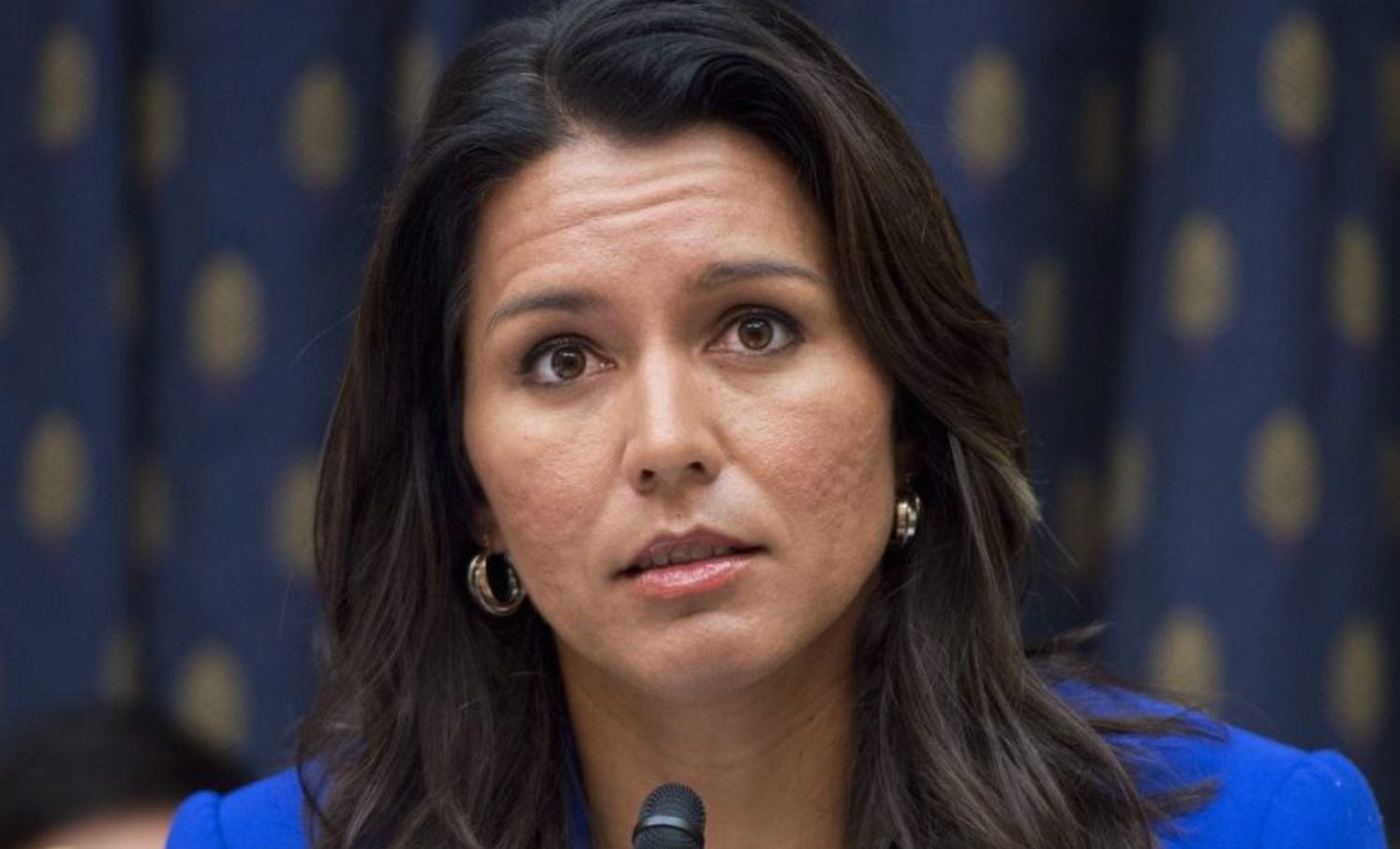
A major investigation by The Washington Post raises deeply troubling questions about who exactly may have been influencing former Director of National Intelligence Tulsi Gabbard, not only throughout her political career but potentially throughout much of her life.
According to Washington Post investigative reporter Jon Swaine, journalists reviewed more than 25,000 pages of emails, internal memoranda, and other documents connected to individuals in Gabbard’s political orbit, as well as people affiliated with the Science of Identity Foundation, or SIF, a religious organization led by Chris Butler, whom Gabbard has publicly described as her guru.
According to the reporting, the documents reveal a recurring pattern in which internal guidance circulated among Butler’s associates often appeared shortly before Gabbard publicly adopted remarkably similar messaging, policy positions, or legislative priorities.
This is what MSNBC reported:
Washington Post investigative reporter Jon Swaine obtained hundreds of confidential memos detailing guidance allegedly sent to Gabbard from 2011 to 2017, including when she was in Congress. Evidence Swaine says points to the memos coming from a man named Chris Butler, head of a breakaway sect of the Hare Krishna group, someone Gabbard has called her guru. The Washington Post compared Gabbard’s remarks in 32 TV interviews between 2014 and 2016 with talking points allegedly sent to her and found that on 24 occasions, Gabbard used language sent to her in those memos almost verbatim. Other times Gabbard used different words but promoted basically the exact same ideas.
The report also included a response from Gabbard’s office. Her chief of staff rejected the allegations, arguing that the reporting amounted to an attack on her faith rather than an examination of her conduct.
This is what Gabbard’s chief of staff told The Washington Post:
The attacks on Director Gabbard’s faith and loyalty are not only false, they are a blatant example of anti-Hindu bigotry.
A public relations firm connected to the Science of Identity Foundation made a similar argument.
This is what the organization said:
Hindu phobia, anti-Hindu religious bigotry, that’s all this is. When a Hindu public figure has a spiritual teacher or shares views with a Hindu religious figure, that alone is somehow evidence of sinister control.
I personally do not care what religion this organization professes to follow. That is not the issue. The Director of National Intelligence occupies one of the most powerful positions in the United States government, and it matters who influences that person. Whether that influence comes from Vladimir Putin, because Russian state media has previously referred to Gabbard as “Putin’s girlfriend,” or from a longtime spiritual adviser, Americans have every right to know who may be shaping the judgment of somebody entrusted with protecting our national security. The issue is not religion. The issue is influence.
To understand why these allegations matter, we first need to understand who Chris Butler is. Butler emerged from the early Hare Krishna movement in Hawaii during the 1970s before breaking away to establish the Science of Identity Foundation. Former members have described SIF as a tightly controlled spiritual community centered on Butler’s teachings and personal authority. The organization disputes those characterizations and insists it is simply a religious organization devoted to spiritual practice.
Whether someone chooses to call it a religion or a cult is ultimately beside the point. The far more important question is whether an unelected religious leader exercised meaningful influence over the decisions of an elected member of Congress and, later, one of the most senior national security officials in the United States government. There is already far too much religious influence in American politics. If one individual operating outside government was helping shape policy decisions made on behalf of the American people, that is something every American should want to understand, regardless of political affiliation.
Perhaps the most striking aspect of The Washington Post investigation is not simply the allegations themselves, but the documentary record supporting them. According to the newspaper, internal memoranda connected to Butler’s circle repeatedly mirrored Gabbard’s later public actions. In one example, a 2014 memorandum urged immediate action on proposed legislation, instructing the recipient to “get it started in the morning” and become “the leader in this regard.” Shortly afterward, Gabbard publicly announced support for the proposal and introduced legislation addressing that very issue.
In another example, internal talking points advised against framing a discussion as a “boohoo, I don’t get to go to the party” situation. Gabbard later used nearly identical language during a CNN appearance. One instance might reasonably be dismissed as coincidence. Two might raise questions. But when the same pattern repeats itself over several years, across interviews, speeches, and legislative actions, coincidence becomes a far less convincing explanation.
The questions raised by this reporting are not abstract. They go directly to the heart of democratic accountability. Who was shaping the policies Tulsi Gabbard presented to the public? Who was drafting the language she repeatedly used in interviews? More importantly, did the American people know who may have been influencing one of their elected representatives before she eventually became Director of National Intelligence? Transparency matters because voters deserve to know whether the officials they elect are exercising independent judgment or whether that judgment is being guided by someone operating entirely outside the democratic process.
Former members interviewed by The Washington Post described Chris Butler as a deeply influential figure whose followers often maintained personal, professional, financial, and political loyalty to him for years. According to those former members, his influence extended well beyond matters of faith into careers, family relationships, business decisions, and political activity. The Science of Identity Foundation disputes those characterizations, and that deserves to be acknowledged. Nevertheless, even if one sets aside the debate over whether SIF should be considered a religion or a cult, the larger constitutional question remains exactly the same.
Government officials are supposed to answer to the Constitution, the law, and ultimately the American people. They are not supposed to answer to an unelected spiritual adviser operating behind the scenes. If policy decisions are being influenced by private religious directives that voters never see, serious questions about transparency, accountability, and independence naturally follow. Those questions become exponentially more important when the individual involved is eventually entrusted with overseeing the nation’s intelligence community and safeguarding American national security.
The Washington Post reports that Gabbard’s chief of staff forcefully rejected the allegations, characterizing the reporting as the work of a disgruntled former volunteer and describing the investigation as an attack on Gabbard’s faith rather than an examination of her conduct. Shortly after reporters presented questions regarding the documents they had uncovered, Gabbard announced that she would be leaving her position as Director of National Intelligence. Her office denied any connection between the reporting and the timing of her departure.
A couple of things are worth noting here. Gabbard’s resignation did not occur in a vacuum. As we have seen repeatedly throughout this administration, Donald has shown little hesitation in removing women from positions of power when they are no longer politically useful to him. We have already watched him push out high-profile women across his administration, including Gabbard and former Attorney General Pam Bondi. It is entirely possible that multiple factors contributed to her departure.
At the same time, the questions raised by The Washington Post investigation are not made less significant simply because Gabbard is no longer in office. If anything, they become even more important. The central issue is not whether Tulsi Gabbard belongs to a particular religion. Nor is it whether Chris Butler’s organization should accurately be described as a religious movement or as a cult. Reasonable people may disagree about those characterizations. The issue is whether the head of a private religious organization exercised influence over somebody who was making decisions on behalf of the American people.
Those concerns become especially serious when the individual involved ultimately serves as Director of National Intelligence. That office oversees some of the country’s most sensitive intelligence operations, receives highly classified information, and plays a central role in advising the president on matters of national security. Americans have every right to expect that those decisions are made independently, based upon intelligence, law, and the national interest, not upon guidance originating from any private individual operating outside the government.
This is why transparency matters. Government officials swear an oath to the Constitution, not to political benefactors, foreign leaders, campaign donors, or spiritual advisers. Public confidence in democratic institutions depends upon knowing that the people entrusted with extraordinary authority are exercising their own independent judgment. If there is reason to believe that somebody outside government may have been helping shape policy positions, legislative priorities, or public messaging, that deserves scrutiny regardless of the ideology, religion, or political party involved.
The same standard should apply across the board. We should be deeply concerned about the possibility of Vladimir Putin influencing American officials. We should be equally concerned about wealthy political donors exercising undue influence behind closed doors. And we should be concerned whenever religious leaders of any faith appear to hold unusual sway over elected officials or senior members of the executive branch. The identity of the person doing the influencing is secondary. The existence of undisclosed influence is the problem.
Unfortunately, we have already watched the wall separating religion and government steadily erode over the last several decades. Republican leaders have increasingly aligned themselves with powerful religious movements, particularly white evangelical organizations that have exercised enormous influence over public policy. That growing entanglement has affected everything from reproductive rights to education, LGBTQ+ protections, judicial appointments, and the broader direction of the federal government. Whether one agrees with those policy outcomes or not, the increasing fusion of religious authority and governmental power should concern anyone who values constitutional principles.
The allegations surrounding Tulsi Gabbard fit into that larger pattern. They raise questions not simply about one individual, but about the integrity of the institutions Americans rely upon to safeguard democracy. Public officials are entitled to their religious beliefs. They are entitled to spiritual guidance. They are entitled to worship as they choose. What they are not entitled to do is obscure the extent to which unelected private figures may be shaping decisions that affect the entire country.
That is why investigations such as this one matter. They are not attacks on faith. They are not expressions of religious intolerance. They are attempts to determine whether Americans received the transparency they deserve from officials exercising extraordinary governmental authority. Those are entirely legitimate questions in any democracy.
Ultimately, this investigation raises the same concern that has become increasingly common throughout the Trump era. Americans are repeatedly discovering that important decisions affecting national policy are often being shaped by people operating outside the public eye—whether they are billionaires, political operatives, foreign governments, media personalities, or religious advisers. Democracy cannot function properly when voters are left guessing who is actually exercising influence over the people they elect.
Any public official who maintains a clandestine relationship with a religious leader whose guidance extends beyond matters of personal faith into questions of governance deserves careful scrutiny. That principle should apply equally to everyone, regardless of political party or religious affiliation. Americans deserve leaders whose loyalty is first and foremost to the Constitution, whose decisions are guided by the law, and whose actions are transparent enough to earn the public’s trust. Those standards are not partisan. They are the minimum requirements of democratic government.

Disturbingly sinister; the underworld which you uncover. Needs dismantling.
Her involvement in this cult was known when she got the job. I distinctly remember reading about eating toenails. But the inmates are now in charge of the asylum, and anything goes, as long as enough money is involved.