


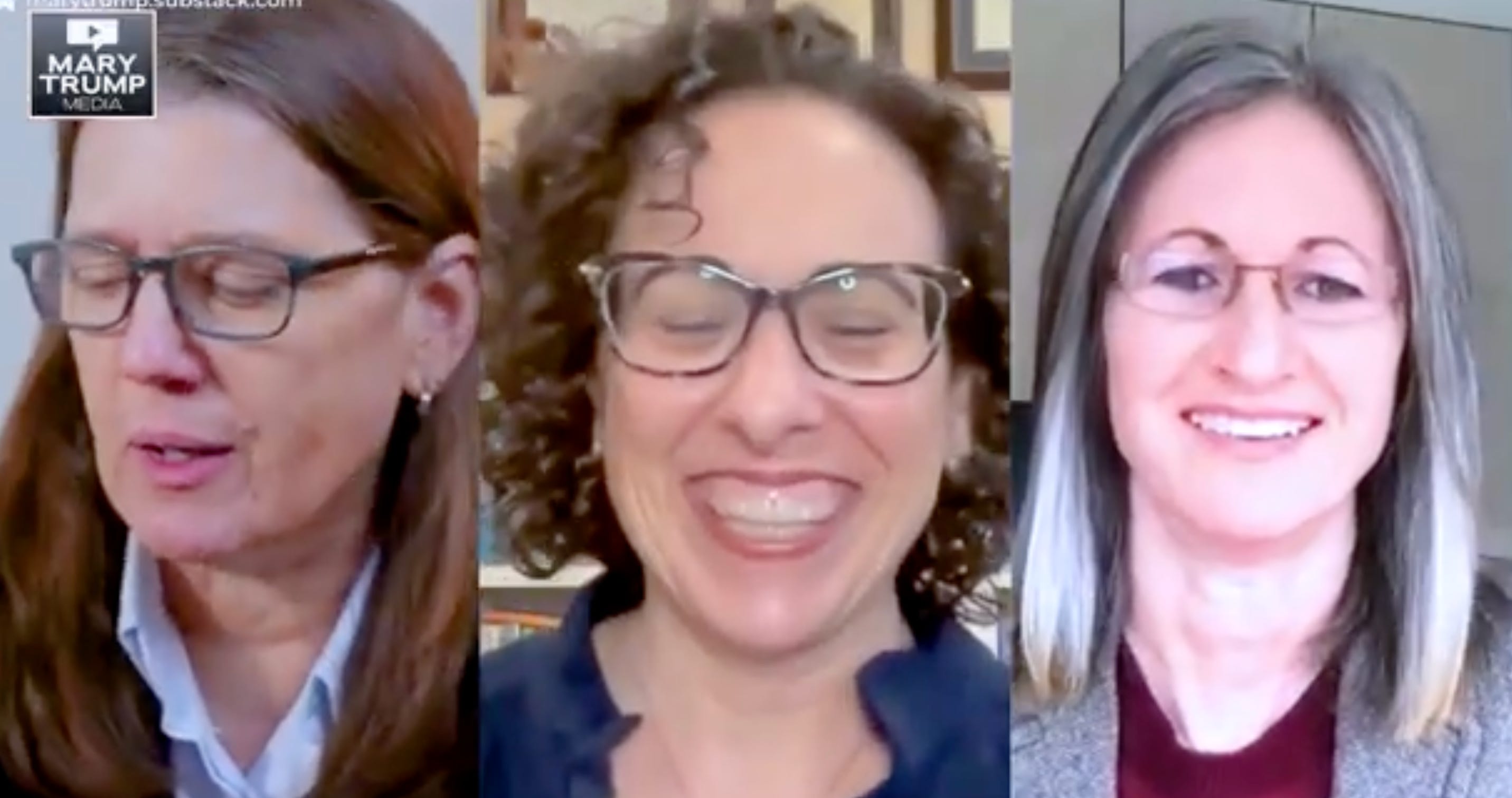
Mary Trump: Ronda Cress and I had a great conversation with Debra Shushan of the Substack The Debrief. We talked about who exactly needs to be held responsible for America’s decline, the vital importance of civil service, and how to fix the problem of money in politics. Little things like that. Hope you enjoy it.
Debra Shushan: I’m so excited to be able to welcome you here today. So we’re doing a bit of counter-programming here on The Debrief because, last week, Mary’s uncle was in New York City delivering a speech at the UN General Assembly. He started out, I understand, by basically telling world leaders how well everything is going, how fantastically the United States is doing. It sounds to me like kind of his standard stump speech that he’s giving to world leaders. This is what Donald said:
Our economy is the envy of the world. Our military’s the most powerful on Earth. Our technology is second to none and we are leading in virtually everything. Two years ago, our country was dead.
Anyway, you know the rest of it.
Ronda Cress: Yes.
Debra Shushan: So Mary, let’s start with you. How did you react to this?
Mary Trump: With the usual mix of horror and shame, I suppose. On the one hand, it is like Groundhog Day. It’s the same script from which he’s reading or the same delusions he’s acting out. But we can’t get numb to this stuff because as things get worse, he gets unbelievably even more grandiose. And people need to be alerted to just how detached from reality most of what he has to say now is because he’s getting increasingly dangerous as our country gets increasingly weaker, basically across the board.
So again, more of the same, yet the context is not the same anymore. We’re in an illegal, unconstitutional war of choice that we basically lost on day one to a militarily inferior country that is now more powerful than it’s been, I think, in my lifetime perhaps. And Iran’s allies are also gaining strength and power in the region. So the knock on effects of that are tragic.
Plus, of course, his benighted, failed and bizarre, frankly, economic policies are making life much worse for Americans, in particular American farmers. We’re going bankrupt at an alarming rate and our alliances have been completely shredded. So this is not the same context it was even a year and a half ago. And, of course, I think it’s worth pointing out, every bad thing that’s happening is a direct result of something Donald has done and all of his co-conspirators who have allowed him to do it.
Debra Shushan: Thank you so much for that, Mary. And I want to take advantage of your expertise. You have the unique expertise of being a trained, credentialed psychologist and also having grown up in the Trump family, having grown up with your uncle and all of the broader family as well.
And so I think it’s really important, as all of us in the United States and the whole world have been observing Donald Trump for so many years, to talk a little bit about his psychological trajectory and what’s happening with him right now.
And I want to just cite for folks, because I don’t think that this got the attention that it deserves. Now, Mary, you have been sounding the alarm for a very long time. In May of 2026, the British Medical Journal published a statement from 30 U.S. psychiatrists and other doctors specializing in mental health. They did not pull any punches. They declared that Donald Trump was mentally unfit to serve as president, and they warned about his ability to launch nuclear weapons, that being a danger to the world.
They noted that they had observed over the past year very concerning deterioration in terms of his cognitive functioning. How do you see that, and how dangerous is this situation?
Mary Trump: Well, starting with the second point first, we cannot overstate how dangerous this situation is, not even mostly because of Donald’s deterioration, which I’ll talk about in a second, but because of how many people continue to enable him at every step along the way.
We need to be very clear about this. Donald has never been fit to be president of the United States temperamentally, psychologically, emotionally, and in terms of his kind of unfathomable incompetence and lack of credentials. He is the least qualified person by a trillion light years to have failed upwards to this office. So I think it goes without saying that he’s unfit.
But when you are somebody who is in obvious cognitive decline, first of all, Alzheimer’s runs in my family. I’m not a neurologist or neuropsychologist. I’m not diagnosing him, but my grandfather had Alzheimer’s. I know what it looks like, and I think we all recognize what cognitive decline looks like.
Obviously, his physical health has been deteriorating for a long time. We don’t know specifically why, because the White House continues to lie about that. But he’s also an 80 year old who’s much older than he would otherwise be because he’s so deeply unhealthy. He doesn’t sleep except during the meetings, apparently. He has a terrible diet. He drinks a lot of Diet Cokes. He doesn’t exercise.
So you have that going on. Plus, of course, he has very longstanding, untreated, undiagnosed psychiatric disorders that, of course, worsen over time. So it’s like this perfect storm of deterioration and, in some cases, decompensation.
As all of these things worsen and he has some sense, it’s not a completely conscious sense, but some sense that he is losing it, he’s losing control of the narrative, which has always been something that he has been good at, he gets more desperate. And we see a lack of impulse control. He’s never had great impulse control, but there are situations in which he seems to have none.
So it is a deeply troubling situation given the fact that as long as he continues to be of use to the Republican Party, or I should say as long as the Republican Party thinks he’s of use to them, as long as his inner circle continues to believe he’s of use to them, they will keep propping him up and he will continue to threaten the safety of basically the world because he’s a nihilist. I said this in 2020: if he thinks he’s going down, he’s more than happy to take all of us down with him.
Debra Shushan: Well, I would say something that many of us are really concerned about, especially for a long time, but especially just in recent weeks when we’ve heard a lot of alarm bells from the heads of artificial intelligence companies talking about the dangers of AI, about the desperate need for oversight, about slowing down.
And there was just a statement that came out from a number of world leaders, the first of its kind, that talked about the need for world oversight, and a key piece of that presumably would be an agreement between the United States and China. We know that Donald Trump is going to meet with President Xi of China later this week.
Do you think there’s anything positive that we could hope from there? I mean, is he looking out for any of us in terms of thinking about these conversations with China?
Mary Trump: No, Xi will get whatever he wants probably. Donald will misrepresent that as some kind of win for him. I mean, I’m sure there will be some economic advantage to him and his cronies, but he will, as he has done with every other hostile foreign power that he has strange allegiance to, like Russia and North Korea, it will benefit China at our expense.
I mean, that’s even happened with Iran, and Iran is not a country that he can gain any benefit from. So he is not just incompetent, he’s clearly enamored of strongmen and they know how to play him. I mean, we’re here in large part because Vladimir Putin had his number in the 80s.
Debra Shushan: Yeah. Ronda, let me ask you, and I want to come back to you, Mary, in just a second, on the kinds of people that Donald Trump finds himself attracted to and who are able to maybe play him, who know his psychology.
But Ronda, I want to ask you, you observed Donald Trump’s trajectory and his first term and his reelection in the same way that the rest of us did, right? You and Mary started dating, I think, at basically the beginning of Trump’s second term. So what has that been like for you to observe all of this from a distance as we have, and then to meet Mary, to get married, and then be part of this fight with her in a way that you hadn’t been able to before? What has that been like?
Ronda Cress: Well, first of all, thank you for having us on today, Debra. As you can imagine, it has been a little bit surreal. Most of my observation of him through his trajectory of running for president before, but failing to get the nomination, and then when he got the nomination and then running, it’s kind of like watching a slow motion train wreck. It’s been like that.
But most of my lens of viewing that has been through a legal lens as an attorney and especially as a civil rights attorney, watching that and realizing that this was not going to be good for civil rights in our country and especially for the communities that I was working with.
And then after meeting Mary and beginning to date her, I mean, of course, then it becomes this surreal thing because seeing someone who is directly engaged in the fight, I mean, he was suing her at the time, and so just having that different perspective really brought it home, I’d say.
Also, not just through my relationship with Mary, but being at the Department of Justice in the Civil Rights Division at the time he got reelected and came back into office, that was also very eye opening.
Debra Shushan: Can you tell us a little bit about that, what you had been working on in the Civil Rights Division, what you’d been working on and what you saw happen at the beginning of the Trump second term?
Ronda Cress: Sure. I was in the Disability Rights Section of the Civil Rights Division, and I knew because I had followed so closely and paid attention in the prior years, I knew that the second term was not going to be like his first. I mean, the first was bad enough. Let’s not mince any words about that.
But I knew it was going to be a lot worse because I knew that he was not going to surround himself with some of the usual old guard who would try to minimize and limit. He was not going to have that this time. I also knew it was very clear from Project 2025 that this was going to be very, very different.
And one thing that was really interesting was I had not been at DOJ for very long, but I was surrounded by people who had spent decades there across administrations, Republican, Democrat, because, of course, at DOJ, none of that is supposed to matter. You can have your personal political opinions outside of the office, but you do not bring them into the office because you are there to serve the American people in its entirety.
And so people said:
We survived the first administration. Of course, there were changes in policies. There are always changes in policies and priorities across administrations. It wasn’t as bad the first time as we thought.
So I think a lot of people thought it was going to be very similar to the first time. And I felt very strongly that it was not going to be.
Relatively quickly, I would say, it became clear that it was going to be quite different. It started out, there was initially kind of an eerie silence, I would say, once he got inaugurated. But then as the leadership, first Pam Bondi, and then eventually when Harmeet Dhillon got appointed and confirmed and they started coming in, then it was like a domino effect of things happening very rapidly.
Major shifts in just the communication structure were completely different. They were not keeping the section chiefs looped in on changes and things. That was very unusual. So they just kept everyone in the dark. It was only the political appointees.
And so it became very clear very quickly that it was going to be quite different, and it also became clear very quickly that it was going to be unsustainable for many people to remain.
Debra Shushan: Thank you so much for sharing that. Let’s go back. I mentioned that I was going to ask because, Mary, you alluded to the kinds of people that Donald Trump seems to be attracted to and who know how to play him very well, and we could talk about Putin and the litany of other dictators.
There’s one person, though, that I think has formulated some sort of relationship with Donald Trump that many of us have watched and been kind of amazed by, and that is your mayor, New York City’s mayor, Zohran Mamdani. This is a guy, their politics could not be further apart. Donald Trump has called Mamdani a communist and everything else, but they just met yesterday at Gracie Mansion, and once again, Donald Trump seems to be captivated. I’m just wondering, what can we learn from that bizarre relationship?
Mary Trump: Yeah, just separately, I have a problem with it. I get that Mamdani has his motives that are probably good ones, but the idea of normalizing this person, of inviting him into your home, of shaking his hand, my stance on this is pretty black and white.
You do not make common cause with fascists. You do not make common cause with authoritarians. You’re trying to destroy our way of life and our country. You do not make common cause with treasonous traitors.
But again, I’m sure, I mean, I don’t think that Mamdani’s motives are bad at all. I disagree with the tactic, but it’s working for him, so I guess it’ll redound to New York’s benefit.
As for Donald’s role in this, I think it shows you how superficial and easily manipulable he is because what matters to Donald? Being flattered. And he knows he can spot strong people, and because he’s so incredibly pathologically weak and constitutionally weak, I think it makes him feel that if they’re hanging out with him, he’s strong too.
Debra Shushan: He’s cool.
Mary Trump: Yeah. And he thinks that if Putin is inviting him over or Kim Jong Un is sending him love letters, that that means he’s worthy of the strongman’s attention. I’m not comparing Mamdani to Putin or Kim Jong Un other than he’s a legitimately strong leader and he’s a very good one.
Debra Shushan: And charismatic.
Mary Trump: But being good or bad doesn’t matter to Donald. It’s being strong, being charismatic, and he’s attractive. That is how superficial Donald is, and Mamdani played him. I think the first time they met, he brought a mockup of a New York Post article with some headline that was flattering to Donald, and that’s literally all it takes.
So again, I disagree with the tactic, but if Mamdani can get something out of it, it potentially demonstrates to people just how pathetic Donald is, that he clearly isn’t paying attention because when Donald’s not in the room with him, Mamdani is having none of it. So he’s just being used, and I don’t have a problem with that.
I have a problem with the number of people who might feel that Donald is being normal. Well, hey, if Mamdani’s hanging out with him, how bad could he possibly be? That’s my concern. But just in terms of who Donald is, it just demonstrates what a weak, what’s the word that people use? He’s a mark, basically.
Debra Shushan: Well, I think this is a good segue. My beat, if you will, is the Middle East and all things related to Israel, Palestine. Benjamin Netanyahu, the Prime Minister of Israel, had been trying to get presidents for many years through many terms to launch with him a war against Iran.
Now, every other leader up until February 28th of this year, when the U.S. and Israel launched this war against Iran, had said:
No, we’ve war gamed this out. We know that it will be a disaster.
But this time Donald Trump said:
Yeah, sure. Sounds good to me.
What’s your sense of why that might have happened?
Mary Trump: I think also Mohammed bin Salman had some influence behind the scenes as well. I mean, I don’t want to take any responsibility away from Donald. This was his decision. I think that’s fair. This war, and he is responsible for the loss of life. He’s responsible for essentially putting the entire global economy at risk.
But again, it just shows you how easy it is to get your way with him if you’re just willing to make him think that he’s going to come out of this looking like a winner, he’s going to be able to do something nobody else has been able to do.
And I have no doubt in my mind, he and some other people in his inner circle are getting very, very, very rich off of this whole thing. That’s all it takes. He doesn’t care about the loss of life. He doesn’t care about the economic hardships he’s bringing upon the American people and people across the world.
So his interests are incredibly narrow, and people need to understand that because there’s no ulterior motive. The motive is right out there. He needs more money to make himself feel better about himself, and he needs to be protected from any kind of accountability. That’s it.
Debra Shushan: So I want to ask about a piece, Mary, that you wrote earlier this month that came out on your Substack that I found especially, I mean, it’s hard to get especially disturbed by anything these days. There’s so much that is intensely disturbing, but I read your piece about Creedmoor, and I’d like you to talk a little bit about it.
Your piece is called Trump Family Horror. So if folks want to look, this is just from earlier September. It’s on Mary’s Substack. You can check it out. And you wrote about Trump’s remarks some months back during his speech at Davos that I think probably passed most people over because nobody knows what Creedmoor is except for you. Can you tell us a little bit about that?
Mary Trump: Sure. Yeah, this is actually going to be a new show we’re developing for the YouTube channel called Trump Family Horrors. I don’t remember the piece exactly in terms of how I presented his remarks, but he went on a very long rant that was incoherent and garbled about when he was a kid, he would ask his mother what Creedmoor was.
Now, anybody in Queens knows that Creedmoor continues to be a psychiatric hospital, but in the 40s, 50s and 60s, it was massive. It was absolutely, because this was before psychotropic drugs, and there were thousands and thousands of patients in Creedmoor. It was a complex that was on many acres of land in Queens, and it’s near someplace called Alley Pond Park.
And it’s not close to where, I mean, it’s maybe a 15 minute car ride, but it’s not right across the street from where Donald grew up. So I don’t know that he would’ve been playing baseball at Alley Pond Park because Cunningham Park was the park right near his house.
So he’s going off about how forbidding its building is and the bars on the windows and what’s going on there.
Debra Shushan: And he talks about actually growing up there.
Mary Trump: Yeah, in the shadow of Creedmoor. And again, it’s nowhere near. Queens is enormous, and it’s maybe two towns east, which you have to get in the car to get there. There’s no other way to get there, so it’s not like he’s walking past it every day.
So in addition to having his mother try to explain what Creedmoor is, she’s also telling him that he plays baseball so well that he could be a professional baseball player, and he’s just rambling and going off on tangents, but always coming back to how impressive and terrifying this psych hospital is.
And it just shows every once in a while, well, or with increasing frequency, I think, he’s revealing to us in his increasingly nonsensical, incoherent, delusional ramblings what concerns him, what unconsciously he’s fearing.
And clearly, getting thrown into Creedmoor is at the top of the list, that and also his fear of irrelevance, which is why he’s naming everything after himself, his need for increasing amounts of attention, which is why we have MMA cage matches on his birthday and whatever that car race was in D.C.
So more and more grandiose homages to him. So the Creedmoor one was just, it was fascinating because I grew up knowing what Creedmoor was too, and that he’s so fixated on it 70, 80 years later, it was just a window into some of his terrors, I think.
Debra Shushan: Yeah. There’s one thing that Donald Trump doesn’t seem preoccupied with, and that is the midterm elections. I mean, at least with the Iran war and what that’s doing to gas prices and Republican members of Congress feeling panicked about what that’s going to mean for them in the midterms, Donald Trump, for the most part, doesn’t seem terribly concerned.
I mean, yes, they just had that midterm convention in Dallas, and he urged people to vote as though he’s on the ballot, but he doesn’t seem to be doing anything to make Americans’ lives better. I mean, obviously, he doesn’t care about us, but even just caring about the Republican Party and the results in the midterms, what do you draw from that?
Mary Trump: Well, he’s never been a strategic thinker, and anybody who has claimed that he is doesn’t understand him, and his ability to act in his own self interest is also clearly waning because he desperately needs the Republicans to win.
But again, as he declines across all of these categories, he is desperate to make it seem like he alone can fix it. Remember that? If he’s on the ballot, if all of the ads are about him. He doesn’t need the Republicans to win. They need him to win when, of course, the opposite is the case.
But this is what happens when, and I mean this sort of colloquially, when raging malignant narcissists are untreated and uncontained. But everything he’s done has almost ensured, getting rid of incumbents like John Cornyn, for example, starting the Iran war, betraying American farmers. Everything he’s doing is undermining the Republicans’ chances of winning.
And I think what’s also fascinating, though, is that Republicans aren’t really doing anything in a big way to distance themselves from him, which they really need to do, but hopefully they won’t do.
Ronda Cress: I was just going to throw in there, Mary said something like everything to legitimately win or promote their views. I think that’s because he’s not planning on trying to legitimately help the Republican Party win. He’s trying all kinds of other dubious and illegal things to try to sway the election in a way.
At first it was the SAVE Act, nonstop trying to get the SAVE Act passed. That failed. So then they’re trying to get voter data from all of the states, and they are 0 for 24. I think Vermont just handed down a decision within the last couple of days saying that. So they’re 0 for 24 on that.
So now it’s the ballots and the mail in ballots. They’re trying to restrict that. It’s threatening to send DHS into polling locations. So I think he does have a plan. It’s just they’re not making any effort to make any changes policy wise to make people vote for them. It’s, we’re going to try to rig the outcome in whatever way that we can using the ruse of fraud or illegal immigrants or voting or whatever other nonsense.
So I think that’s something everyone needs to be aware of and fully prepared for.
Mary Trump: Yeah, that’s absolutely right.
Debra Shushan: Yeah. No, I also really appreciate you mentioning that. I mean, that is my concern as well when it appears that Donald Trump doesn’t really care about losing the midterms, that he doesn’t care because he doesn’t intend to abide by the popular will and is doing all of the other things that you spoke about.
I want to ask you both, you have started a PAC, the Mary Trump Transcend PAC. It is a progressive political action committee aimed at challenging MAGA extremism, dark money and corruption. I would love to know, maybe Mary, you can speak to this, why you’ve decided to do this.
And Ronda, as the lawyer here who worked for DOJ, I’d love to hear from you what you have learned about our broken system. We used to call it campaign finance, and at this point it’s just unlimited since Citizens United, unlimited amounts of cash.
So what have you learned from this process of actually setting up a PAC? Maybe Mary, if you want to speak first about setting up the PAC.
Mary Trump: Sure. Well, Ronda and I made a very conscious decision after she left DOJ to make sure that our schedules were flexible so if work required travel, we could travel together and just spend more time together.
And we also, as everybody here is, are deeply concerned about the future of this country and the possibility that even if Democrats win, a critical mass of them will still fail to see what needs to be done in order to make sure we don’t ever get into this situation again.
So the idea of starting a PAC appealed to us for a couple of reasons. One, and Ronda will speak to this point more broadly, our goal over the long haul, because we are in this for the long haul, we’re not going to stop in 2028 even if Democrats win, is to change the culture of how politics are done in this country.
We at least want to be part of that conversation and movement. But secondly, to identify and support the kinds of candidates who actually do understand what’s at stake, are willing to meet the moment and check off a good percentage of our criteria for what that means.
So people who are dedicated to civil service, people who will demand accountability for the corrupt, treasonous people currently in charge of everything, people who will not throw any population under the bus for the sake of expediency, who are willing to speak truth to power and are willing to do what politicians are supposed to do, be experts in governance and be real civil servants who don’t end their terms richer than they were when they started them.

Thank you for the article, Mary . Your uncle’s health is very much deteriorating. He may not wake up one morning.
Go to democracy.io where you can easily send the following message to your 3 members of Congress:
I strongly urge you to oppose Section 219 of the House FY2027 NDAA and parallel Senate language establishing the "United States–Israel Defense Technology Cooperation Initiative."
This proposal goes far beyond traditional military cooperation. It would create a framework for joint research, procurement, co-production, technology transfers, network integration, and data-sharing across advanced military technologies, embedding the U.S.-Israel relationship deep within defense acquisition and industrial systems.
I am particularly concerned for five reasons:
• First, it would reduce democratic oversight and transparency by shifting key aspects of the relationship into defense procurement and technology programs that receive far less public scrutiny than direct military aid and appropriations.
• Second, it would further entangle the United States in another nation's military policies and make future policy independence more difficult. Once defense industries, supply chains, and military technologies become deeply integrated, reversing course becomes politically and financially challenging.
• Third, it ignores longstanding counterintelligence concerns. U.S. authorities have investigated significant Israeli espionage activities for decades, including the Jonathan Pollard spy case, the NUMEC nuclear-materials investigation, the krytron-smuggling operation, and the Lawrence Franklin case involving an Israeli diplomat and senior AIPAC officials. Recent reports also indicate that the Defense Intelligence Agency elevated Israel's counterintelligence threat designation to its highest level.
• Fourth, Congress should not deepen military integration at the very moment the United States has been drawn into a catastrophic war on Iran for Israel. As Secretary Marco Rubio has acknowledged, this is a war being fought for Israel, while President Trump continues to justify it by repeating Prime Minister Netanyahu's claims about Iran's nuclear program instead of relying on the U.S. intelligence community's assessment. This war is already destabilizing the global economy and has begun to harm the American economy and American people through higher costs, market instability, and recession risk.
• Finally, Congress should learn from past policy failures. Before the Iraq War, Prime Minister Benjamin Netanyahu gave false testimony in Congress and was among the most prominent advocates for military action against Iraq. The consequences were catastrophic for both Americans and the Middle East—tens of thousands of US casualties; trillions of $ of debt; & injury, death or displacement of MILLIONS of innocent civilians. He lies about atrocities to babies on October 7th to:
• engender outrage & vengefulness in Israelis
• dehumanize Palestinians
• and get unconditional diplomatic & military support from the United States—tens of billions of dollars, even as Israeli leaders were espousing genocidal rhetoric from October 7 and have been acting on it to this day. In truth, 2 infants died per Israeli social security [1]. We can't trust a state fabricates such deeply disturbing claims and that manipulate US to enable genocide.
We started a war of aggression on Iran "for Israel" per Marco Rubio, based on disinformation from Netanyahu that contradicted 18 US intelligence agencies. The war has:
• cost close to a trillion dollars, and is increasing daily
• caused hundreds of US casualties
• damaged or destroyed most of our based on the region
• killed or injured tens of thousands of Iranians and damaged schools (killing over 100 young girls), hospitals and clinics, World Heritage cultural sites, even a synagogue, and vital civilian infrastructure —all war crimes
• had a significant negative effect on the US economy, hurting all Americans, as well as people around the world. Experts predict a recession which could quickly become a depression.
• put us at risk of a world war
Congress should ensure that U.S. foreign policy remains independent and based on American interests—not institutionalized through permanent military integration with any foreign government.
Please oppose Section 219 and any similar Senate provisions.
Thank you for your service and for putting the American people first.
---
[1] October 7th death toll according to Wikipedia article with hundreds of sources, including Israeli National Insurance Institute data and numerous sources from Israeli media (listed below 👇🏽)
• 695 Israeli civilians, including 36 children
• 2 infants tragically died, but neither death was intentional (one from a bullet through a door, one a miscarriage involving a Bedouin woman)
• 376 Israeli soldiers
• 71 foreign workers
Note: The IDF has acknowledged employing the Hannibal Directive during the October 7 attacks which, according to many credible analysts caused the death of hundreds of Israelis—”mass Hannibal" according to one commander. Multiple investigations and reports have stated that the most significant destruction was due to Israeli tank fire, artillery, and Apache helicopter Hellfire missiles—and that they struck many locations where Israeli civilians and soldiers were present. Some military efforts estimate that the IDF killed hundreds. Just a couple examples:
• 70 cars heading from the music festival towards Gaza were destroyed by Hellfire missiles, according to military experts, burning many of the occupants beyond recognition. If each car held just 2 hostages, that would be 140 deaths in just one location. Netanyahu knew the truth but lied—he allegedly saw the horrific "friendly fire" incidents as an opportunity to demonize Hamas and thus beneficial to the Israeli cause
• Six Israeli children were killed by the IDF in one incident in Kibbutz B’eri, along with many adults
• The commander of Erez Crossing ordered strikes on this important military installation, killing many Israeli soldiers.
https://en.m.wikipedia. org/wiki/2023_Hamas-led_attack_on_Israel
Some of the sources:
The Times of Israel, The Jerusalem Post, Haaretz, Ynet, Walla!, Israel Hayom, Mako (Channel 12), i24news, Globes, Kan
Plus these Israeli institutional sources: IDF, Israel Police, Shin Bet, Israel Central Bureau of Statistics, ZAKA