


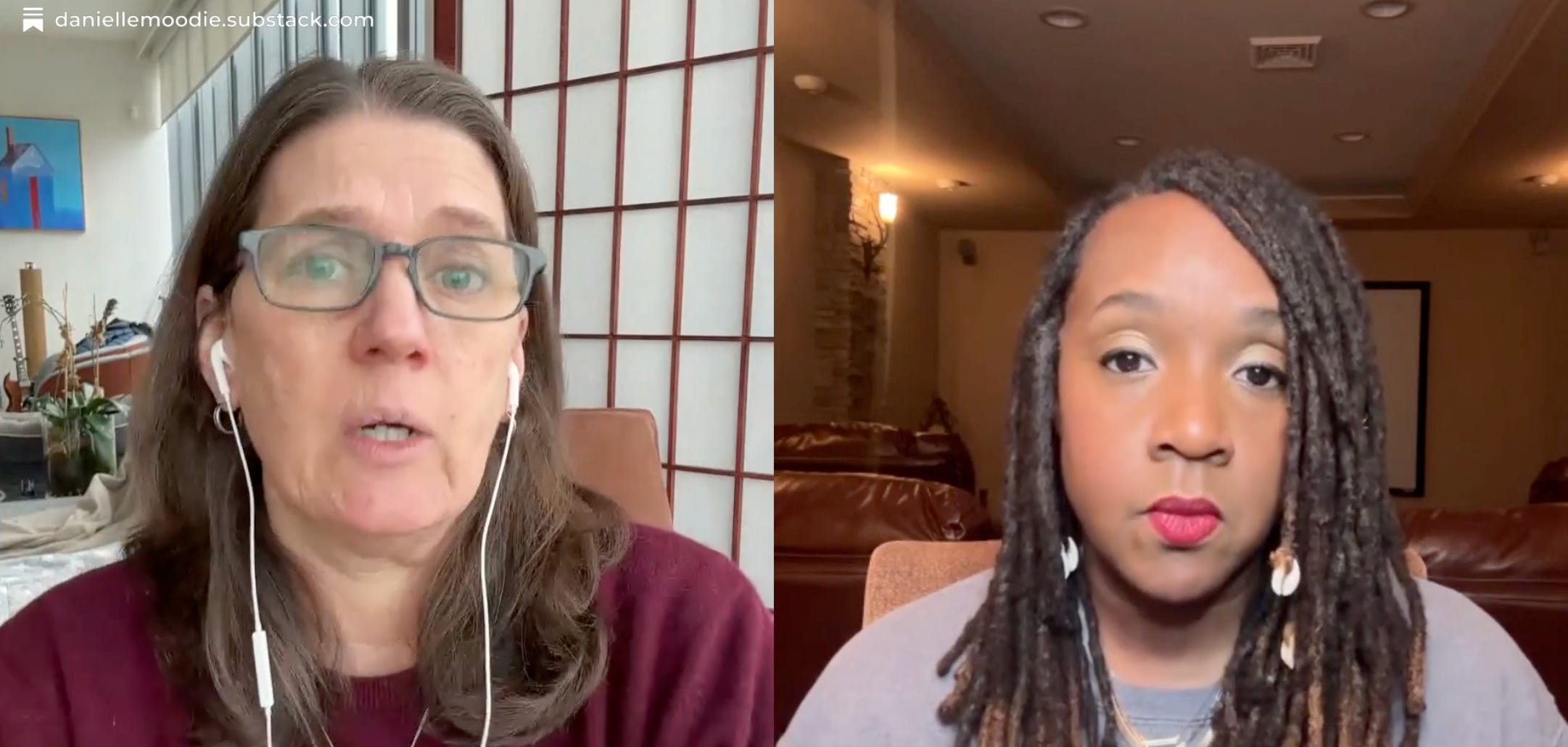
[Transcript edited for clarity, length and flow]
Mary: I guess the question to ask is: what the hell?
Danielle: Yesterday, I woke up and I put it on Threads and I put it here on Substack, and I said, “Am I the only one that feels insane every morning?” Every morning that you wake up, I just have this desire to run out into the middle of the street and scream.
Danielle: Because if I feel insane—yeah. Can I also—do you want to do that? Meet up , you know, eight or nine a.m., and just scream?
Mary: Yes.
Mary: Also, obviously, you are not alone in that. I think one of the issues of our time—and I’m being very serious about this—is how to maintain some semblance of equilibrium in a reality in which they are intentionally trying to drive us crazy with the onslaught of horrors.
Mary: Even the things that are meant to distract us from other horrors are, in and of themselves, horrible. I think feeling crazy is almost universally shared. But sometimes we also feel so isolated because of it. We think, “Is it just me?” Especially because we’re constantly up against it and can’t turn away from it because it’s our jobs. I think a universal 8:00 a.m. scream would not be a bad idea.
Danielle: I just think, we take our vitamins, have a sip of coffee, then collectively go into the street, scream, and go on about our day. Yesterday, I don’t know, Mary—I have these moments throughout the week, and I know that so many people watching feel the same way.
Danielle: The world is being run by actual, living, breathing monsters. When Hillary Clinton used the term “deplorable” for those who supported Donald Trump, that wasn’t even strong enough. We have monsters. As members of Congress read the unredacted Epstein files, they are saying these people are sick. Something is broken inside of them. So they feel the need to break everything—break democracy, break our spirit, break morale, break our shared moral values.
Danielle: Then you look at the news. What is the AP and The New York Times reporting on? The jobs report. “Trump’s Labor Department released…” As if we’re going to take anything they say at face value when ADP and private companies are telling us they fired tens of thousands of people. The market is hemorrhaging. But Trump’s Labor Department says, “All is well.” So again, don’t believe your eyes. Don’t believe your ears. Believe what they are telling you.
Danielle: It’s indoctrination. It’s gaslighting. It bubbles up. Some days I feel like my hair is on fire. Why is everybody walking around like this is normal?
Mary: Nobody should be.
Mary: You bring up two points that are really important. First, about what Hillary Clinton said. She referred to a “basket of deplorables,” and she was talking about a subset of Donald’s supporters—the worst of the worst. She pulled her punches. She got ripped apart, and it was presented as though she was maligning the entire Republican Party, which was not what she was doing.
Mary: Sorry, my cat is coughing up a hairball behind me. Also, I apologize—I’m under the weather, so I sound like I swallowed sand.
Danielle: Your cat is screaming.
Mary: Yes, exactly. That’s the sound. Modeling for us.
Mary: To your broader point, what Hillary Clinton said is now true of all of them in leadership. Every Republican leader is a fascist. They are monsters. They are amoral. There are no lines they won’t cross. I’ve said this many times about Donald: there is no “worst.” It will always get worse. He will always get worse. There is no bottom.
Mary: Coupled with that is the helplessness this instills. What do you do when the people with all the power are monstrous and willing to do anything to stay in power? And at the same time, they are making a concerted effort to make us not believe what we see.
Mary: Before Danielle and I came on, we were talking about how to navigate all of this. How do we figure out what broader things we need to focus on so we’re not constantly distracted by the onslaught of horrors?
Mary: But first, I want to welcome everyone. Thank you for being here. Please subscribe to Danielle’s Substack, The DAM Digest, and her YouTube channel. She does incredible work every day.
Check Out Danielles Youtube Channel HERE
Mary: So how do we keep our wits about us? What are the themes here? We’ve been talking about the rise of authoritarianism, Donald’s fascistic desires, and how every time there’s more news about Epstein, something crazier happens to distract us.
Mary: All week we’ve been talking about the Epstein files, and I keep reminding people that Minnesota is still under occupation. People are staying home from school, not going to work. There are checkpoints. They are using Minnesota as a test case for what they want to nationalize.
Danielle: I think we need sanity pods. During COVID we had pods. Now we need groups we check in with—family, friends, community, independent voices we trust.
Danielle: People tell me—and I’m sure they tell you—that they feel less crazy. Less alone. Like, “Okay, other people see this too.”
Danielle: We need to echo and amplify. Like the women in the Obama administration did—if one spoke and wasn’t acknowledged, another would repeat it until it was addressed. That’s what our communities need to do.
Danielle: We need to amplify analysts asking why investigations are being launched around the world while no one in America is doing anything about the monsters mentioned repeatedly in the Epstein files—Donald included over a 1 million times.
Danielle: We need to combat normalization. When someone like Megyn Kelly uses phrases like “barely legal” to minimize child rape, that needs to be called out. If we don’t have shared conviction around protecting children from sexual violence, what are we doing?
Mary: That is exactly their worldview. Power is all that matters. For Donald, it’s money, which translates to power. Independent media is essential because there is a right-wing propaganda machine and very few spaces outside independent platforms.
Mary: Corporate media has normalized Donald for over a decade. And that normalization continues. We’re supposed to focus on jobs numbers while ICE enacts violence on American soil.
Mary: Republicans swapped out one Nazi for another at ICE. That was supposed to make us feel better?
Mary: If anything has the potential to take down the Trump regime, it’s the Epstein files. If anything has the potential to wake people up, it’s ICE. Does that track for you?
Danielle: When you see a disabled woman hogtied, a five-year-old detained, babies and toddlers held in detention centers—that’s visceral. ProPublica has documented what’s happening in Texas detention centers. There are thousands of children. These are real children. babies toddlers and children being detained. You can tell a very real story from those images. We need to bring attention to the voilence. Don’t follow the bouncing ball. Why was the El Paso airspace shut down? We need to ask these questions.
Danielle: ICE needs to be abolished. Any Democrat who cannot say that clearly does not deserve your vote. ICE is not the Constitution. It’s 25 years old. It doesn’t have to exist. It is not Mount Rushmore or the Constitution. Again, Donald is building baby goulags on private land without any infrastructure.
Danielle: They are building detention facilities on American soil and treating people like Amazon packages. That was said by someone in the Trump regime.
Mary: There is a danger that there won’t be midterms. That means we fight harder. Primary anyone who won’t abolish ICE. Primary anyone who won’t commit to Supreme Court reform.
Mary: This could be a massive wave election. Lets get rid of established democrats that do not do the job. We need Democrats who understand this moment.
Danielle: We did ourselves a disservice with “vote blue no matter who.”
Danielle: Their values matter. Their integrity matters. We deserve more than crumbs. I want the best minds. People who serve the people, not donors. I want those that are going to activate around the people.
Danielle: People who understand America’s potential to be a diverse, multicultural democracy—if the right people are elected.
Mary: Correct.
Mary: Please like and share this video. And if you believe in our mission, please subscribe to the Mary Trump Media channel. Thanks.
Check Out the Mary Trump Media Youtube Channel HERE

GRAND JURIES STAND UP TO TRUMP’S PERSECUTORS
The Associated Press reported that “ A grand jury in Washington refused Tuesday to indict Democratic lawmakers in connection with a video in which they urged U.S. military members to resist “illegal orders,”...The Justice Department opened an investigation into the video featuring Democratic Sens. Mark Kelly and Elissa Slotkin and four other Democratic lawmakers [ the other Democrats who appeared in the video include Reps. Jason Crow of Colorado, Chrissy Houlahan of Pennsylvania, Maggie Goodlander of New Hampshire and Chris Deluzio of Pennsylvania] urging U.S. service members to follow established military protocols and reject orders they believe to be unlawful. All the lawmakers previously served in the military or at intelligence agencies.”
This refusal of a grand jury to indict upon the urging of Trump’s prosecutors follows on the heels of other grand jury rejections of Trump’s prosecutors’ attempts to charge felonies, including:
1. Letitia James (New York Attorney General) — alleged mortgage fraud (Virginia grand jury) Reuters reported that DOJ attempted to prosecute (and then re-try) the case and a grand jury rejected the proposed indictment. ABC likewise reported that a grand jury refused to indict James when DOJ attempted to revive the case. PBS reported a further failed attempt to re-indict, describing additional grand-jury refusals.
2. Federal grand juries in Los Angeles and Washington, D.C. refused to approve felony charges in some cases involving alleged interference with federal law enforcement officers during protests, including a highly publicized instance of a person accused of throwing a sandwich at a federal agent.
3. A Chicago grand jury declined to indict a couple accused of assaulting federal officers outside an ICE facility, resulting in prosecutors dismissing the complaint (though they could seek charges again).
THE GRAND JURY IN HISTORY
The principles underlying the need for grand juries can be traced back to the Magna Carta in 1215, though the name had not yet evolved at that time. It was not until the 17th century in England that the employment of a grand jury matured into existence and became embedded into the English psyche as serving as an entity that screened charges before someone could be put to trial—one of the roots of the grand jury’s “buffer” role between the government and the accused.
The use of grand juries were carried over to the American colonies, in which one famous usage of the grand jury served as a model for future generations to come:
Colonial America: The Zenger Case (1735): In the now famous case of John Peter Zenger (New York, 1735), he was a printer charged with seditious libel for publishing criticism of New York’s royal governor. Two grand juries reportedly refused to indict him before the Crown secured charges through alternative means that resulted in Zenger’s acquittal. The case represented a powerful precedent for establishing a citizen’s buffer against unjust charges upon a ruler’s command and also for demonstrating early American resistance to criminalizing political criticism. (Sound familiar?)
The requirement for grand juries was later embodied in the 5th Amendment to the U.S. Constitution which requires that defendants may only be prosecuted for federal felonies upon the issuance of a grand jury Indictment. In the implementation of this Amendment, The Federal Rules of Criminal Procedure require a quorum of 16 grand jurors and no more than 23, of which at least 12 grand jurors must vote for an indictment.
Members of the grand jury, and trial jurors for that matter, are generally selected by lot among the community in which the alleged crime was committed or in which the trial is to be held (taking into account a possible change of venue due to adverse publicity against the defendant).
The point of all of this is that both grand jurors and trial jurors represent a cross section of the community’s residents and who bring their values, their principles, their integrity and their commitment to honesty, their common sense and their fairness with them into the room where they deliberate.
Grand jurors and trial jurors have often served as bulwarks against prosecutorial excesses , abuses , biases, political grand standing and as betrayers to their own profession whose fundamental principle requires them to strive to see that justice is done.
The above cases where grand jurors refused to indict political enemies of Donald J. Trump on trumped-up charges prove that our democracy works.
Let us all spread the word among our communities that those who are called to serve on grand juries and trial juries should be vigilant in insuring that no one be prosecuted or convicted for political reasons, or for exercising their Constitutional rights and that no one be convicted if they have a reasonable doubt as to their culpability.
Mary, I hope you feel better soon.
One of my parents was a textbook sociopath and I have been in two relationships (including a marriage) with people who tried to undermine my sense of reality and self. What you and Danielle have described is something I’ve noticed: Trump and nis administration essentially want everyone in this country to have a similar relationship with them. “Don’t believe your eyes and ears. Believe me, I am trying to do what’s best for you.”