


[Transcript edited for clarity, flow and length]
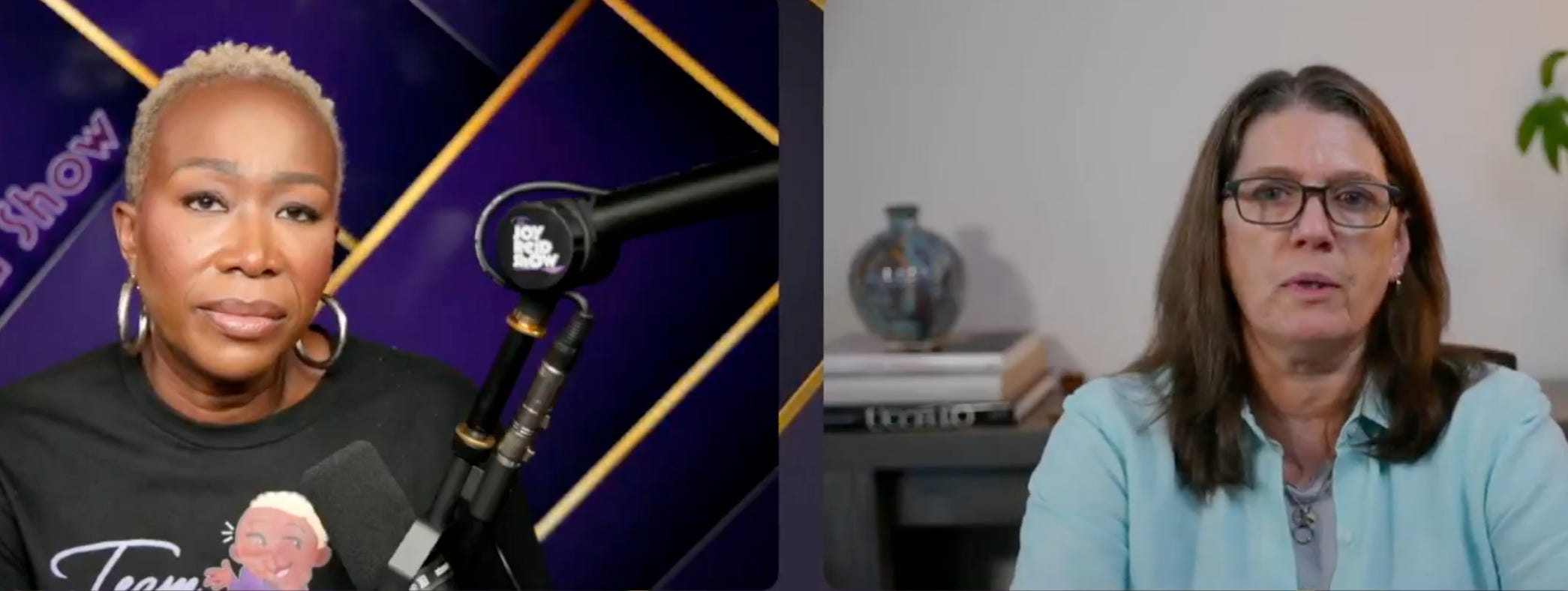
Mary Trump: I sat down with the phenomenal Joy Ann Reid, and we talked about many things, including algae ridden reflecting pools as a metaphor and the fact that what’s happening with Donald right now is a difference of degree, not kind. We also discussed the ways in which his increasing decline is revealing who he has been all along. I hope you’ll check it out.
Joy Ann Reid: Mary L. Trump is an American psychologist and author. Her first book, Too Much and Never Enough: How My Family Created the World’s Most Dangerous Man, which came out in 2020, sold nearly a million copies on its first day of publication, including to me. She is also the author of two other amazing New York Times bestsellers, The Reckoning and the memoir Who Could Ever Love You. She writes The Good in Us, a bestselling newsletter on Substack, and is the founder of Mary Trump Media and the Mary Trump Media YouTube channel.
Mary Trump, it’s so good to have you. Welcome to your debut on The Joy Ann Reid Show.
Mary Trump: Joy Ann Reid, I can’t believe it took so long. It’s so good to see you. I want that shirt also. I’m going to have to get one because it’s awesome.
This is such a pleasure for me. I’ve been following everything you’ve been doing, and it truly is an honor to be here.
Joy Ann Reid: Thank you. Before we even get into the substance of our conversation. I’ve been interviewing Mary L. Trump since 2016, but we only met in person for the first time last week at the amazing Jane Fonda event, Rise Up and Sing. It was wonderful finally getting the chance to meet you in person, along with your beautiful wife. We had such a great time.
Mary Trump: We really did.
Joy Ann Reid: Let’s talk about what’s happening now. Congressman Ted Lieu recently implied that your Uncle Donald is actually ill. His ankles are very swollen, and he’s got strange marks on his hands, including what almost looks like a bite mark on one of them. To your knowledge, is he physically ill?
Mary Trump: I don’t have any more insight into that than anybody else, but I have eyes in my head. I don’t think we can pretend anymore that everything is fine.
I also have to say that it’s great to hear Ted Lieu talking like that because I think you, I, and others have been saying for years that this is exactly how people need to confront Donald Trump on a daily basis. Until recently, though, people continued to pull their punches.
To be honest, as concerning as his physical appearance is, and this is not an ad hominem attack, I’m simply describing observable facts. His ankles are swollen. His hands look terrible. They’re bruised. He is incapable of staying awake. He struggles to focus on anything. His newest habit seems to be telling people that nobody is interested in what they’re talking about, which apparently only happens when they aren’t talking about him.
All of those are troubling signs regarding his physical condition. Some of them, such as the hypersomnia and the increasing lack of impulse control, can also be signs of cognitive decline.
As many people know, Alzheimer’s disease runs in my family. Hopefully it skips my generation, but it is part of our family history. I see similarities between my grandfather’s behavior and Donald’s behavior. My grandfather, of course, was Donald’s father.
What we’re dealing with is a perfect storm of psychological, emotional, physical, and cognitive decline because, on top of everything else, Donald has lived for decades with severe, untreated psychiatric disorders.
Joy Ann Reid: We’ve had Dr. John Gartner on the show talking about narcissistic personality disorder, something you’ve discussed as well. Beyond narcissism, as a psychologist, what else do you see?
Mary Trump: Technically, diagnosis is a process. Donald isn’t my patient, and a proper diagnosis would require an extensive battery of tests. There’s certainly a great deal of comorbidity, meaning we’re not talking about just one condition.
More importantly, though, I think we’re past the point where the precise diagnosis matters. What matters is how he is behaving, and his behavior is becoming increasingly alarming.
I hear former allies saying they don’t recognize him anymore. That’s nonsense.
What’s happening is that this perfect storm of decline is revealing who Donald has always been. He’s losing control, not only of himself but also of the narrative he’s spent decades constructing about himself.
That’s what we’re seeing. We cannot allow people to excuse his behavior by pretending this is somehow new. Nor can we allow anybody in this corrupt fascist Republican Party to pretend Donald alone is the problem because they’ve known exactly who he is all along.
Tom Tillis may be waking up to the reality the rest of us have been living with, but he also helped create this reality.
Joy Ann Reid: He did. All of them did. The enablers all saw it.
Those of us who’ve watched and disliked your Uncle Donald since the 1980s have always seen the cruelty. I’ve never been a fan because of the way he treated the Central Park Five. The racism and the meanness were always obvious.
What’s new to me isn’t the cruelty. It’s the desperation.
Back in the 1980s and 1990s, it was clear he wanted to build a legacy. Everything had to be called Trump Tower, Trump Park, Trump this, Trump that. Putting his name on things was incredibly important to him.
Now it feels even more desperate. He wants airports named after him. He wants his face on money. He wants monuments. It’s almost as though he sees his own demise approaching and is trying to create a permanent version of himself on Earth because he doesn’t believe he’ll find one anywhere else.
Do you see that?
Mary Trump: That’s a fascinating observation.
I would suggest that, from the very beginning, putting his name on things was about protecting a very fragile ego. It was really my grandfather’s name because it was my grandfather’s fortune, connections, and business acumen that made the Trump name valuable in New York real estate.
Donald was never the self made man he claimed to be. He was never the brilliant entrepreneur or real estate genius he pretended to be.
One thing I realized after my grandfather died was that my grandfather cared deeply about legacy. Donald did not.
As soon as he possibly could after my grandfather’s death, Donald insisted that his siblings sell virtually everything my grandfather had built because he needed cash.
That made me wonder what Donald actually cared about.
I think you’re right. There is an accelerating desperation to put his imprint on everything, perhaps as a way of denying his own mortality.
Donald is a nihilist.
Putting his name on buildings, accumulating more money, and acquiring more power are all attempts to fill a void that cannot be filled.
The fundamental tragedy is that Donald has never been loved.
The thing he has wanted more than anything else throughout his life is the one thing he can never truly have because my grandparents left him incapable of either giving or receiving love.
That emptiness can never be filled.
As he continues declining and begins confronting the reality that he is not who he imagined himself to be, I worry he will have no hesitation about trying to take the rest of us down with him.
Joy Ann Reid: It almost feels as though, once he’s gone, everything bearing his name will eventually be renamed. We already saw what happened with the Kennedy Center. He put a tarp over it so nobody could see the embarrassment of having his name removed. The people who oppose his fascist regime want his name removed from everything. They want him erased from history. They don’t want anyone to remember him. That has to be his greatest fear, doesn’t it?
Mary Trump: It’s difficult to understand the depth of the narcissistic wounds Donald carries or the terror he lives with every day. Donald has always been a terrified little boy, and I don’t think he’s ever been more frightened than he is right now because he’s losing control. He’s also losing the support of many of the people who have stood by him, and on some level, he knows it.
Unfortunately for him, those truths are beginning to break through to his conscious mind. Remember, he has spent his entire adult life protecting himself from the reality of who he actually is, and that is becoming increasingly difficult, if not impossible. Eventually, it will become impossible, and he’ll have to confront what people really think of him.
For anyone who says we’ve already spent too much taxpayer money putting his name on things, building monuments in his honor, or creating ballrooms and arches, and that we shouldn’t spend another dime taking his name off them, I’m not suggesting we do. I’m suggesting that every penny Donald and his useless children have stolen from the American people should be recovered, and we should use that money to erase their names from everything.
Joy Ann Reid: People really need to read your first book. They’re all excellent, but Too Much and Never Enough is incredibly revealing because it makes clear that your grandparents simply did not know how to love their children. Is that essentially what you’re saying, that your grandparents didn’t know how to love your father, your aunts, or Donald?
Mary Trump: I think the greatest indictment of my grandparents is that they had five children and, in very different ways, every single one of them became a damaged human being.
My grandmother is a separate issue, but my grandfather was the one who held all the power in the family. He was a sociopath, and that’s a terrible place from which to begin a child’s life. The only thing that mattered to him was money, and he taught that lesson to all of his children. Thankfully, my father wasn’t like that, but Donald certainly was.
Donald turned my entire family into a zero sum game where there could only ever be one winner. For reasons I still don’t completely understand, my grandfather chose Donald. Over the course of his life, he gave Donald approximately $410 million, much of which Donald squandered.
More importantly, he created a man who believes money is everything. Donald believes the amount of money you have determines your worth as a human being. He believes money stands in for love, value, respect, and every other meaningful human experience.
Of course, none of that is true.
That’s why it’s never enough.
Joy Ann Reid: You can certainly see that in his adult children. They’re constantly scrambling for money because, in many ways, that’s all they know. They have to prove to their father that they’re wealthy, even though much of that wealth comes through nepotism rather than hard work.
Mary Trump: That, and robbing the American taxpayer blind.
Joy Ann Reid: Exactly.
There’s a clip I want to play because I’ve never understood why Donald tells stories like this. It’s so strange, and I keep thinking maybe Mary can explain it to me.
This is what Donald Trump said:
Yes, sir. And the mother’s screaming, Darling, I love you, Tara. And the father’s looking, saying, She has no chance. And she’s like this. Drops him. And she’s devastated.
What is that? What is going on there?
Mary Trump: Wow.
That seems like something emerging from a very deep part of his psyche, some memory he wishes he didn’t have access to.
I’ll try to explain it, but I’d also like people who continue supporting him to explain why they think that’s acceptable presidential behavior.
Yes, technically it is presidential behavior because Donald happens to be president, but there is something profoundly pathological about it.
He’s talking about a mother and a father. Something is clearly going wrong with the mother, and the father responds by saying, “Whatever. I don’t care.”
Honestly, that sounds a lot like my grandparents’ house.
It’s deeply disturbed.
Part of what’s contributing to Donald’s stress and decline is that I think he’s reliving parts of his childhood. Again, I don’t say that to generate sympathy. He had an extraordinarily difficult childhood, and in many ways, it’s what led us to where we are today. His developmental history was never going to produce a healthy, well adjusted adult.
I think he’s increasingly haunted by memories of those experiences, and they’re surfacing in public in ways he can no longer control.
That’s another sign that he has lost control over himself, over what other people think of him, and perhaps most importantly, over what he thinks about himself.
That has to be terrifying.
Joy Ann Reid: Former President Barack Obama recently broke his silence during a podcast interview and said that Donald Trump is obsessed with him, which I think is obvious. What do you think that obsession comes down to? Is it because President Obama is Black? Is it because Donald is jealous that a Black man became a successful president, is beloved around the world, and has everything Donald wants? Is it simply racism? How do you explain his obsession with the Obamas?
Mary Trump: I think you’re right. Racism absolutely plays a role because Donald isn’t simply racist. He is a racist. That’s an important distinction. Many white Americans hold racist beliefs because those ideas have been ingrained in our culture for generations, especially for people who grew up in the 1960s, 1970s, and 1980s. But being a racist is something different. It’s a choice. It’s an ideology.
Donald comes by it honestly. My grandparents were racists as well.
But I think there’s something even more fundamental at work because this obsession is specific to President Obama and everything he represents. By every conceivable measure, Barack Obama surpasses Donald. I don’t even like saying he’s an infinitely superior human being because that implies Donald possesses redeeming qualities to compare.
More importantly, Barack Obama humiliated Donald publicly at the 2011 White House Correspondents’ Dinner, and Donald cannot tolerate humiliation. It is literally the worst emotion he can experience, especially when it comes from someone he believes, in his deeply depraved worldview, should be inferior simply because of the color of his skin.
We see versions of this constantly with journalists. They ask straightforward, fact based questions that don’t fit the story Donald wants to tell, and he lashes out because he can’t tolerate reality. But when a powerful Black man humiliates him in front of millions of people, that becomes something he can never forgive.
Since that night, Donald has devoted himself to dismantling Barack Obama’s legacy. Unfortunately, because the Republican Party has enabled him every step of the way, he has succeeded in undoing many of President Obama’s accomplishments. One of the clearest examples was ripping up the Iran nuclear agreement, which ultimately contributed to the illegal and unconstitutional war of choice that followed.
Joy Ann Reid: It’s such a strange dynamic because every president brings their personal history into office. Bill Clinton clearly had issues involving his father that played out publicly during his presidency. But what’s so odd about Donald’s obsession with Barack Obama is that it only seems to exist from a distance.
He can repost racist images or attack President Obama online, but when they’re actually together, he behaves completely differently. At President Carter’s funeral, he seemed almost eager to talk with President Obama. It was almost as though he wanted President Obama’s approval.
It’s the same dynamic we’ve seen with Zohran Mamdani. Donald attacks him from afar, but when he’s in the presence of someone stronger, he suddenly behaves differently.
What’s that about?
Mary Trump: It’s because Donald is a bully, and bullies are inherently weak.
Donald is the weakest person I’ve ever met in my life.
It’s easy for him to take shots at people who are stronger, smarter, and more respected than he is when they’re not standing in front of him. But when he is actually in their presence, I think part of what fuels his resentment is that he probably admires Barack Obama.
That creates an enormous amount of psychological conflict for someone like Donald. He despises everything Barack Obama represents, yet on some level he also recognizes qualities he wishes he possessed himself.
Joy Ann Reid: Two more questions.
First, the Epstein files.
Donald Trump appears in the Epstein files more than anyone except Jeffrey Epstein himself. His name appears more often than almost anyone else’s. Looking at this simply as someone who has known him for most of your life, do you believe he did the things some women have alleged he did when they were children? Do you think he engaged in conduct that would make him a pedophile?
Mary Trump: Obviously, I have no inside knowledge about any of that.
But I always begin from the same premise. Believe women.
Beyond that, we’re not stupid.
There’s a reason somebody appears repeatedly throughout the Epstein files. Representative Jamie Raskin joked that Donald’s name appears more than a million times. As you said, his name appears more than anyone else’s except Jeffrey Epstein’s. The odds that every one of those appearances is entirely innocent are extraordinarily small.
We also know that only part of those documents has been released. Given that this process has been overseen by what I consider the most corrupt Attorney General in American history, preceded by the second most corrupt Attorney General, first Todd Blanche and before him Pam Bondi, we have every reason to believe that some of the most damaging material has not been released.
Then there are the independent allegations.
Donald has been accused by at least twenty three women of sexual harassment, sexual assault, or sexual abuse. A jury found him liable for sexual abuse.
Finally, after promising repeatedly during the campaign that he would release the Epstein files, he has done everything in his power to prevent their release.
If he were innocent, I honestly can’t imagine someone behaving in a way that looks more guilty.
Joy Ann Reid: I’ve kept you much longer than I intended, but it’s been worth every minute.
Before I let you go, tell everybody where they can follow your work. I encourage everyone to subscribe to the Mary Trump Media YouTube channel and to your Substack, The Good in Us. What are you working on next?
Mary Trump: My wife, Ronda, and I recently launched a new political action committee called Mary Trump’s Transcend PAC.
We launched it on Donald’s birthday because we thought the timing was appropriate.
Our mission is to do everything we can to identify and support candidates who understand what’s at stake in this country, which is everything, and who possess the courage and determination to meet this moment.
We’re looking for leaders who won’t capitulate to special interests, who are committed to holding bad actors accountable for the tremendous damage they’ve inflicted on this country, and who will finally help America become the multicultural democracy it has always aspired to be but has never fully achieved.
That’s our mission in a nutshell, and we’d love for people to visit the website and learn more.
Joy Ann Reid: I love it. We’re going to support that mission, and we’ll make sure everyone has the link so we can spread it far and wide.
Please give my best to Ronda. She is wonderful, and it was so great finally getting to spend time with both of you in person.
We’ll have to do it again soon, preferably over drinks.
Mary Trump: Absolutely. It was so lovely being here. Thank you so much for having me.

Thank you for the conversation with, Ms. Joy. I listened to the podcast the questions were asked in a gracious manner and answered honestly by you Mary. Thank you both so very much. Most of all I thank you both for your integrity, and hope in answering those questions.
Felon tRump will be remembered alright, but not in the way he envisions for himself. It will be in infamy as one of the world's biggest conman in company with scammers and grifters, Ponzi, Madoff, Holms, Parker, Pearlman et.al. Felon tRump's con, his facade, was based on his faux genius, 'art of the deal', business acuity, seeking investment opportunities based on this and eventually seeking public office as President of the US. All the lies and deceptions are catching up with him as the majority of the public sees him for what he is: a malignant megalomaniac whose psychopathic fixation is on money and power by any means. His downfall is starting a war with Iran (contradicting his ending forever wars) in which he thought he would emerge as a hero being the only one who could bring down this hated regime. This is his unravelling. He lost. And everyone (except his sycophantic cult) realizes he was not about governing and 'making America great again', his con slogan borrowed from Reagan. It was all about him conniving and scheming to enrich himself by way of exploiting public office (with a little help from his Russian friends). This is how history will cement his legacy as a legendary con artist.