


[Transcript edited for clarity, flow and length]
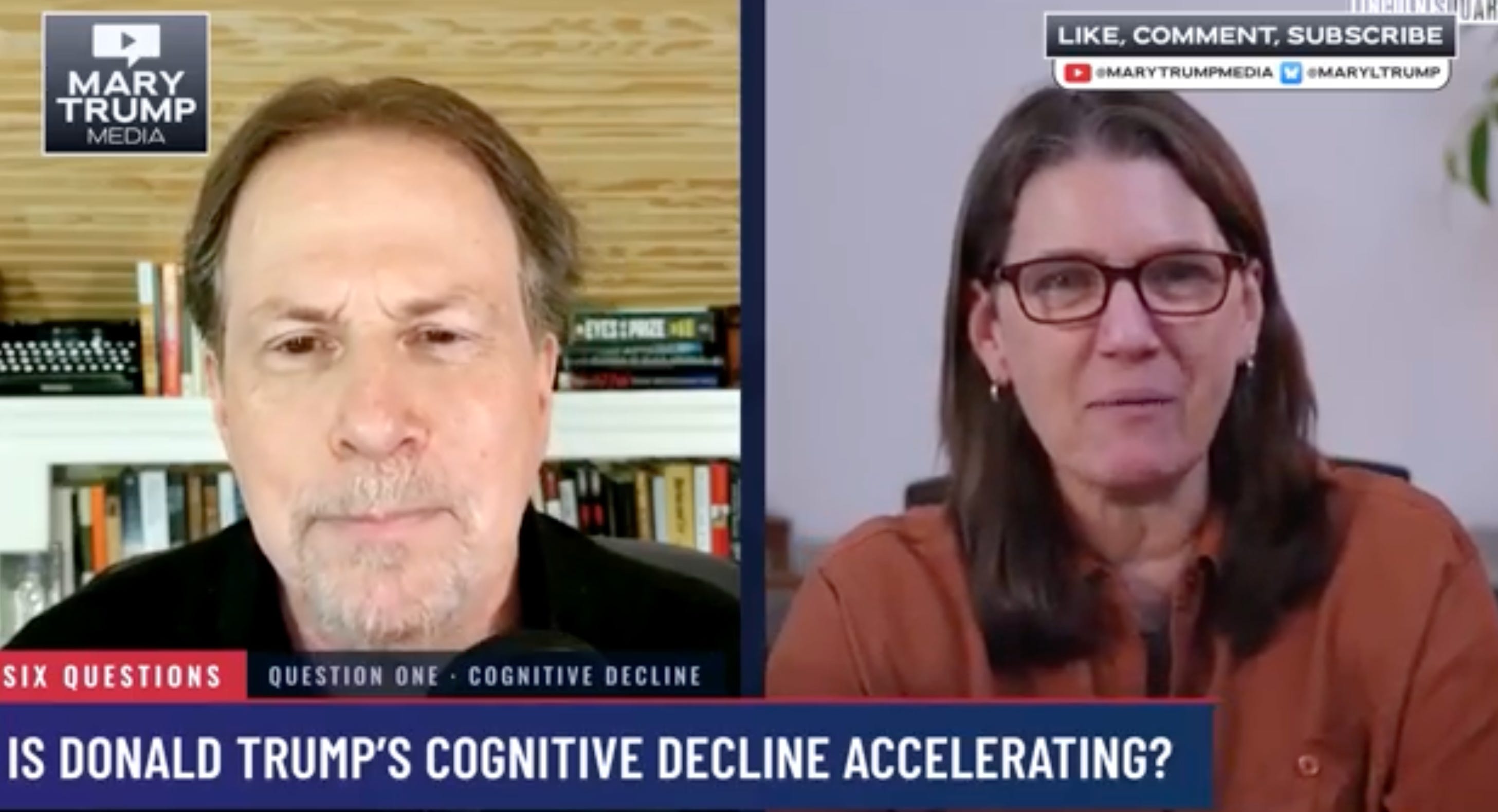
I had the honor of appearing on the premier episode of Steven Becshloss, “Six Questions.” And in addition to talking about the very serious events going on in the world today, he also asked me six awesome questions. Hope you enjoy.
Steve Beschloss: Mary, I’m so excited that you could join me. Honestly, there’s no one I wanted to talk to more than you to get a read on where things are. The last few weeks have seemed particularly reckless and chaotic. The near-daily flip-flopping on the war with Iran, the extreme and violent threats, and the more frequent expressions of indifference.
Donald Trump said yesterday, “I don’t really care if the talks with Iran collapse.” It mirrored, to me, his recent careless remark: “I don’t think about Americans’ financial situation.” In the last few weeks, he’s been posting extreme AI images of self-delusion, portraying himself as Jesus, on Mount Rushmore, on horseback beside George Washington, along with a lot of his usual hostile targeting of perceived enemies.
So let’s jump in. My first question: How would you describe Donald’s current state of cognitive decline, and is it accelerating?
Mary Trump: First of all, Steven, it’s so awesome to be here with you on your new show. I’m very excited to be here. Thank you.
Because everything is bad, last I checked. And one of the things that’s very bad is Donald’s cognitive decline, which is worsening. I’m not a neuropsychologist or neurologist, but I don’t think one has to be. One just has to be observant.
As some people know, my grandfather, Donald’s father, had Alzheimer’s, and I see a lot of similarities in the way they look, the way he talks sometimes, and his lack of impulse control. It’s very worrying because, of course, this is on top of other issues he’s clearly having in terms of poor physical health, which we see evidence of, and about which the White House continues to lie.
And then there are his longstanding, undiagnosed, untreated psychiatric disorders, which are also worsening over time.
Steven Beschloss: Right. We’ve talked before about malignant narcissism and sociopathy, which have been playing out for decades. How much of this, in your view, is about dementia, combined with those other disorders?
Mary Trump: I think it’s a perfect storm of all of those things, plus the enormous stress anybody in Donald’s position would be under.
That stress is exacerbated by the fact that, perhaps for the first time in his life, he has painted himself into a corner he can’t get out of. The 47,000 plates he has spinning in the air aren’t working anymore. A lot of them are falling to the ground, and they’re no longer distracting people from his unbelievable incompetence and corruption.
The dementia is a serious problem because you don’t want somebody in a position of power suffering from cognitive decline, especially when that person is surrounded by sycophants and yes-men who refuse to step in.
But, Steven, I’ve heard a lot of people say Donald is different now, that he’s not the same guy he used to be. I would push back vehemently against that. I think what we’re seeing is a stripping away. His cognitive decline is actually revealing who he’s been all along.
Steven Beschloss: We’ve talked before about narcissistic collapse and looked for moments when some humiliating event might finally break through his self-delusion. Are there signs that we’re seeing that now?
Mary Trump: Absolutely.
Part of it is the cognitive decline and the resulting loss of impulse control. But I also think it’s the dawning realization, even if not entirely conscious, that he’s losing control of the narrative.
Donald has been on the brink of narcissistic collapse for decades, but there has always been somebody there to pick him up, to assuage him, to remind him that he is the greatest creature who has ever existed.
It’s important for people to understand why he may finally be approaching that collapse. Donald has spent his entire life trying to avoid humiliation. If there is one thing that terrifies him more than anything else, it is being revealed as the pathetic loser he knows deep down he is.
So much of his psychic energy has been devoted to protecting his fragile ego from the truth about who he actually is.
Steven Beschloss: Let’s move to question two. Is there anything about his cognitive state that surprises you? Are there surprises still to come?
Mary Trump: No and no.
One thing you can credit Donald with is consistency. Nothing he does should surprise us based on what we know about him. And there is no bottom.
One of my mantras is that there is no worst. He will always get worse. I think the last decade has proven that.
Steven Beschloss: We’ve talked before about the possibility that, if things get bad enough, he’ll burn it all down. What does that mean?
Mary Trump: When you’re dealing with a deeply psychiatrically disordered person in cognitive decline, who is losing what little impulse control he ever had and who possesses enormous power, we need to keep our eyes wide open.
In addition to everything else, he’s a nihilist. One reason we have no idea who in the Republican Party may try to succeed him is that Donald doesn’t believe anybody can or should. He doesn’t believe that anybody or anything should survive him.
Steven Beschloss: Let’s zoom out. How has his mental illness infected the country? Are we seeing a kind of mass psychosis and rising sociopathy?
Mary Trump: It’s very alarming.
We’re probably going to spend the rest of our lives trying to understand this. Clearly, we haven’t learned all of the lessons we needed to learn from World War II and the Holocaust.
We need psychologists, psychiatrists, sociologists, anthropologists, and others to help us understand what happened and how to prevent it from happening again.
One factor is that there are a lot of people with authoritarian personalities. They are susceptible to charismatic leaders, and whether it makes sense to us or not, Donald is one of them.
He has tapped into people’s discontent and given them permission to be their worst selves.
Shockingly, there are people who genuinely like his cruelty. They relate to him. They see themselves in him. They are often weak people who feel the world has treated them unfairly, even when they occupy positions of privilege.
We’ve been building toward somebody like Donald in the White House for decades. This is not a one-off.
Steven Beschloss: George Washington worried about the rise of despotism and warned that a demagogue would feed upon the ruins of public liberty. It feels remarkably prophetic.
What about leadership? Will this sociopathic style continue influencing future leaders?
Mary Trump: This is the Republican Party now.
We cannot allow Republicans who enabled every horror Donald Trump committed against this country, its people, and the world to later point at him and pretend he was the only problem.
There is no returning to normal because there is no normal to return to.
Quite frankly, the Republican Party has been a party of authoritarians and fascists for some time. They laid the foundation for this moment, and every one of them needs to be held accountable.
The Democrats’ mistake has always been saying we need to look forward, not back. In my view, that has been a tragic misjudgment.
Steven Beschloss: Again and again in American history, people who committed profound betrayals have escaped accountability because leaders preferred to move on.
Mary Trump: And it’s worse than that.
Gerald Ford is known for pardoning Richard Nixon, which was an awful mistake. But he also pardoned Robert E. Lee. Then Jimmy Carter pardoned Jefferson Davis.
It’s not just that we fail to hold people accountable. We wipe the slate clean.
Steven Beschloss: Let’s talk about national trauma. How traumatized is the country?
Mary Trump: We’re so traumatized that many of us don’t even recognize it.
Some people were traumatized by the 2016 election. Virtually all of us were traumatized by COVID.
The problem is that you cannot heal from trauma while you are actively being traumatized. If you don’t recognize the foundational trauma, then every new trauma compounds the original one.
We are in very deep trouble. We’ve always been terrible about mental health in this country.
We are a nation of traumatized people who lack the tools and language to grapple with what we’re experiencing. Unless leadership helps the country heal and understand what that means, things will only get worse.
Steven Beschloss: Which brings me to my final question. How long will it take to repair the damage once he’s gone?
Mary Trump: This is a generational project.
It assumes Democrats regain power and understand what their responsibility is. We need leaders who understand what’s at stake and who are willing to make serious systemic changes.
We need to protect civil rights, protect human rights, and reimagine what this country stands for. We need to redefine who we are and who we want to be.
Part of that process may require stepping back from the world stage. We’ve done enormous damage over the last decade, largely because of Donald and the Republican Party, but also because Democrats failed to do enough when they had the opportunity.
We need serious soul-searching about America’s future role in the world.
This is not something that changes over a couple of election cycles. It requires long-term dedication.
Steven Beschloss: I think that’s exactly right.
The trust that has been broken with allies around the world will take generations to rebuild. The soft power that once connected America to the world has been badly damaged.
And we also need to confront issues like gun violence, which remains a profound source of trauma for millions of Americans.
Mary Trump: I agree.
Steven Beschloss: Before we finish, let’s do a lightning round.
What makes you happy?
Mary Trump: My people.
Especially after 2016 and COVID, I became very isolated. Finding my way back to the people I love has meant everything. They’ve helped me get through these dark times.
Steven Beschloss: What makes you angriest?
Mary Trump: That people like Donald, who are corrupt, undeserving, and incompetent, continue to fail upward and gain power at the expense of what really matters: kindness and empathy.
That continues to enrage me.
Steven Beschloss: What’s your favorite word?
Mary Trump: Paradigmatic.
Steven Beschloss: Why?
Mary Trump: I don’t know. I just think it’s a cool word.
Steven Beschloss: What living person do you most admire?
Mary Trump: Jane Fonda.
And as a group, the people of Ukraine.
Steven Beschloss: What historical person do you most admire?
Mary Trump: I’m terrible at answering that question.
Instead, I’ll say the people throughout history who were part of resistance movements, whether the Underground Railroad, the French Resistance, or other acts of courage in dark times.
We need to learn from them and try to emulate their bravery.
Steven Beschloss: What gives you hope?
Mary Trump: Just look around.
There are so many people standing up for their neighbors, their communities, and their values. People are putting themselves on the line while corporations and institutions fail us.
The willingness of ordinary people to act, often without support and without knowing whether their actions will matter, gives me hope.
There are still so many people like that in this country and around the world, and I am deeply grateful to them.
Steven Beschloss: You give me hope too.
You’ve been an incisive observer, but more importantly, you’ve committed yourself to helping people make sense of what we’re living through.
Your work matters now, and it will matter just as much when the time comes to repair the damage.
Thank you for taking the time today.
Mary Trump: Thank you.

Trump is off the scale in every way. Vance also needs to keep his nose out of hate mongering in the U.K. All distorted cognition, often deliberate and to shock; same with Farage his mate!
Thank you for sharing this conversation. Mary, your understanding and insight and professionalism help us all in maneuvering through this difficult time.