

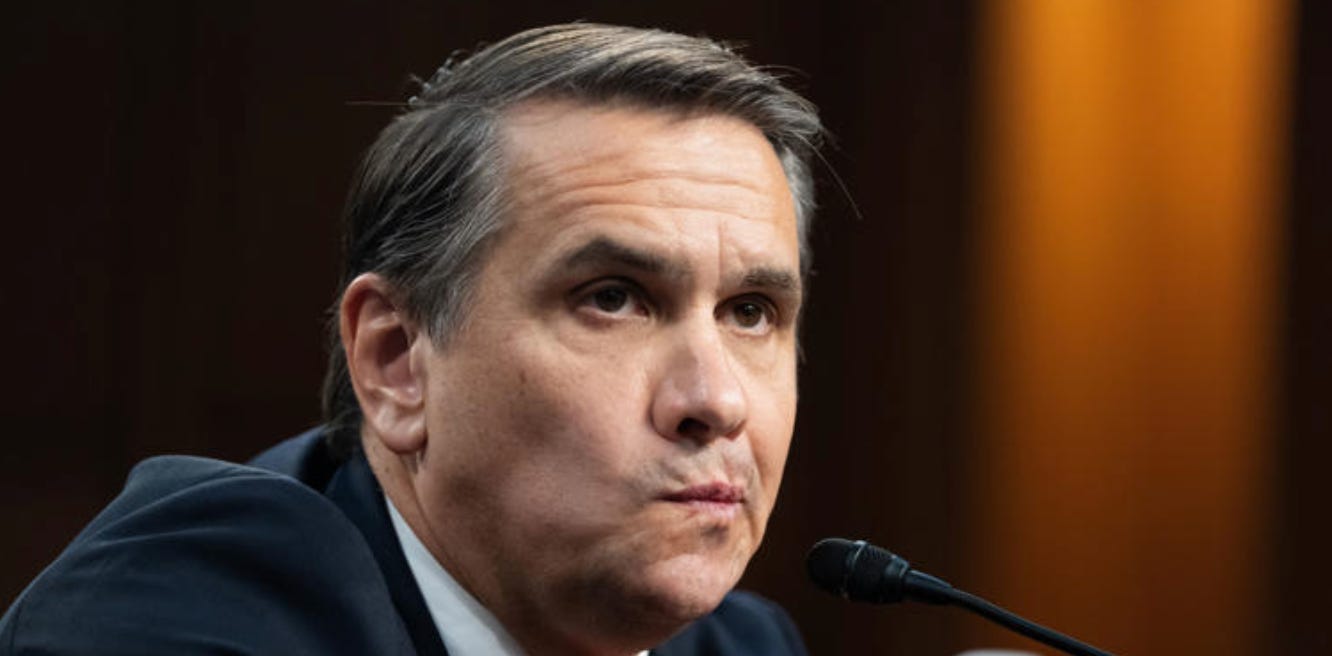
Justice delayed has always been justice denied. That is especially true for survivors of sexual abuse.
While Acting Attorney General Todd Blanche sits before the Senate Judiciary Committee seeking confirmation to permanently lead the Department of Justice, his department continues to face mounting questions over its handling of the Epstein files and its refusal to provide critical records to New Mexico Attorney General Raúl Torrez. Those records are needed to continue an investigation into Jeffrey Epstein’s Zorro Ranch on behalf of survivors who have been waiting far too long for justice.
On June 30, Attorney General Torrez sent a letter to Todd Blanche warning that every day those records remain out of reach makes future prosecutions more difficult. On June 9, Torrez publicly expressed hope that the Department of Justice would cooperate with New Mexico’s investigation by providing the requested federal records. He explained that those documents are essential if his office is to fully investigate what happened at Epstein’s New Mexico ranch and pursue justice for survivors.
This is what Raúl Torrez said during an interview with NBC.
Reporter: To do this, to conduct this investigation, you obviously need materials. You need information. And you have asked, and you referenced this yesterday too, that you’ve asked the DOJ for unredacted access to the Epstein files and you still do not have it. Why do you think that is?
Torrez: Well, look, we’re working through a process. It’s called the two week process. It’s complicated, but the bottom line is there is a longstanding practice of federal law enforcement and state law enforcement collaborating, coordinating, sharing information. We have engaged the Department of Justice. We are still waiting for that access. It is frustrating. I’ll tell you that it is hindering our ability to move this investigation forward at the pace that I would like.
As of July 15, two weeks had passed since Torrez sent that letter accusing the Department of Justice of withholding records necessary to continue the investigation into Epstein’s ranch. According to Torrez, those records still had not been produced.
His warning could not have been more direct.
Without complete and prompt access to relevant, unredacted federal records, survivors are being denied justice. Every delay makes accountability more difficult. Witnesses relocate. Memories, already burdened by years of trauma, become less reliable. The opportunity to bring meaningful prosecutions continues to deteriorate.
Torrez wrote:
Every day that the USDOJ withholds these records, the foundation upon which a New Mexico prosecution could be built erodes. Witnesses relocate and become unreachable. Memories, already strained by years of trauma, fade further.
After Torrez’s letter became public, a US Department of Justice spokesperson insisted the agency had already provided a substantive response to New Mexico’s request and remained willing to assist the investigation.
If that is true, then what exactly is the problem?
Provide the records.
Saying you have provided “substantive” materials is not the same thing as providing all of the materials investigators need. More importantly, this Department of Justice has done very little to earn the public’s trust. Since the beginning, first under Pam Bondi and now under Todd Blanche, the department has consistently delayed, obscured, and resisted efforts to fully release the Epstein files.
At this point, it is difficult to avoid the conclusion that delay itself has become the objective.
Whether the goal is to protect powerful individuals whose names may appear throughout those records or simply to prevent additional scrutiny, the practical effect is the same. Survivors wait while evidence grows older and opportunities for justice diminish.
That issue followed Todd Blanche into his confirmation hearing before the Senate Judiciary Committee on July 15. During the hearing, Senator Dick Durbin questioned Blanche not only about transparency surrounding the Epstein files but also about the Department of Justice’s obligation to the survivors themselves.
This is what Senator Dick Durbin asked Todd Blanche.
Let me talk to you for a moment about the survivors who are in the room. There are ten individuals who were exploited and abused by Mr. Epstein. They are here today. None of them have had a chance to speak to anyone in the department or FBI, though they’ve asked repeatedly. So can I get your word under oath that within the next thirty days you will personally sit down with these ten victims and hear their case in terms of what needs to be done by the Department of Justice?
This is how Todd Blanche responded:
Chairman, I appreciate them being here today. I also have somebody from my office who’s spent her entire career working on cases like Mr. Epstein’s. She’s in charge of our task force investigating human trafficking. She’s available to talk to them.
Senator Durbin was not asking whether someone else could meet with them.
He was asking whether Todd Blanche would.
Durbin continued.
She can sit right next to you. She can sit right next to you when you meet with these survivors.
Blanche responded:
I have never said I will not meet with survivors.
Durbin pressed him again.
Will you meet with these ten survivors? I’m asking you on the record.
Blanche replied:
If they have lawyers, as you know, I’m prohibited from meeting directly with them. I have met with counsel for survivors, as have many people in the Department of Justice. But if they are represented by counsel, we will work with their counsel. If they don’t have a lawyer, I will certainly make arrangements to make sure the right people at the Department of Justice meet with them.
Durbin continued.
Will you get it done within the next thirty days?
Blanche answered:
I will get it done today if that’s necessary. My point is there’s somebody here who can meet with them today, get their information and arrange to meet with them.
Durbin closed with a point that should never have needed to be made.
I think you ought to be in the room because you ought to hear this. You have singular responsibility for these files.
That exchange speaks volumes.
Todd Blanche repeatedly searched for ways to delegate the responsibility. He pointed to staff members. He pointed to procedures. He pointed to lawyers. At no point did he simply embrace the opportunity to sit down with the survivors himself.
That reluctance stands in stark contrast to the time Blanche voluntarily spent meeting with Ghislaine Maxwell, Jeffrey Epstein’s convicted co conspirator in the rape and sex trafficking of girls and young women.
Blanche did meet with the 10 survivors after pressure from lawmakers on Thursday. He also found the time to meet with Ghislaine Maxwell. He has struggled to find the same urgency for the people she victimized. That contrast is impossible to ignore.
As the New Mexico Attorney General continues to make clear, the Department of Justice is withholding records that could allow investigators to continue pursuing crimes connected to Epstein’s New Mexico ranch. Every day those records remain unavailable makes meaningful accountability more difficult.
That is unacceptable.
It also raises an obvious question.
Why does Todd Blanche appear so committed to slowing investigations that could help survivors finally obtain justice? His actions increasingly suggest that his highest priority is not uncovering the truth but controlling access to it.
Time and again, Todd Blanche demonstrates that he is not acting like the Attorney General of the United States. He continues to act like Donald Trump’s personal defense attorney.
That distinction matters because the Attorney General’s client is not the President. It is the United States of America.
The Department of Justice exists to pursue justice wherever the facts lead, regardless of politics or personal relationships. When it instead becomes an institution that delays investigations, withholds evidence, and frustrates efforts by state prosecutors to seek accountability, it ceases to fulfill its most fundamental purpose.
The survivors deserve better.
The American people deserve better.
And until the Department of Justice begins acting in the interest of justice rather than in the interest of protecting powerful people, those questions will only become more urgent.

Blanche knows the name of every rich and powerful rapist in the files. He also knows just how deeply involved Trump was with all of Epstein's actions. He will never allow any of it to become public if he can. But when it does, and it will, there will be a whole lot of men fleeing to non-extradition countries.
Thank you for the article, Mary. Todd Blanche is under investigation by the New York bar association. Please my fellow senators vote no on his nomination. Please give to Mary’s traced pact. It’s really important that we get candidates who are worthy to run for office and will not take money from AIPAC.