

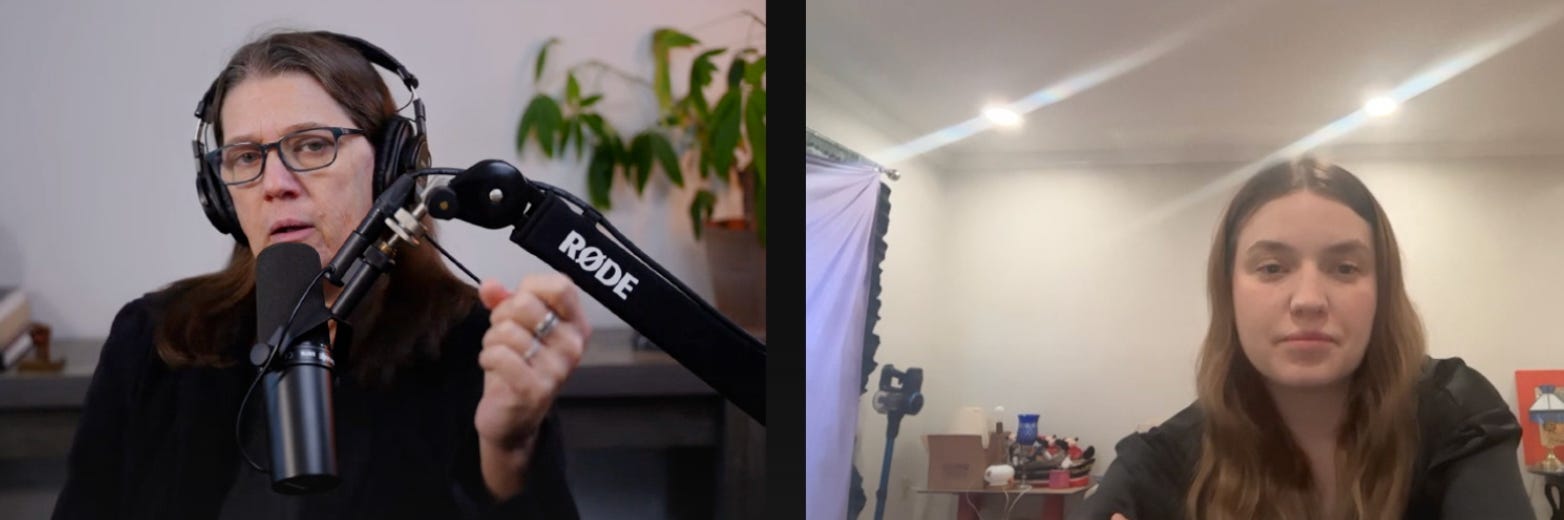
Watch Full Video
[Transcript edited for clarity, flow and length]
Mary Trump: Now that Democrats have taken overwhelming majorities in the House and Senate, it is time for America to do justice by the Ukrainian people and give them all of the funds and materials they require to prevail over Russia. I had a compelling conversation with Kelsie Kimberlin, a Ukrainian American singer songwriter who went to Ukraine in search of her cousin’s grave. Andrei was a soldier fighting for his country when he was killed by Russian forces at the age of 20. In her new documentary, The Last Message, Kelsie reminds us of the human cost of this illegal war of aggression by Russia against Ukraine and what is still at stake for an ally that America continues to fail.
Please check out Kelsie’s music HERE
The Last Message Full Documentary HERE
Check out Justice Through Music HERE
Mary Trump: Kelsie, thank you so much for being here.
Kelsie Kimberlin: Thank you for interviewing me.
Mary Trump: Of course. I think that you have done something essential that the American people need to see, and that is to bring a level of humanity and intimacy to the horrors occurring in Ukraine thanks to the illegal war being waged by Russia against the Ukrainian people. This film started for you in a very personal place and for a very personal reason. So if you could let people know the impetus behind your journey to Ukraine and the documentary, I think that is a good place to start, because it is where you started.
Kelsie Kimberlin: So, just to give a little background, my mom was born and raised in Ukraine. I have been going there my entire life. The documentary stems from one of my best friends, who is also my cousin. He volunteered for the armed forces in Ukraine, and he ended up getting killed by Russia. What I stood to take from it was that a lot of people were talking about territory, territory, territory. They were forgetting about the people and the small villages where my family came from. A lot of people would say, “Oh, go back to the villages or go back home to Ukraine,” but how are you supposed to go back when your entire home has no electricity and no water, and your fields are mined? So a big part of this documentary was me trying to make sure his name would not be just another name on the wall, and that he could live through it and fight for what is happening. Because Russia, this is not a war. This is terrorism and almost genocide.
The Last Message Documentary HERE
Mary Trump: Yes, it is. And I think, to your point about territory and Russian incursions into Ukraine’s sovereign territory, that is obviously against international law, but that is not the only thing we are talking about, and it is certainly not the most important. We are talking about the destruction of towns, the murder of Ukrainian citizens, and war crimes being committed by an aggressor that the United States has certainly not done enough to stop. We will get to that in a second, but one of the things that is so moving about your film is the way in which you connect with people. The film illustrates the concerns and the devotion of the Ukrainian people and of others who voluntarily came to Ukraine to fight on its behalf, despite perhaps not having any connection to the country beyond understanding just how egregious this Russian terrorism is.
There is one scene in an orphanage where they are talking about air raid sirens and how bad the conditions are and how stressful it is, but they are trying to get in art supplies so the children can express themselves with paint, et cetera. To me, it was a reminder of the very human story you are telling, and that this is not just about surviving. It is about preserving humanity and the things that make being human matter. So could you talk a little bit about some of your experiences with the people you met in the film, which, to me, resonated in a way I was not entirely expecting?
Kelsie Kimberlin: Honestly, you are the first person who has ever spoken with me about it this way and asked that question, and I am really happy that you asked and saw it that way. A big part of my film was trying to make it as raw as possible. The kids have basically built the entire orphanage. Everything has been a free for all art expression, and it is a way of just being a kid again. I think a lot of kids, I guess, around here, especially around the US, were used to TV, iPads, and going to restaurants. When I grew up with my cousins, it was running in the fields, playing soccer, art, drawing, and making imaginary things. So that was a really big thing there. When I was talking with everyone there, I wanted to go in unscripted.
I wanted to put my mind into an American who had no clue what was going on. A lot of my questions were maybe things I already knew, but I wanted them to be raw, going in almost like an innocent child asking these people to tell their stories. I feel like a lot of people have talked about territory, or they have talked a lot about the military, but a lot of people have forgotten about all the people in these territories who stayed, fought to keep their land, and kept everything going for the future generation. So that was a big part of me going in raw and just asking questions.
Mary Trump: I do too. I think that is because there is not necessarily such a thing as the right question under certain circumstances. You were going there for what seemed a dual purpose. Again, it was your very personal journey back to Ukraine to say goodbye to Andrei, your cousin, and to highlight for those of us not paying enough attention, or paying attention to the wrong things, what the people of Ukraine are dealing with, suffering through, and prevailing over, quite frankly. So I want to get back to where this all started. The impetus for your going, as you said, is that your cousin was one of your best friends, and you did not end things with him on the best note. I think it is a reminder of how important it is to try to stay connected to people, even under difficult circumstances, and it is because you were upset with him for having enlisted, since he was so young. So can you tell us how young he was and why he was so determined, not only to enlist, but to fight under the worst circumstances? He went to the front, is that right?
Kelsie Kimberlin: Yeah, he did. He was killed in Avdiivka, which was one of the worst battles. It was actually when the US stopped funding, and they were trying to decide whether they should fund them or not. So they lost. They had no food, no weapons, no aid, nothing. That is why Avdiivka was really important. A big part of this is that we are dealing with hundreds of thousands of people who have been kidnapped. We have been dealing with killed children. We are also dealing with a lot of kids who have never had military combat experience in their life, and they are going and doing this. A big part of this is that I did not leave on good terms with him, and that is why I named it The Last Message. But The Last Message was more like, I feel like we always look back on the ones we lost and on what we said and what we did not say. He was 20 when he passed. I think he was about to turn 21, a couple days before his birthday.
I always say 2021 because he was alive for about five days just sitting there, which I found out when I was actually on the front lines from his combat people. Sometimes it is a little hard for me to talk about. But a big part of going down there was that he chose to go in. He had always been that person who was a little hotheaded but stubborn, kind of like me in a sense, and he always fought for causes he believed in. I think he just saw how much Ukraine was changing. He always wanted peace. He wanted to defend his country. He always saw the work, like I did, with talking about American guns. I did a video, and I think he was always inspired by it.
But yes, one of the things I was also doing in The Last Message and visiting his grave, which was a big part of it. I did not answer his last text message, which still gets to me today. I looked at it, and then he passed, and none of us knew he was at the front line. That was a lot for me, and I still think I carry a lot of guilt. So one thing I always say is that you had that message, but there is a big message I believe in: never go to bed angry with someone you love, no matter how mad you are.
The Last Message Documentary HERE
Mary Trump: Yeah, and the circumstances of that very difficult time, when you two were very close but had a fight, were that you were supposed to see each other, but he did not want to see you, because he did not want to be talked out of his determination to serve his country. Then that escalated, so you did not answer his message, but that is what we do. In the context of what is happening over there, it does bring home just how important it is not to let things get in the way of communicating with those we love most. In part, your decision to go to Ukraine was to say goodbye in a way you had not been able to do. There is a quite lovely conversation you have with your driver, whose name, I apologize, I cannot remember. Dave?
Kelsie Kimberlin: It’s okay, David.
Mary Trump: Thank you. Oh my goodness, David, who is not Ukrainian. So you are talking about this, and it is very difficult. He says something that really resonated with me. He said, “I know he’s already forgiven you,” because he went to work in Ukraine and lied to his family about it. So I think he understood your cousin’s motivations, but he also understood that your cousin understood your motivations. I thought that was lovely. Was that healing for you to hear him say that? And then, of course, to have him tell you that what you were doing by going to say goodbye was an extraordinary thing as well.
Kelsie Kimberlin: Yeah, there is a lot that was not filmed in that car ride, but hearing that was... I think when you hear and see someone else who is not Ukrainian, who went to fight and had almost the exact same experience, you can see I just start crying, and I try to hold it back, almost for the camera, in a sense. No, that healed me a lot. We are still really good friends to this day. A big part of this journey is that I think he lives on through this film, and I know now his name is going to be known everywhere. So I think this film is kind of my way of saying sorry. I was saying sorry, but it is also kind of fighting for what he believed in, as I believe in it too. And that grave scene, if I will tell you a little bit about it, the grave is not there anymore. It got hit by a missile. I am really glad I got to go see it, because I am the only one on my side here. My mom never got to see it, so I was very lucky.
Two months later, it was hit by a missile, and the entire village was gone, and my grandparents were evacuated from there as well. And what you guys see there, too, in the car ride, you saw I was holding back tears. It is something that is really vulnerable for me, and I thought it was really important for the world to see that it is not only affecting Ukraine, it is affecting American families as well.
I did not bring my grandparents with me to the grave, because I did not think it was fair for us all to do it together. So that was a very vulnerable moment that you guys see in the doc. But I am glad I got to go. A little part of me keeps me doing these interviews now, even though I am in different time zones and I am a little exhausted sometimes. I will admit that. It makes me really sad sometimes, also coming back from Kyiv recently. What keeps me going is the thought that we will never be able to go back to that village. You will never be able to bring your husband or your kids to where you grew up. So that is a big part of what keeps me fighting right now.
Please check out Kelsie’s music and The Last Message Documentary HERE
Mary Trump: I wanted to ask you about how Ukrainians were feeling and are feeling about the lack of support from this country. Obviously, it is worse. It is infinitely worse now, but I think the Biden administration did not do enough. In fact, when you were at the mechanics repair shop, the gentleman you spoke to said, “Just forge the signature and get us our 2,000 tomahawks.” Because the truth of the matter is that if we had done everything we could have done for Ukraine at the very beginning, I think we would not be having this conversation.
Now here we are five years later, and the government of the United States of America has betrayed Ukraine and the Ukrainian people to benefit a murderous Russian dictator who has the blood of so many Ukrainian adults and children on his hands. That has to be utterly brutal for a people who have, against every odd imaginable, managed to stay in this fight for so long. How are they holding up under such circumstances?
Kelsie Kimberlin: You know what is funny that I am going to tell you? When you go to Ukraine, a lot of Ukrainians, if you are American, thank you. They say thank you for a lot of the things that happened, but there are some parts, like Victor. But what I will tell you is that there are a lot of them recently who have seen through it. They thought, when Donald said this, that things might change: “Oh, I’m going to come into that press conference and I’m going to have this ceasefire. I met with Putin.”
This is what Donald said before that press conference, and he never talked about it once. I told all my Ukrainian friends, “He’s not going to talk about it.” So they had hope for a little bit. I think the one thing a lot of my friends and family have talked about is that right now they are so tired, and a lot of them are in their 20s. They have not lived their 20s. They have not been able to find their families. But also, why are we not supporting a country that is being attacked by a terrorist nation? Why aren’t we? America was built on the principles of, we fought for our freedom, so we are always going to help the underdog, and we are never going to defend a terrorist nation against someone who is defenseless. So where did those principles and morals go? I just do not understand.
Putin has violated international law by invading Ukraine. He has never held up any agreement, so I do not even know why we are talking about peace treaties. Didn’t we do that with the Black Sea? And I will not lie to you, and I am going to say it. A lot of people in Ukraine and here now are asking why we have a president, the first president we have ever had, who has never once talked back to Putin or come at him. He has also never even gone to Ukraine, and I want to mention that as well. Why has he never even stepped foot in Kyiv?
Mary Trump: Yeah. Well, unfortunately, I think it is a very simple answer, because he does not care about Ukraine, and he is either beholden to or enthralled by Vladimir Putin. As we have seen in the last couple of weeks, with the most abject betrayal of Ukraine, it is about money and it is about power. Again, I think this builds on the failures of other presidents. Now, don’t get me wrong, no American president has been as vile and despicable on this issue as Donald has been, but I think there is a long line of failed American policies when it comes to Russia in particular and the way Russia has treated Ukraine. So I think that has led, in a way, to a situation in which the worst president we have ever had is not being reined in and is not being stopped.
We are now in a situation where one of our allies is being directly and negatively impacted by us, and it is a travesty. So the question becomes, how do we turn that around and how do we make it up to the Ukrainian people? It is not looking good, at least in terms of the fact that we have an American president who is helping the enemy of our ally. How do we make it up to the Ukrainian people? Or, I guess, let’s start here. Do the Ukrainian people see it that way? Are they getting sick of America’s inability or unwillingness to help? Have they had it with the fact that Donald has behaved so abysmally towards Ukraine’s president, Zelenskyy? And what can Americans do to prove that I think a big majority of us actually do care what happens to Ukraine?
Kelsie Kimberlin: So I think it is America, but it is also Europe that needs to start getting more involved. We need victory, and we need policies put in place. We need victory, not negotiations. That is a big thing as well. I also want to say, because we were talking about the no fly zone, why are we going into the no fly zone, and why is nothing happening? That is a big thing to me too. You asked a loaded question. I know my father over here is going to say, “Don’t answer,” but I am going to answer it. I just think we need to support Ukraine with more weapons. I think a lot of people want to say no drones, no drones, no drones. They are used, like FPV drones. That has been a big thing with me and with my foundation.
Check out Justice Through Music HERE
The thing is, drones are going to save lives. They are going to keep fewer boots on the ground. But I also want to point out that if we look at history, I just want Americans to realize, and before that, I am going to answer your question about Ukrainians. Ukrainians are very sweet. We do not go around blaming, blaming, blaming, in a sense. Yes, we get tired, and we will overthrow a dictatorship. We have done that. But the thing about Ukrainians is that we come together and we stay strong no matter what. We have been taken over many times and invaded many times. At the end of the day, a lot of them are thankful, but we are also looking at America, and I want everyone to wake up. If we are talking about the three main parties we have now, Democrats, Republicans, and MAGA, that is what we have right now.
Mary Trump: You’re very generous, because I don’t think there is any distinction between Republicans and MAGA.
Kelsie Kimberlin: But there is some, I will say, that I have noticed about some people. Some people are like, have you seen George Bush? He watches and he’s like, “Oh my God.”
Mary Trump: He does nothing.
Kelsie Kimberlin: Yeah, he does nothing. So one thing I want to say to everyone is let’s look at history. What happened when Russia invaded other places? Where did they go? Belarus, the border, Poland. They have already done that. What have they tried to do over the centuries? So let’s say if we reward them with a deal and they get to keep territory, I’d like people to realize that is rewarding a terrorist country. But also, have you ever read the one where you give a mouse a cookie and then they want milk?
Mary Trump: Oh my goodness. Yes, I have read all of them.
Kelsie Kimberlin: That is Russia to a standpoint, and a simple thing for millennials to understand. So we are not going to give them that. That is what I am saying. But I also want people to realize, imagine where you are living right now in the world. Let’s say I was living in New York City. Let’s say, “Oh, I need to give up New York City. I have to move out of New York City to have peace in my country, but I can never go back to my homeland. I can never show my kids that.” Do you think any American is going to be okay with that? That is what I want Americans to think about.
Mary Trump: Yeah, Kelsie, that is such a good point. I think one of the problems is that we have never had this situation here. It is literally unimaginable for Americans to understand what Ukrainians are going through. I agree with you. Ukraine needs all of the weapons. It needs all of the supplies. It needs all of the money. They should have had it when this whole thing started. It surpasses understanding that the Biden administration did not do more when it had the chance, but that is a conversation for another time. Agreed. So I think there is no argument here, especially when you are looking at a situation in which far too many people who are not directly involved are doing exactly what you describe: “Well, just let Russia keep the territory. It has stolen from a sovereign nation, and then we will just call it a draw.” No, because, as you said, Vladimir Putin has committed war crimes against the Ukrainian people. Appeasement never ends well. Just ask Nazi Germany. Seriously, this is not the way to go here.
I think that anything other than a decisive loss for Russia and real accountability for the monsters who started and are perpetuating this war is not good enough. So I am completely with you on all of that. The question then becomes, how do we help people who do not have a real sense of what Ukrainians are experiencing understand exactly how much is at stake? Because another issue that I think people in other countries in the West, especially America, fail to understand is that Ukraine is not just fighting for its sovereignty. It is fighting for Western liberal democracy. So I think one answer to that question is what you have done. Make it personal. Show people what is actually happening on the ground in these villages, in these towns, and in these cities. I think this documentary is vitally important. So I want to ask you, how has the reception been, and is it getting enough play?
Kelsie Kimberlin: So currently it is a potential Oscar nominee. I am working with 42 West right now. I do not think I am ever going to win anything, and I do not care to win. My point is that it gets enough noise around it, with that being a part of it, that it ends up blowing up. So my point is that probably by January, I want to start going around the world and showing it. That is my way of getting noise around it right now. It played for a week in LA at the Royal Theaters. Then I had a premiere in Kyiv, and 250 people showed up, which was crazy. I did not think that was going to happen.
Mary Trump: Oh, that is amazing.
Kelsie Kimberlin: My point is that right now I do not think it has gotten much traction in the US as much as I would like it to, but that was the whole point of doing the Oscar potential nominee campaign. What I am talking about now is that you cannot put something out unless you get some noise behind it, right?
The Last Message Full Documentary HERE
Mary Trump: Right. Oh, absolutely. Absolutely.
Kelsie Kimberlin: And a big part of it, too, is that I have been asked about it. I have a lot of B roll footage, so I think I want to make maybe a part two, which is completely raw, just everything, straight through, if this ever does blow up and I can put it out.
Mary Trump: Yeah, and honestly, that is the world we are living in. You need something to go viral, you need to get the hits, et cetera. So I think having it potentially nominated for an Academy Award would be fantastic.
Kelsie Kimberlin: A big part of the movie, which I just completely remembered, is that it answers what to do. At the end, I go to the courthouse and I file a lawsuit. So that is a big part of it too, which is holding them accountable. A bunch of people can join in this lawsuit if they are American and lost a family member there. I think that is actually a big part of your question about how Americans can get involved. That is a big part of how to get involved. Anyone can join it.
Mary Trump: Yeah, so it could be a class action suit.
Kelsie Kimberlin: Yeah. Weapons, pressure on politicians, get involved.
Mary Trump: This is a deeply moving film, and it also demonstrates the extent to which these horrors have an impact on our ability as human beings to be creative and to feel our joy. In a way, it comes full circle, and you find your song. So can you talk about that process? Because music is obviously extraordinarily important to you. Toward the end of the film, there is an incredibly moving moment when your dad is on one of the guitars, I believe, with somebody else, and you find your song.
Please check out Kelsie’s music HERE
Check out Justice Through Music HERE
Kelsie Kimberlin: That was actually the day after the grave. I asked my dad to play the guitar because I had one hour of sleep, and I was pretty distraught. A big part of that is that I had a hard time writing for a really long time. I think a lot of my passions went away, if that makes sense. I will thank him, because a big part of this documentary is that I found a lot of myself again because of him, and I always thank him for it.
I had a big part in writing “Star,” but I wrote only a little bit of it. I realized everyone is like a star in their own way. A quote I really like to share is, “But without the dark, you never see the stars.” I feel like that resonates with Ukrainians. Right now they are going through the dark, but they are all stars in their own way, and one day they are going to see all the stars. That is a big way I like to think about that song. There is also the music and writing of that song. I do like my fun music and the things I grew up with, but a big thing I have realized is that a lot of young people are not really watching the news anymore. They are watching 30 second TikToks or listening to music. So I like to come up with causes I believe in and put them into songs, and I hope the younger generation gets involved. That is my way of doing it. I think we need many more people in their 20s like me. I am in my late 20s, but sometimes we feel a little awkward going on these interviews, and we are really nervous. We are like, whoa, we are very nervous, but I was really happy and excited to be there.
We need more people in their 20s who are open, honest, and vulnerable and to start speaking the truth. I cannot think about anything besides social media. My God. I remember the days in high school when my friends and I would make signs about making America great again and go out. We have lost that. I think a lot of people, we have all these older people, politicians, and people in the news who want to talk badly about the younger generation. But how about we teach the next generation, involve the next generation, let them mess up, and build it with them? So that is what I am trying to do.
Mary Trump: Yeah, and I think you are right, because that is the future. Millennials, Gen Z, and Gen Alpha, you are the future. There is a degree to which I understand the apathy, because my generation and the older generation have put so much on you. We have catastrophic climate change to contend with, school shootings in this country, COVID was an absolute disaster, and on and on and on. Economically, it is almost impossible to get ahead if you graduate from college. So I understand the frustration and the anger, but it is also true, and to your point, that it is the younger generations who have the power, if only they would wield it.
Kelsie Kimberlin: Change it.
Mary Trump: Yeah. It is up to you. You collectively have enough power to do that. So that is another reason I think what you are doing is so important. We have to end there, but I wanted to thank you for speaking out and being so brave and doing something that needed to be done, but nobody else, certainly nobody your age, was doing. Going to the place that most needs our help right now and trying, at least, to educate the American people about what they are going to be complicit in if they do not act. So Kelsie Kimberlin, it has been such a pleasure to speak with you.
Kelsie Kimberlin: Thank you so much.
Mary Trump: Thank you for what you do. Thank you for this documentary, and everybody needs to go see The Last Message. We will all the links below. And Kelsie, please keep us posted about the Oscar nomination.
Kelsie Kimberlin: Thanks, I really appreciate being on here. I actually really enjoyed it.
Mary Trump: I did too. So thank you. Thank you again.
The conversation continues in the comments, so let us know what you think.
Please check out Kelsie’s music HERE
Check out Justice Through Music HERE
The Last Message Full Documentary HERE

Hear hear!
WILL THE BIG COWERING LAW FIRMS NOW STAND UP TO TRUMP AND HIS LACKEYS?
Placing Money Above Principles Is Their Commonality
MEMBERS OF THE HALL OF SHAME:
1.Paul, Weiss, Rifkind, Wharton & Garrison
2.Skadden, Arps, Slate, Meagher & Flom
3.Milbank
4.Willkie Farr & Gallagher
5.Kirkland & Ellis
6.Latham & Watkins
7.Allen Overy Shearman Sterling
8.Simpson Thacher & Bartlett
9.Cadwalader, Wickersham & Taft
On April 11, 2025, The Guardian reported that the above 9 prominent law firms signed agreements or “settlements” on or about March 20, 2025 with the Trump administration that were characterized in the press as having been coercive and/or intimidating, though I would characterize them as blackmail.
Trump had previously punished several firms with executive orders because of their connection to adversaries or involvement in causes inconsistent with his policies or positions. These orders threatened to cripple the firms by essentially making it impossible for them to do business with any client that had business before the government.
1. What punishments did Trump actually order?
Between February and April 2025, Trump issued a memorandum and several executive orders targeting law firms that had represented political adversaries, litigated causes he opposed, or employed attorneys involved in investigations of him.
The orders contained five principal sanctions:
1.Punishment
Practical consequence
2. Suspension of security clearances
Attorneys could no longer handle classified or national-security matters requiring those clearances.
3. Loss of federal contracts
Federal agencies were directed to terminate contracts with targeted law firms, to the extent permitted by law.
4. Scrutiny of the firms’ corporate clients
Companies holding federal contracts were required to disclose relationships with targeted firms; their federal contracts would then be reviewed.
5. Restrictions on access to federal buildings and personnel.
Lawyers could be impeded in representing clients before federal agencies or dealing with government officials.
6. Exclusion from federal employment
Agencies were directed to refrain from hiring employees of the targeted firms, subject to specified exceptions.
With the above orders in mind, the “settlements” that the Trump administration extraced from 9 additional law firms called for these firms to devote a total of $940 million in pro bono legal services to a list of beneficiaries and causes specified by the Trump administration.
These were operative presidential directives, not merely warnings of future action. However, the orders did not instantly accomplish every contemplated consequence. Some measures required implementation by federal agencies and were subsequently blocked by the courts.
Trump’s punitive sanctions with the greatest financial impact included the following:
Consider a large corporation that uses one of these firms to advise it on a merger, regulatory investigation, or substantial commercial transaction. Suppose that this corporation also receives billions of dollars in federal contracts. The executive orders issued by Trump required disclosure and scrutiny of relationships between federal contractors and the disfavored firms. Although they did not automatically cancel every contract held by a client, the government was expressly directed to examine those relationships and consider contractual action. Therefore, a corporation could have a powerful reason to discharge a targeted law firm, even if the firm were providing excellent legal services and had committed no professional misconduct. The economic risk extended beyond the law firm’s own federal contracts to its much larger private-client business.
On March 23, 2025, Brad S. Karp, Chairman of Paul, Weiss, Rifkind, Wharton & Garrison, sent an extraordinary email to the firm’s 2,500 attorneys and employees three days after his agreement with President Trump. In his email, he stated:
“Only several days ago, our firm faced an existential crisis. The executive order could easily have destroyed our firm.”
Karp explained that the government’s actions threatened not only Paul Weiss but its clients, who faced possible loss of federal contracts if they continued to employ the firm.
Karp went on to explain that the firm had initially prepared to sue the administration, but concluded that even obtaining an injunction might not rescue its business.
He disclosed that clients had already indicated they could not continue using Paul Weiss, despite wanting to maintain the relationship. He believed the stigma of being regarded as unacceptable to the administration could persist even after a courtroom victory.
Karp also explained that he considered himself responsible for protecting the livelihoods of the firm’s approximately 2,500 lawyers and other employees.
HOWEVER: Four major law firms refused to reach settlements with the Trump administration and instead challenged the punitive executive orders in federal court. ALL FOUR PREVAILED.
The results are particularly significant because four different federal district judges in those cases concluded that the executive orders violated constitutional protections.
All four courts found violations of the First Amendment, with additional constitutional grounds addressed in individual decisions. These cases are now on appeal by the D.O.J.
The four successful district court challenges provide substantial judicial authority for the proposition that the executive branch cannot use its regulatory and contracting powers to punish lawyers for constitutionally protected representation of disfavored clients.
How is it that these 4 major law firms were successful in exercising their legal and moral integrity by vindicating their Constitutional rights and the Constitutional rights of their clients while Paul Weiss, Rifkind, Wharton & Garrison and the other eight big money law firms were more concerned with “protecting the livelihoods of the firm’s lawyers and other employees”?.
One would have to wonder how Paul Weiss and the other 8 law firms who succumbed to “settlements” with the Trump administration would handle an issue whereby, in the middle of the case, there was a clearly foreseeable successful path to a highly profitable judgment against the U.S. Government that would greatly benefit their client but which would be in violation of that law firm’s prior “settlement”with the Trump administration if it pursued the issue. Such a predicament would clearly constitute a conflict of interest by Paul Weiss which would have to be disclosed to the client per the standard rules of legal ethics. With a clear win within sight by raising the issue but violating the settlement with the Government, would Paul Weiss disclose the conflict of interest to the client that Paul Weiss could win the client’s case if they could raise that issue but that Paul Weiss is precluded from raising the issue per Paul Weiss’ settlement with the Trump administration? The client, of course, would then most likely fire Paul Weiss, ask for their fee back, and go to a law firm that had the moral backbone to stand up to Trump, as the 4 major law firms above did.
What would be the worse case scenario for Paul Weiss’ client be if Paul Weiss knowingly and intentionally withheld the conflict of interest from its client and simply decided to collect its fee from the client and not raise the issue against the Trump administration and thereby lose the case?
Given the comeuppance that Trump and his lackeys just received from the American people, one would have to wonder if these nine law firms will begin to give less priority to “protecting the livelihoods of the firm’s lawyers and other employees” and more priority to moral courage and legal integrity by nullifying their “settlements” with Donald Trump and his lackeys.