

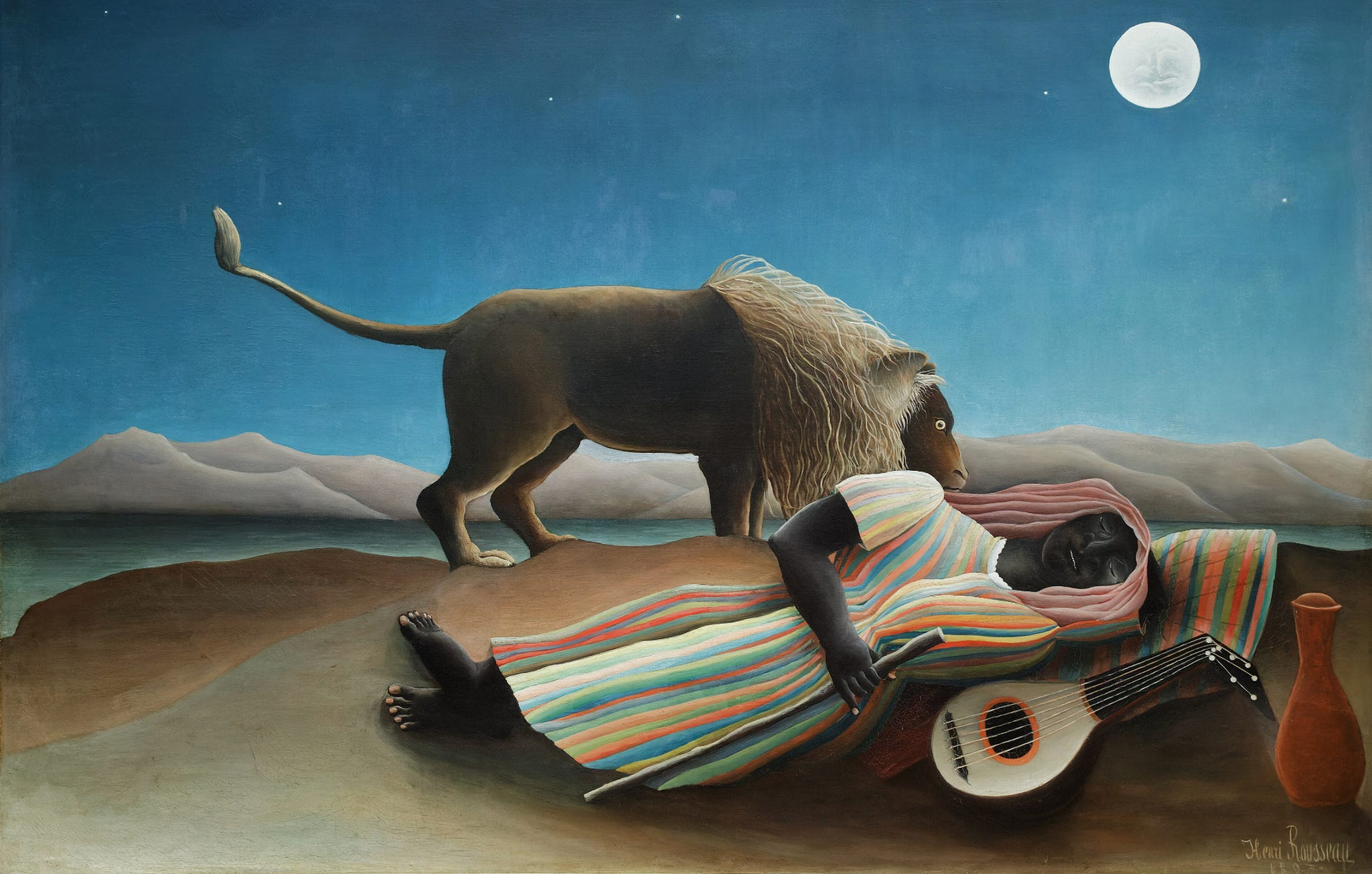
The first time I saw Henri Rousseau’s The Sleeping Gypsy at the Museum of Modern Art I was struck by a deep sense of familiarity. I knew that painting. But I’d never seen it in the museum before, so how was that possible? I eventually figured out that one of the kids in my neighborhood had had a Sleeping Gypsy belt buckle. So that explained the sense that I’d seen it before—but beyond that, the painting resonated with me.
Despite growing up in Queens, I spent very little time at museums. When we went into the city (which is how we referred to Manhattan), it was almost always to see shows. I visited MOMA when I was already in college. By then, I understood literature—I had a deep sense of how language and narrative worked and why they resonated with me. My reaction to The Sleeping Gypsy was new and I had no tools and no context within which to understand it.
On a canvas measuring 51 x 79 inches, Rousseau had created a world I wanted to walk into and lose myself in, a world as complex and beckoning as many of those created within the novels I loved. It felt, on the one hand, that a new way of looking at the world had been opened to me and, on the other, it was inarticulable. I was woefully uneducated and I didn’t have the vocabulary. A friend of mine at Tufts was an art history major and I mentioned this to her. “I know what I like,” I said, “but I don’t know why I like it.” Why did that scene, those colors, that sky, and the preternaturally calm river winding in the background move me as it did?
For my birthday that year she gave me a monograph of Rousseau’s work which she inscribed this way:
“Start with what you love.”
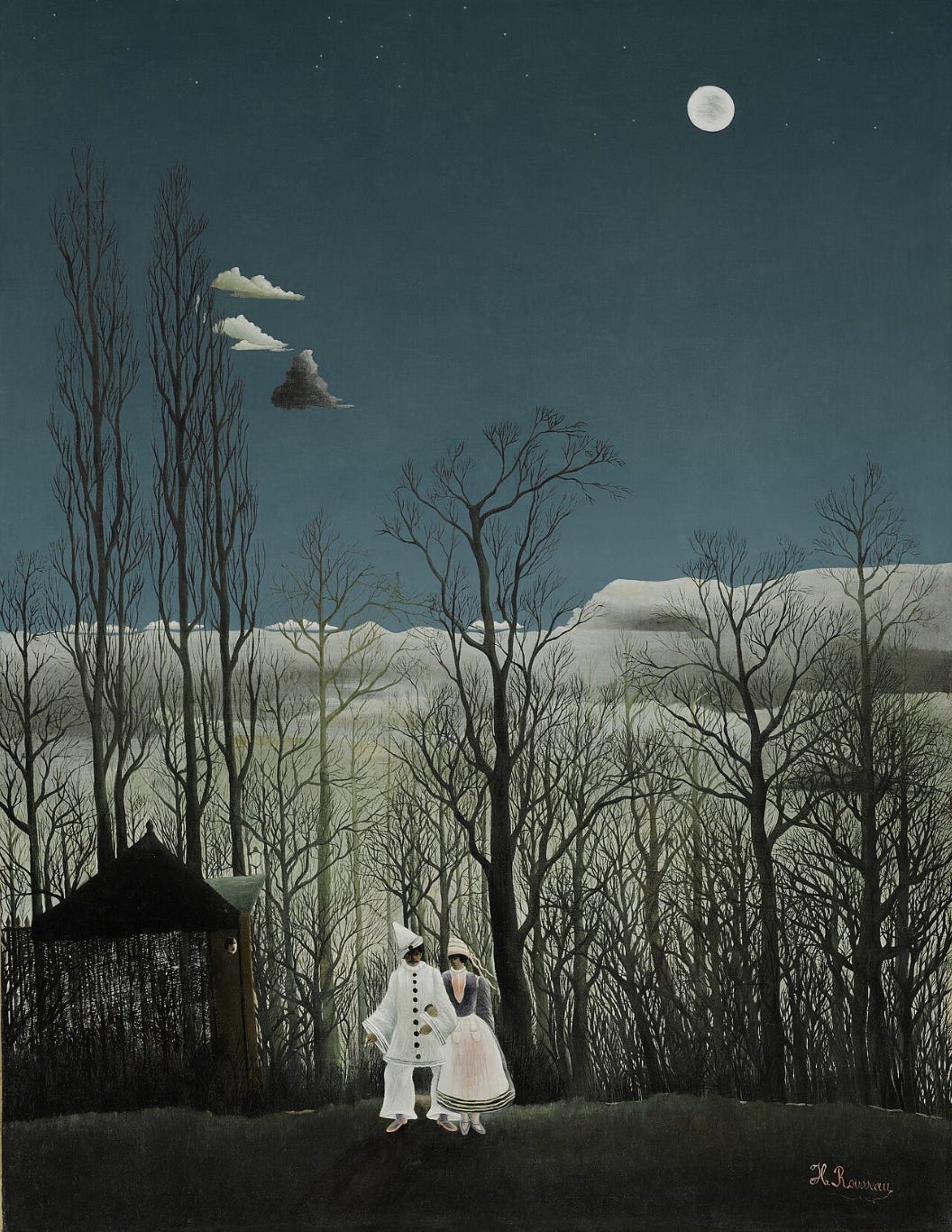
Eventually, what I ended up loving more than anything else was the art of late fifteenth century Tuscany (especially Florence), but, as with literature, I remained open to (almost) everything. And even though I can’t say Rousseau is among my favorite painters, a handful of his paintings remain among my favorite works. So, when I found out there was a Rousseau exhibit at the Barnes Foundation in Philadelphia—including The Sleeping Gypsy on loan from MOMA—I did something I rarely do: I decided to get tickets and go see it on Friday. It didn’t take long to get through and I was struck, as always, by the uneven quality of Rousseau’s work—the fact that I loved some of his paintings so much, and others not at all.
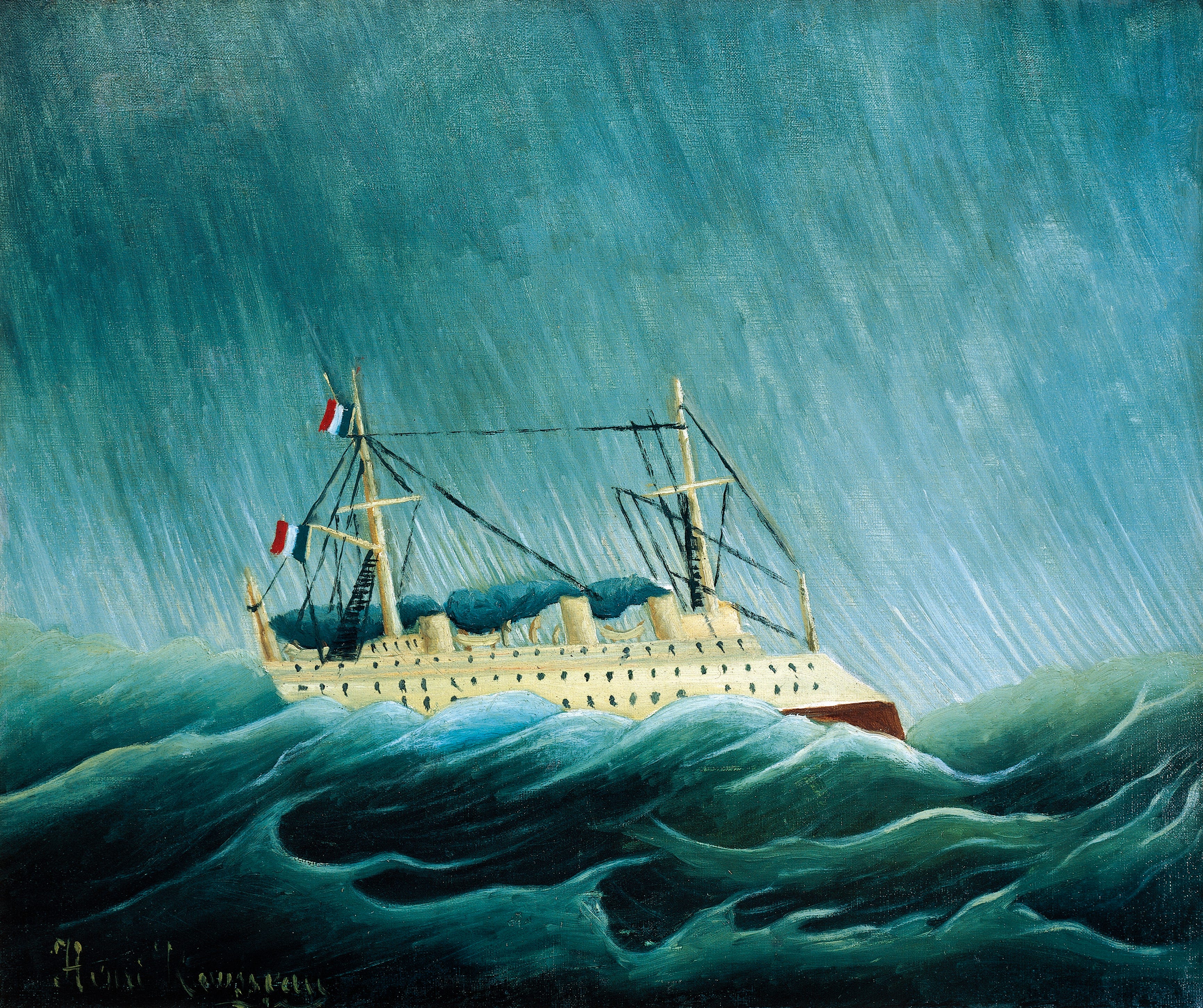
The exhibit included all my favorite pieces, though, including A Carnival Evening (1886), The Football Players (1908), and The Storm-Tossed Vessel (1899). The Sleeping Gypsy (1897) was in the last room, and as I stood in front of it, I felt like I’d come home to something I’d forgotten I missed. I could have looked at it all day. When Rousseau showed his greatest work at the 13th Salon des Indépendants, it was called “childish” and “uneducated;” it was universally mocked. Which just goes to show you, sometimes standing outside of accepted norms to come to an essential truth is the best way to approach art—and the world.
After we left the Barnes, we had a couple of hours before the train left for New York. It was a gloomy day—in the low forties with the threat of rain—and we found a pub. After lunch, we ordered a pint and sat by the fireplace to get some work done. It was cozy and comfortable and exactly what I needed to remind myself that I’ve been forgetting the simple pleasures, and how important it is to hang onto them, especially now.

I love how you trace the moment art first claimed you, not through expertise but recognition. Sometimes the things we meet by accident end up shaping our entire way of seeing.
This is a perfect Sunday evening nightcap. I'm not familiar with Rousseau's work so this is a great introduction. Thank you.