

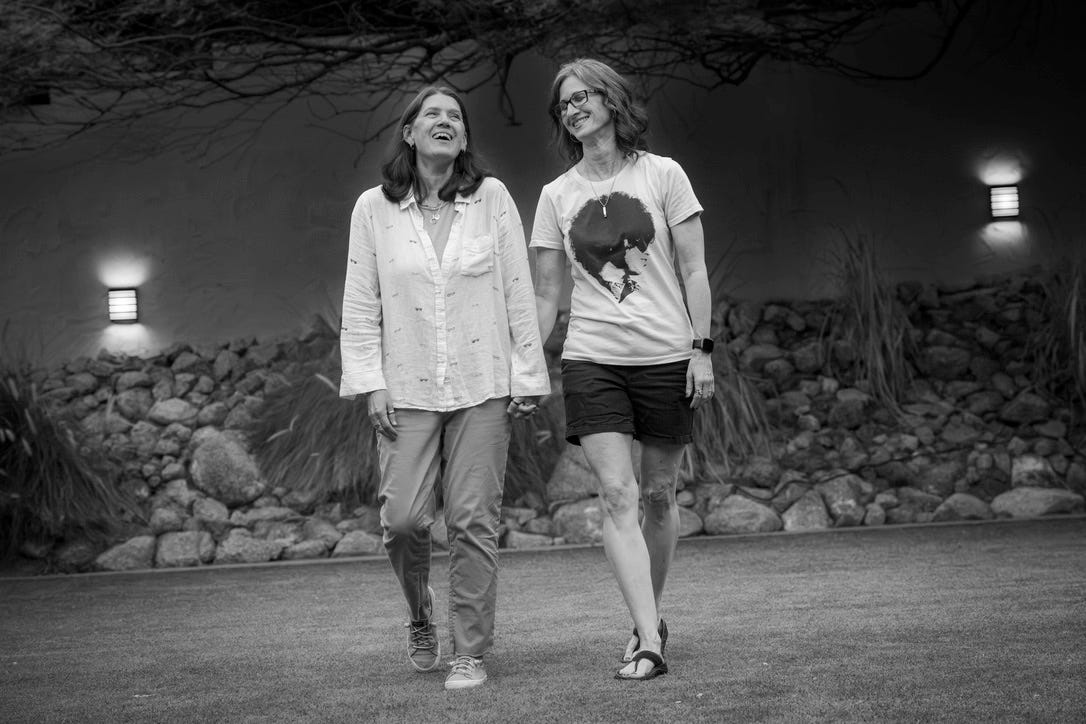
At the beginning of last year, I had every reason to believe that 2025 was going to be worse than anything we saw during Donald’s first administration. I had no reason to believe it would also be the best year of my life. That came out of nowhere. The change in my fortunes came at the beginning of a last-ditch attempt to stop the long, slow slide into despair that I’d been experiencing for about three years. In the wake of the publication of my first book, I seemed to find my footing. I did a lot of media in the lead up to the 2020 election and then in the wake of January 6; I wrote another book; started The Good in Us; and launched a podcast. The truth is, though, I didn’t really know what I was doing and nothing I did do felt like it was in my wheelhouse.
Despite the fact that I knew more people and had more friends than I’d ever had, I became increasingly isolated. I lost out on incredible opportunities—concerts and plays I’d bought tickets for but couldn’t bring myself to attend; invitations to meet fascinating people I almost always rejected. On rare occasions I would attend an event for work, but I backed out of most of those, too. I became too anxious and self-conscious even to be among friends most of the time.
My friends Amy and Nils had been asking me to come out to visit them in Arizona for months—to take a break, change the scenery—but even getting on a plane seemed beyond me. After the 2024 election, though, all bets were off. I got a ticket and planned to leave at the beginning of December. Two days before I was supposed to leave, I broke two of my toes after walking into a piece of exercise equipment I’d just moved. I canceled the trip and the downward slide became something of a tailspin.
From then on, I was driven by a sense of desperation. I rescheduled my trip and flew out to Arizona on January 17, three days before Donald’s second inauguration, not because I necessarily thought I could get better, but because I didn’t want to keep getting worse. I knew if I didn’t do something drastic—leave my apartment (something I rarely did at the time); stay with friends, one of whom I’d only met in person once and the other I’d never met in person at all; go to Arizona for an unspecified amount of time—I was risking everything.
Over the course of the next six weeks—which ended up being the length of my stay—I stayed in a casita on Amy and Nils’ property and, in the process of putting myself back together, two extraordinary things happened. First, Amy and Nils took care of me in a way I’d never been cared for.
They seemed to know, even when I did not, when to give me space and when I needed company. They nurtured me, and included me, and shared their lives and their home and their dogs, Pete and Rose, with me. I had never known two people so grounded and down-to-earth; so generous with their time and resources; so understanding and intuitive. They lived in a way that inspired me—with generosity of spirit and a deep understanding of what really matters. They faced challenges with an honesty and a resolve that freed me up to do the same. They saw something in me I couldn’t see, which humbled me.
And because of all of that, the second extraordinary thing became possible. Three days after my arrival, on the morning of the Inauguration, I received an email from Ronda Cress. I recognized her name because we had met twice--once in December 2022 at a fundraiser I hosted and then again in September 2024 at Politics and Prose in D.C. for a discussion of my third book.
We had been sporadically in touch via email during that time as well, so it wasn’t odd to hear from her. The contents of her email, however, were not at all what I would have expected. After acknowledging that great change was upon us in the form of Donald’s second term, Ronda wrote that she was stepping outside of her comfort zone to let me know that she was interested in getting to know me. There was nothing inappropriate or alarming about her letter—it was well-crafted and eloquent--but it made me feel defensive, mostly because I didn’t understand why anybody would be interested in me at all.
Later that day, I went over to Amy and Nils’ house and asked them to read Ronda’s email. I wanted to know what they thought, I said, but really, I wanted to have my feelings validated. Nils read it first and said he understood where I was coming from. And then it was Amy’s turn. We were standing at the island in their kitchen and when she finished reading, she looked at me over her glasses. She put my phone down firmly on the counter, crossed her arms, and said, in her still-thick New Jersey accent, “Are you out of your fucking mind? This letter is incredible and it deserves a response.”
And she was right—it did deserve a response. It took me a week, but I finally sent Ronda a short placeholder email, thanking her for writing and acknowledging that writing me that letter took a lot of courage. I would write at greater length when I had a chance. A couple of hours later it occurred to me that I had no idea what to say so I texted and suggested we schedule a phone call.
We spoke that night—for four and a half hours. Four nights later, we spoke for another six hours. Not long after that, we talked on the phone every day for an average of three hours until we finally met in person in March when I visited her in Washington D.C. where she was an attorney for the Disability Rights Section of the Civil Rights Division of the Department of Justice. By then, I knew—that I was deeply in love, and that, against all of the odds, I had found the perfect person for me.
And we both knew that a lot of uncertainty lie ahead. Being at Donald’s DOJ—even in the Disability Rights Section—was becoming increasingly untenable under the new leadership. When Harmeet Dhillon’s tenure as Assistant AG of the Civil Rights Division began, the situation deteriorated rapidly. Career professionals who had dedicated their lives to protecting the rights of the American people were being indiscriminately reassigned, demoted, or forced out. It became clear that Ronda would not be able to stay and she resigned in May and moved to New York.
One thing we have both learned, is that it’s never too late. Ronda had been a civil servant in Ohio for over 20 years before landing her dream job at the DOJ. I was 55 years old when my first book came out and, it’s safe to say that my life now has almost nothing in common to the life I had before that. Both of those massive and consequential changes led us to each other. It is never too late to find a new career or change the course of your life or find extraordinary love. Now my life is rewarding and full of love and absolute joy in ways it never has been.
At our wedding in Arizona and the wedding celebration we held in New York a month later, we realized we were surrounded by friends and family who, to a person, not only made our lives better, but also made us want to be better people. While the two of us are still finding the best way to be of use in these very trying and uncertain times, we are buoyed up by all of the love and support that surrounds us.
While Ronda was still at the DOJ, we were very careful to keep our relationship private because of my very vindictive uncle and, especially while she was deciding if she could stay at DOJ, I didn’t want to risk exposing her to his retribution. After Ronda resigned, it didn’t seem necessary to go public, especially while she was figuring out her next steps.
Ronda has dedicated her entire life to helping other people and she’s discovered a new way to do that. Recently, she started a Substack called The Little Girl with the Big Voice which aims to help people find and use their voices at a time when they are most needed.
You can check out her Substack here:
Remember, it is never too late, for any of us.

Thank you, Mary, for sharing this with us. I am so happy that you found your way out of the darkness and discovered love at the same time! You and your wife deserve all the best in your lives together. Blessings on you both.
Mary, I'm crying with happiness for you both.