

Is the Trump regime trying to kill all of us by making prescription drugs unaffordable? Well, according to Donald’s arithmetic, the answer is yes, it is. Welcome to this week’s installation of The Art of the Scam, where we follow the gobsmacking grift being perpetrated by Donald and his coconspirators.
On September 18, 2026, Donald announced major agreements with 26 of the biggest pharmaceutical companies, claiming Americans would receive drug discounts of 60, 70, 80, and even 90 percent. But, of course, he had been making even bigger claims for months. At times, he said he would lower prescription drug prices by hundreds of percentage points. That would essentially mean we would get the drugs for free and the pharmaceutical companies would have to pay us.
On July 8, aboard Air Force One at RAF Mildenhall in the United Kingdom, Donald told reporters just how much he claimed Americans were saving.
Donald: So we got it down, and it’s a great question because that should have a huge impact on healthcare because prescription drugs is a big price, but prescription drugs have come down 400 to 500 to 600 percent under Trump, and that alone should win us the midterms. And the Democrats will terminate it and try and blame somebody else like us, as I call it, the Democrats. Democrat.
Wow. My brain just short circuited. Oh, that must be because I’m a Democrat without a B, I’ll have you know. There he is, claiming he has lowered prescription drug prices by 400, 500, even 600 percent, which, again, is arithmetically impossible. I also love it when he refers to himself in the third person.
But here’s what’s really going on. On September 24, the Kaiser Family Foundation compared 32 brand name drugs available through TrumpRx with publicly listed prices in 11 other wealthy countries. Seventeen of these drugs were cheaper than the international average, but 15 were more expensive. Thirteen of those drugs cost more through TrumpRx than in every other country with comparable data, and nine cost at least twice the international average. That’s a lot, especially when TrumpRx, which shouldn’t be named after anybody because it is the government’s service, is actually costing Americans more money for many of the medications they need.
Let’s take Enbrel, for example. Enbrel is used to treat rheumatoid arthritis and other autoimmune conditions, which means that it’s a very important drug treating very serious conditions. TrumpRx listed it for $3,354, which is unaffordable to the vast majority of people who need it. The average price of Enbrel in other countries that the Kaiser Family Foundation examined was $641. That is 80 percent less than that drug costs in this country, thanks to Donald.
Now, redactions have become something of a metaphor for the Trump regime. He makes enormous promises in public, which he has no intention of keeping. The details are completely blacked out. Donald’s claims of historic drug savings are no exception here. Americans still can’t see exactly what he negotiated, and that’s intentional because he doesn’t want us to.
On September 19, roughly 120 pages of the Trump regime’s agreements with Pfizer and Eli Lilly were obtained through Freedom of Information Act litigation. They’re heavily redacted, hiding negotiated prices, financial terms, and other provisions. What is visible shows that the companies received protection from Donald’s threatened pharmaceutical tariffs. Some agreements can also exempt manufacturers from federal drug pricing programs, while the regime committed to using trade policy to push other countries toward paying higher drug prices.
The Pfizer agreement also allows some TrumpRx prices to increase annually under certain circumstances, but the conditions are redacted. And again, that is intentional because I think it’s worth hypothesizing that Donald is gaining some advantage by doing the pharmaceutical companies a solid.
So while Donald claims prescription drug prices have fallen dramatically, Americans still can’t see much of the information needed to determine what they’re actually saving, if anything at all. We also don’t have any insight into what pharmaceutical companies received in return for making a deal with the Trump regime or how long any of those savings, to the extent that there are any, will last.
The Pfizer and Eli Lilly agreements currently run through January 20, 2029. That is Donald’s final day in office, and I’m sure that’s a coincidence.
On September 23, Senate Democrats again demanded that the agreements covering more than two dozen drug makers be revealed. Robert Kennedy, unfortunately Secretary of Health and Human Services, told senators in April those agreements would be released except for proprietary information and trade secrets. Lawmakers say they still haven’t received them.
When Kennedy was sworn in at HHS on February 13, 2025, he promised to end what he called the corruption and corporate capture of America’s health agency. Well, when it comes to Kennedy’s own MAHA movement, that’s the ridiculous and inaptly named Make America Healthy Again movement, I suggest that follow the money is good advice.
Also on September 23, The New York Times reported that Kennedy’s latest financial disclosure shows he received $4 million in book advances over the previous year from Skyhorse Publishing, owned by his longtime publisher, Tony Lyons. Kennedy’s wife, Cheryl Hines, also received $210,000 in consulting fees from MAHA Action, an organization led by Lyons. And considering she’s an actor, I’m sure she’s very well qualified to be consulting on anything having to do with Americans’ health.
Lyons also runs the so called MAHA Center. Bloomberg reported that it was soliciting corporate sponsorships for its September 29 summit in Washington. Packages reportedly reached $300,000 and included a speaking slot with meaningful input on the panel composition and topic. The package also reportedly included a private dinner with Kennedy and Centers for Medicare and Medicaid Services Administrator Dr. Mehmet Oz, which sounds to me like one of my worst nightmares come true.
One announced participant is Grail CEO Josh Ofman. His company is seeking FDA approval for its Galleri multicancer blood test, which an FDA advisory committee considered on September 23, just six days before the summit. HHS says Kennedy, Oz, and other officials weren’t involved in soliciting the sponsorships and didn’t know about the arrangements, which I do not believe because they have no credibility whatsoever. Prove it, I say.
Kennedy has also disclosed the book advances, and HHS says he complies with applicable ethics requirements. Well, maybe we need better ethics requirements. No government official, whether elected or appointed, should be able to make outside money during his or her tenure because that leads to serious conflicts of interest.
Kennedy disclosed roughly $275,000 in housing and airfare from longtime friend and political supporter Gavin de Becker. De Becker says the gifts reflect their longstanding friendship. I’m sorry, I can’t believe it. Longstanding friendship? That sounds familiar because, remember, Donny’s Russian oligarch buddy just threw hundreds of thousands of dollars at him for his wedding because he thinks Donny is such a great guy. It has nothing whatsoever to do with Donny’s access to the President of the United States.
So the promise of future savings is a sales pitch that runs rampant throughout the Trump regime. Pay more now, trust us, and the savings will come later. That’s sort of how they’re treating the economy. Yeah, it’s bad now, but that’s all Biden’s fault. We promise you it’s going to be so much better in two years if you can survive.
As I mentioned earlier, Mehmet Oz now runs the Centers for Medicare and Medicaid Services, which oversee programs that provide health coverage to roughly 160 million Americans. That’s almost half of us. The agency recently canceled approximately 315,000 Affordable Care Act enrollments covering more than 760,000 people that CMS says were unauthorized.
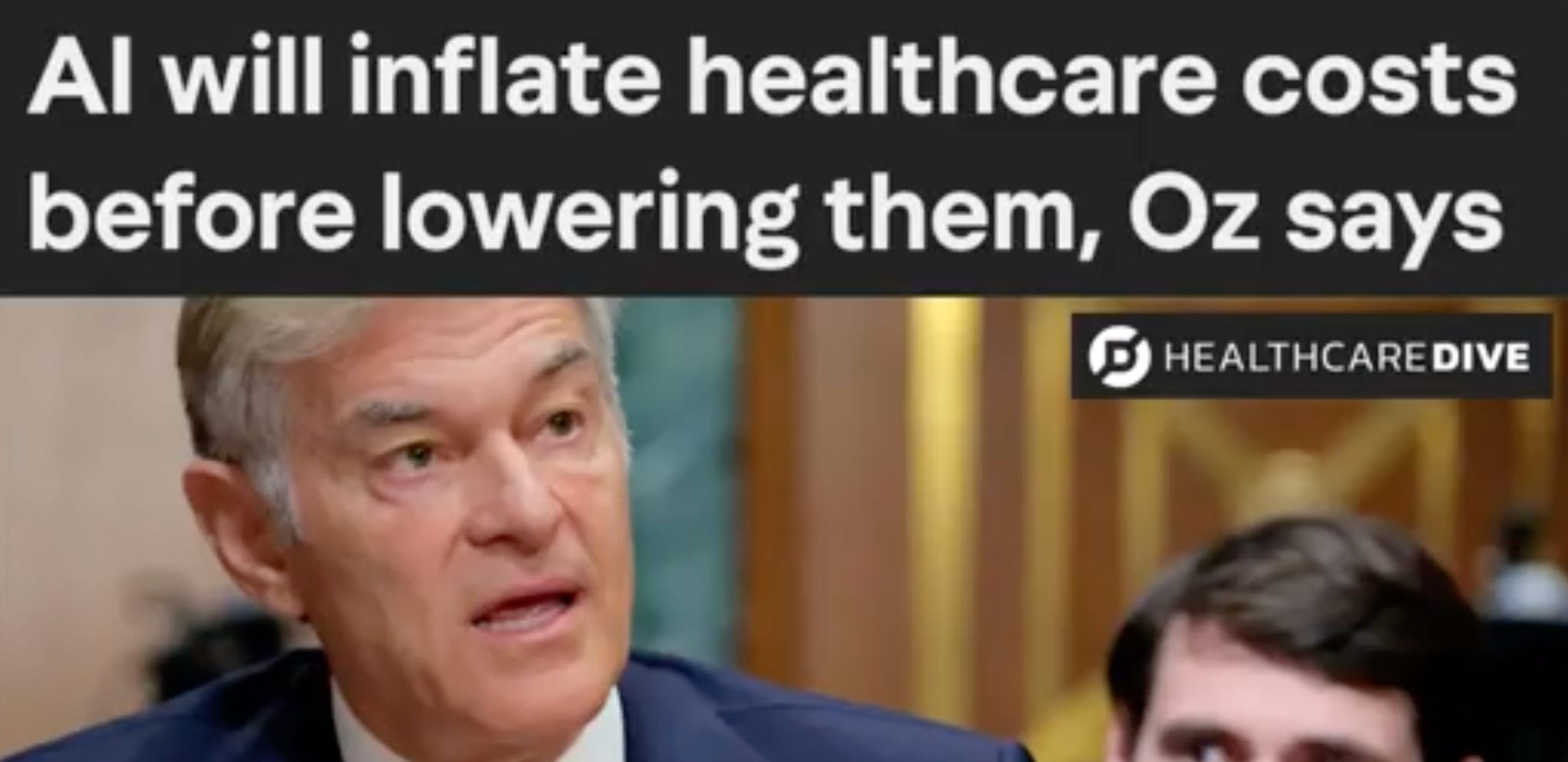
At Oracle’s Health and Life Sciences Summit in Orlando on September 23, Oz acknowledged that AI could drive healthcare costs higher in the short term while arguing that the long term effect would be just the opposite because, of course, he did.
This is what Oz said:
Well, short term AI is going to be inflationary because it’s going to turbocharge the ability of the current billing systems to work more effectively. You can up code, you’re not going to miss any diagnoses. You’re going to see doctors be able to take care of more people, so there are going to be more CPT codes generated. That’s why we are so rapidly rushing towards the accountable care element of this game.
Okay. Tell me absolutely nothing by saying a lot of words because I didn’t understand anything that man just said.
Oz is also using AI to hunt for fraud in American healthcare. How about just stick to your job and help Americans be healthy or get better when they’re sick? Get them treatment instead of canceling their Affordable Care Act coverage. It is highly unlikely that such a significant percentage of people, 760,000 people, were improperly or fraudulently enrolled in that program.
At the same Oracle summit on September 23, Oz explained how AI could help him catch what he called the bad guys.
OZ: But if I can give everyone a little confidence, one of the first things we do when we think you’re stealing from Medicaid is... My thought process, if you’re stealing from the poor, you probably won’t pay your taxes. So we like to give their information to the IRS because that’s actually a much easier way to catch people. But my goal is just to chase the bad guys to some other sector of the U.S. economy, and AI will help us do that.
I have a great place for you to start. You want to chase the bad guys who are stealing money from the poor? You could start with Senator Rick Scott, who committed Medicaid fraud to the tune of hundreds of millions of dollars and got away with it and got elected to the Senate. How about Donald? How about Kennedy? How about you, Oz? You quack.
There’s already a warning about what happens when algorithms become involved in healthcare coverage decisions. UnitedHealth is facing an ongoing lawsuit alleging that its nH Predict algorithm was used to deny Medicare Advantage patients post acute care. Now, of course, UnitedHealth disputes that allegation, but why should we believe them?
Right now, American healthcare is in shambles because charlatans and conspiracists are in charge of everything, as are people who see it as their mission in life to scam as much money out of the American people as humanly possible, even if, or perhaps especially if, it makes us all sicker.

Thank you Mary. It’s always the Scam. There’s not a one in this regime that aren’t a grifter or con…
Dr. Mehmet Oz has been under intense public and political scrutiny regarding his personal business "sideline deals" and potential conflicts of interest.
As head of CMS, Dr. Oz oversees a $1.5 to $1.7 trillion federal budget that influences private insurance, pharmaceutical companies, and digital health tech. The primary business deals, holdings, and related ethics controversies involving Dr. Oz during his tenure include:
* ZorroRX: A health benefits company co-founded by Dr. Oz and his son, Oliver Oz. The company functions as a telemedicine intermediary utilizing the federal 340B Drug Pricing Program. Healthcare experts flagged this as a direct conflict of interest, given that CMS heavily influences the regulation of federal prescription drug programs.
* Sharecare & CareLinx: Disclosures revealed Oz previously held up to a $26 million stake in Sharecare, a digital health company he co-founded. Sharecare operates CareLinx—an in-home care program heavily utilized as a supplemental benefit by Medicare Advantage enrollees.
* Private Health Insurers: Oz previously held up to $600,000 in UnitedHealth Group stock, alongside investments in CVS Health and Cigna. Because Dr. Oz heavily advocates for “expanding private Medicare Advantage plans” (and previously co-authored a proposal for "Medicare Advantage for All"), lawmakers have routinely questioned whether his policies inherently favor his former investment network.
* Pharmaceutical and Tech Giants: His portfolio historically featured substantial stakes in tech firms like Nvidia (up to $5 million) that build AI software for hospitals, alongside drug manufacturers like AbbVie.
Before taking office, Dr. Oz's financial disclosures revealed a personal net worth between $98 million and $332 million, heavily driven by media earnings and investments in health sectors regulated by his own agency. To secure his confirmation, he did sign a federal ethics pledge promising to divest from over 70 conflicting companies and health-related funds within 90 days of taking office and resign from paid advisory roles and corporate board seats (such as with the health retailer iHerb). Also, his intentions of recusing himself from policy matters directly impacting his former personal financial interests until divestment was finalized.
When he was first elected, one of my friends said “He’s going to get us all killed.”
Little did we know he’d have a second term. Her words were prescient.