


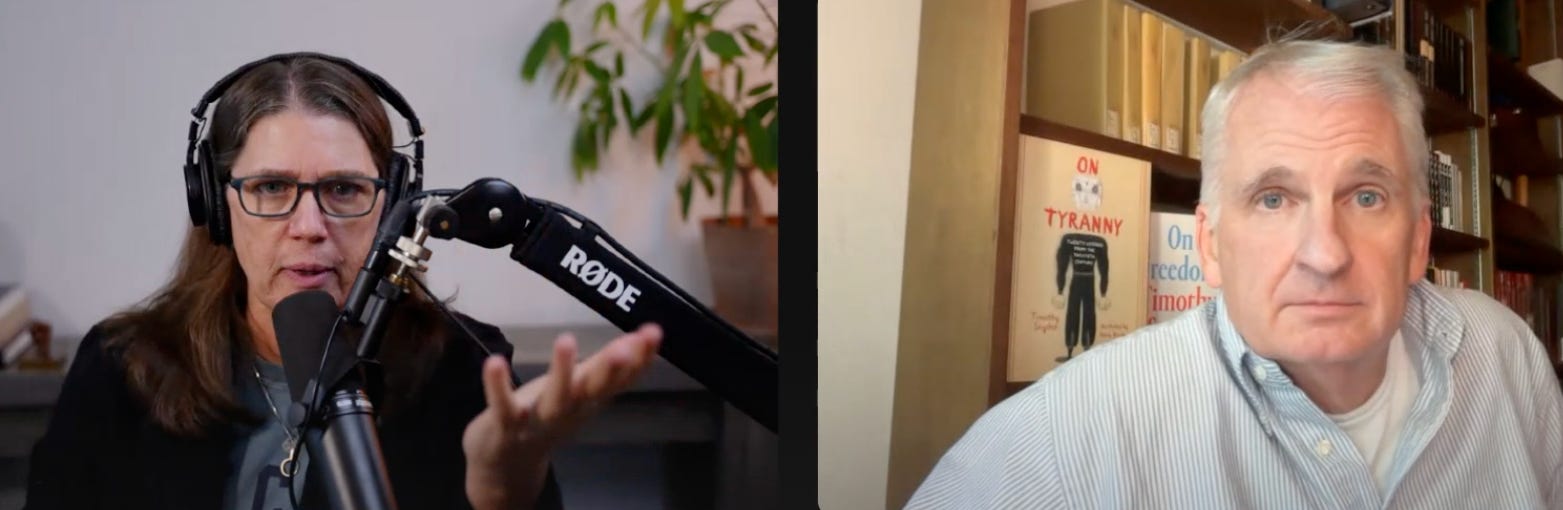
Watch the entire interview here:
[Transcript edited for clarity, flow and length]
Mary Trump: Timothy Snyder, it is wonderful finally to be able to speak with you. First, I want to make sure everyone knows about your Substack, Thinking About, which has become an invaluable resource for me and many others. You recently posted a series called the Kharkiv Meditations, recorded during your latest trip to that border city in Ukraine. I found the ten meditations heartening, sobering, and hopeful. One thing I appreciate about your work, particularly this series, is your willingness to discuss morality, belief, hope, and even joy. Could you talk us through your trip and some of these meditations?
Timothy Snyder: I’m very happy to be here and looking forward to the conversation. I go to Ukraine because I’m a scholar of Ukraine, I have major projects there, and I have friends to see, both at the front and elsewhere. I go because I’m doing my job. I don’t mean that as a dig, because many people in this administration, and in the United States generally, ought to be going to Ukraine but aren’t, even though it is their job.
We have an enormous amount to learn about modern warfare, even from a narrow national security perspective, and we’re failing to learn it. Beyond that, there are deeper political and moral lessons to be learned from people facing extraordinarily challenging circumstances who nevertheless show up and do what needs to be done.
I was helping run a major history conference and took a few days to visit Kharkiv, a city extremely close to the Russian border. It is literally a frontline city, where the Russian advance was stopped and turned back. You can observe the front relatively easily and visit people defending it.
When you’re in Ukraine, you respect the air raid sirens, and you have time to yourself at night to think. That’s why I wrote the meditations. When you’re on the edge, you sometimes think better. You think differently when you’re sleepless or surrounded by people taking risks. Those circumstances came together and gave me the opportunity to write them.
Mary Trump: Russia’s illegal invasion of Ukraine has been heartbreaking to witness. Saying the Biden administration’s response was woefully deficient is an understatement. Ukraine’s history and willingness to confront this hostile foreign power are humbling, but they also expose the deficiencies in our own response to aggression against Ukraine.
The first book of yours I read was Bloodlands: Europe Between Hitler and Stalin. It was extraordinarily difficult to read. We’re still dealing with the fallout from those horrors, yet the American government seems unwilling to recognize that this war against the Ukrainian people and their sovereignty is also a war against the Western democratic alliance. Ukraine isn’t just fighting for its own future. It’s fighting for all of us.
The Trump regime’s response has been abhorrent, and I don’t know whether we can even call ourselves Ukraine’s ally anymore. Yet Ukrainians continue to demonstrate an extraordinarily hopeful vision for the future. Their courage is remarkable.
You’ve described meditating on small acts of courage, moral language, doing one good thing, and the richness of language itself while you were in a war zone. What has your experience as a historian and your time with the Ukrainian people taught you about the possibility of hope during such dark times?
Timothy Snyder: You can’t resist the worst without thinking about the best. You can’t oppose the other side’s bad ideas without having good ideas of your own, and you can’t do anything by yourself.
There are two questions here: why Ukraine matters and what we can learn from Ukrainians. Ukraine has repeatedly been central to world history, including both world wars and events going back hundreds or thousands of years. As a historian of the region, I continue to discover things that astonish me about its importance.
This war has lasted longer than the First World War and longer than the Second World War as the Russians count it. The casualties are immense. It is the defining modern war of the twenty first century, with two advanced sides using increasingly sophisticated technology.
The stakes extend beyond Ukrainian dignity, freedom, and sovereignty. They concern fundamental principles. Is it acceptable for one country to invade another, kidnap children, rape women, and murder civil society activists? Or are we in a world where such things can and should be resisted? That is an enormous question.
I was able to visit Kharkiv because friends drove me there, because I had friends at the front who invited me, and because organizations are doing the work that makes these visits possible. One positive lesson is the power of civil society.
By civil society, I simply mean groups outside government where people work together toward shared goals. For 25 years, Ukraine has repeatedly demonstrated that people organizing together can make the difference, whether they’re defending democracy, fighting corruption, or resisting a foreign invasion.
That matters because we often think about politics as one election after another. In between, we feel alone and imagine that voting is the most we can do. That approach benefits authoritarians and aspiring tyrants like Donald Trump. We need to organize before and after elections, not just to win, but to ensure that victories hold and lead to meaningful change.
This kind of politics also feels better. When I’m in Ukraine, I’m often in a better mood because I’m surrounded by people who are more courageous and better organized than I am. That’s a useful rule everywhere: find people who are more courageous and organized than you are, then join them. If we follow that lead, I think things can turn out all right.
Mary Trump: That resonates with those of us watching the degradation of this country. This isn’t simply about winning an election. It’s about making the victory count. We can’t just promise to restore what existed before. We need to do something qualitatively different.
The system, as it currently exists and has been exploited, is designed to prevent fundamental structural change, even when Democrats hold power. Division and isolation are part of that process.
You describe fascism as a mechanism for denying reason, and you argue that resisting it means refusing to surrender to cynicism and scorn. You’ve also spoken about preventing our opponents from stealing our joy.
I appreciate that you talk about optimism, hope, and joy. Without a positive vision for the future, we risk repeating the past and ending up somewhere even worse. If winning is all we’re fighting for, what are we fighting for?
You’ve also written about the effort to convince people that government itself is the problem. Ronald Reagan famously promoted that idea, encouraging people to see government as a hostile force. What’s the antidote to that argument, which has been so successful on the American right?
Timothy Snyder: I want to return to what you said about the system. The U.S. system is designed in many ways to slow radical change, but we’ve added things the Constitution did not foresee that make matters worse. One is money in politics.
The founders weren’t anticipating super PACs. The idea that a Supreme Court calling itself originalist could imagine super PACs into existence and claim they are consistent with the founders is absurd.
If we want to unleash our imagination, we must constrain money in politics. We need to figure out how to do that. Money in politics doesn’t accelerate progress. It accelerates self destruction. It prevents effective policy because it gives donors’ interests and eccentric worldviews disproportionate influence, preventing government from functioning.
We need to imagine how to get money out of politics after the Democrats win this election, which I expect them to do.
My book On Freedom addresses the broader question of government and freedom. Americans are right to care about freedom, but we’ve come to understand it incorrectly. We think freedom means having nothing stand in our way, and from there it’s easy to conclude that government must be bad because it creates obstacles.
But freedom isn’t simply about removing obstacles. It’s about what we could do if those obstacles weren’t there. It’s about the person we want to become and the good things we can bring into the world.
Freedom is a cooperative project. It isn’t just about being angry with government. It’s about forming a government that creates the conditions for people to become their best selves and bring good things into reality.
You can’t have freedom without government. You can’t have decency, dignity, prosperity, or health in a modern society of hundreds of millions of people without a functional government organized around what would benefit people.
We have to win that argument, but we also need to demonstrate what government can accomplish. Democrats could pass legislation showing that people don’t have to carry college debt or that everyone can have access to health care. Even if the president vetoes those laws, they would help people remember what government can do and imagine a better future.
Politicians also need to talk about how much better life could be. I don’t mean returning to the status quo. We could live longer, work less, send our children to better schools at lower cost, suffer less from disease, and live happier lives. If we don’t make the effort to imagine these possibilities, we can’t expect politicians to promise them or pursue what is possible.
Mary Trump: As you say, this is about remaking things, not simply repurposing them or going back to the way they were.
There are two conditions that make this moment different. First, our time to change the world for the better is limited by the climate crisis, which the people currently in power are hastening and exacerbating.
Second, wealth is increasingly concentrated in fewer hands. Unlike in previous eras, the amount of money people can accumulate is essentially unlimited, putting tech bro oligarchs beyond the realm of ordinary human experience.
How do we confront that? Their argument seems nihilistic and antithetical to the changes you and I, along with many others, believe are necessary.
Timothy Snyder: Climate change and the tech bros are deeply connected. Data centers can worsen climate change, but the connection goes further. Both involve unsustainable extraction.
If we continue extracting coal, natural gas, and oil, we risk bringing our species to an end or leaving fewer people alive in unimaginably humiliating circumstances. The tech industry is also extractive. It treats our brains as targets for manipulation and profit, seeking to make us more obedient, less intelligent, and more predictable. Our increasingly limited wealth then flows into the hands of a very small number of people. Sadly, that is happening already.
Our limited time is part of the problem, but it can also be part of the solution because these companies can be regulated. Canada does it, although it could do more. The European Union does it, too.
I also think we should pursue a policy of billionaire export. We have more than enough billionaires. There’s an American fiction that we must keep them because they pay taxes. They often don’t. Their tax avoidance means everyone else pays more, while their activities are also subsidized by government.
If we want everyone to be richer, we should be willing to let billionaires leave. They regularly threaten to go elsewhere. My response is that they should go. We have plenty, and we can share them with other countries. The funny thing is that many countries don’t actually want them.
The larger point is that wealth concentration can only be addressed through government policy. These people claim government is bad because they don’t want to pay taxes and are competing to accumulate ever more money. But wealthy people can be taxed. The fact that so few people now hold so much wealth strengthens the case for a functional government.
If billionaires move to Argentina or elsewhere, it doesn’t matter if they weren’t paying taxes here anyway. Companies such as Amazon and Facebook have also managed to avoid paying taxes. We need much stronger regulation of these companies and their profits.
The stakes of this election are therefore extremely high. It’s not just about good policy or climate change. It’s also about humanity.
Donald Trump has increasingly become a sock puppet for the tech bros. He’s weak and malleable. Flatter him a little, and he does what you want. If we have two more years of tech bro oligarchy, we’ll have a serious problem. Despite some differences among these people, their general project is to disable government and replace it with something else.
Mary Trump: As you say, they don’t believe in America. They aren’t even libertarians. They’re communists.
I want to end on a positive note, beginning with something you discussed a few months ago: superpower suicide, or attempted suicide. America, and certainly Donald, seems to be checking off all the boxes that could lead to the country’s suicide. These are choices we’ve made. Voters chose to put him back in office. We have problems with succession, ideology, the way he mishandles adversaries and mistreats allies, the destruction of education, and the rejection of science.
But often, the moments when things are most dire also present the greatest opportunities for positive change.
How do you see this country moving forward if Democrats win in November? And, crucially, what must happen if those who return to power understand what’s at stake and seize the opportunity to make this country and the world better?
Timothy Snyder: Those two parts of your question fit together because the important thing isn’t the election itself. It’s the sense of victory and responsibility that comes with it.
Things must already have been broken for Donald Trump to come to power, and he has wrecked an enormous amount with the help of many other people. But the systemic problems and the wreckage aren’t enough to get us to something better. Our choices are now something better or nothing at all.
We can’t simply return to the status quo or look for a middle ground that doesn’t exist. Given the systemic problems and the wreckage, we have no option but to try to build something much better. Anything else is cowardly and doomed to fail.
We must move from electoral victory to confidence in that victory, then to bold declarations and the beginnings of a vision. We need a vision of a country where government works, where people are prosecuted for corruption, where children have better opportunities than their parents, and where we get along with other countries.
But we must proceed step by step. We have to win, recognize that we’ve won, enforce that victory, and accomplish significant things as quickly as possible. Then we have to help people imagine how those achievements can lead to an America that is neither like the past nor the present, but something different and better.
Mary Trump: That also means all of us, as voters and people who care about democracy and this country’s future, must put pressure on those in power and make sure they understand what we require of them.
Timothy Snyder, it has been wonderful to have this opportunity to speak with you. Everyone should check out your Substack, Thinking About. Your interviews and observations are fantastic. Please read all of his books, from Bloodlands to On Tyranny to On Freedom, and everything in between.
This has been such a pleasure. Thank you so much for being here.
Timothy Snyder: I’m glad I could do it. Great to meet you.


This is excellent news👍
I don't know who they think is going to buy their stupid products after they bankrupt the country.