

[Transcript edited for clarity, flow and length]
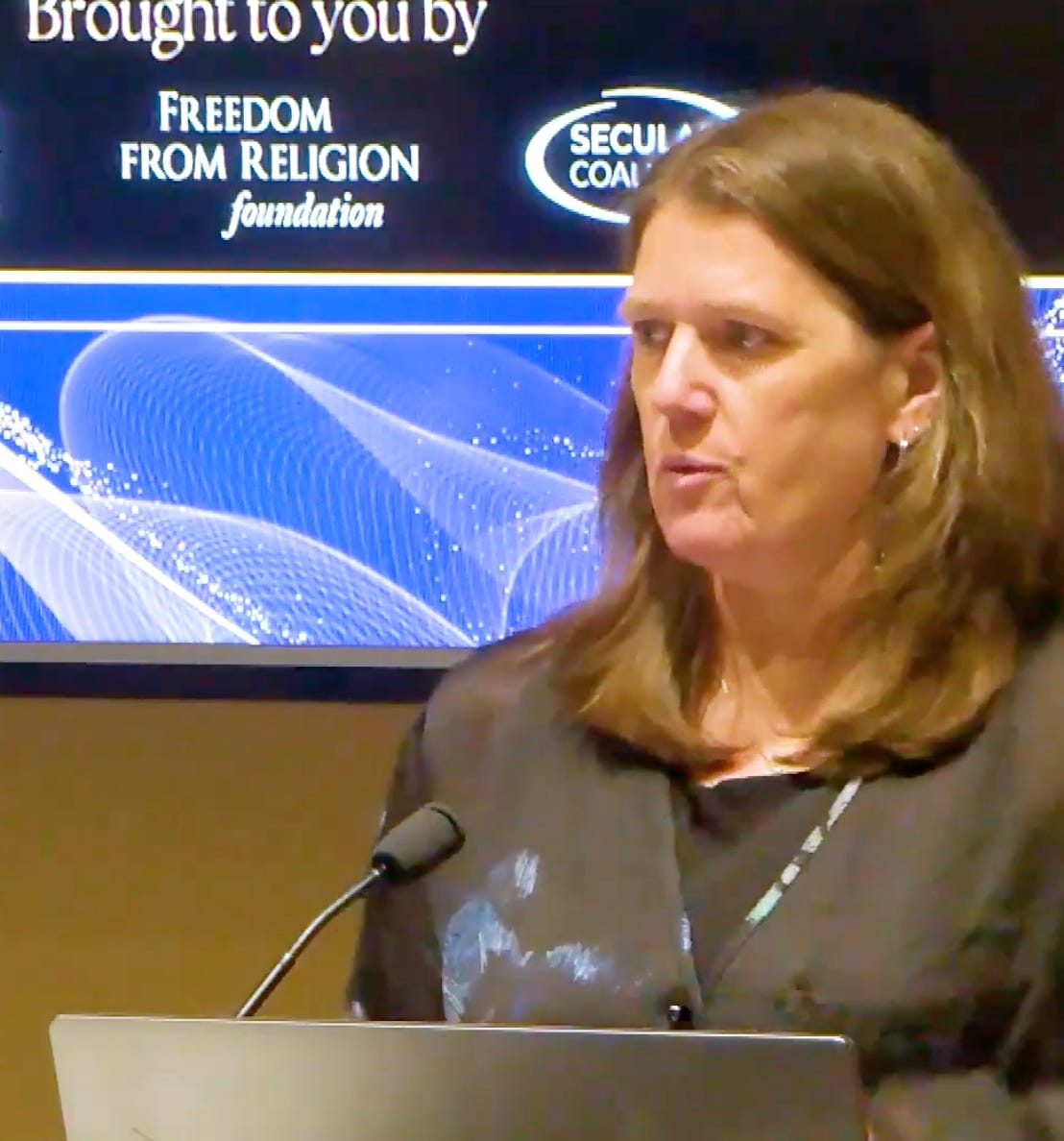
A few weeks ago, I had the great honor of delivering the keynote address at the Reason Reception hosted by the Free Thought Caucus in the House and sponsored by the Freedom From Religion Foundation, the American Humanist Association, and the Secular Coalition for America. It was an extraordinary event, and I was deeply honored to be part of it. I wanted to share a portion of those remarks with you because I think they speak to something much larger than the political moment we currently find ourselves in. They speak to the role reason, democracy, and our shared humanity must play if we are going to find our way through it.
I began with what, admittedly, was an easy joke.
Donald has one about “Two Corinthians.”
Two Corinthians walk into a bar.
That’s the entire joke because he has never read it.
He has not read the Bible. He has not read the Constitution. And, with all due respect, he could never be a member of the Free Thought Caucus. Not simply because he is irreligious, although he certainly is, but because he has no capacity whatsoever for reason.
Once I got that out of the way, I talked about a moment that has stayed with me for years.
Back in 2008, during one of the Democratic primary debates between Hillary Clinton and Barack Obama, one of the moderators asked both candidates to name their favorite Bible verse. I remember immediately feeling my heart sink. When both candidates answered the question without hesitation, I felt even more discouraged because, on the one hand, it felt complicit, and on the other, it represented such a profound missed opportunity.
I have often imagined the answer I wish one of them had given.
What’s my favorite Bible verse? If I have one, how is that remotely relevant to my ability to lead this country?
I would, however, be happy to discuss my favorite constitutional amendment.
That moment has stayed with me because it perfectly illustrates something that has troubled me for much of my life: the cynical misuse of religion as a tool for political gain. It is one thing for faith to guide a person’s private moral life. It is something entirely different when politicians invoke religion as a means of manipulating voters or proving their qualifications for public office. Those are two very different things, and we have spent far too long pretending otherwise.
The truth is, I was actually a very religious child, something that surprises people because it certainly did not come from my family. Looking back, I am still not entirely sure why I feel almost embarrassed admitting that, but I do. What offended me was never religion itself. What offended me was the version of religion practiced by certain members of my family.
My grandfather, Fred Trump, was a devoted follower of Norman Vincent Peale and his proto-prosperity gospel. The Power of Positive Thinking saturated my childhood. It was more than a bestselling book. It became a philosophy that justified every cruel, corrupt, and selfish thing my grandfather ever did.
That is one of the great dangers of prosperity theology.
If you believe you are inherently great, as my grandfather certainly did, and as somebody else we all know believes he is, then you never have to concern yourself with becoming good.
If you believe that your success proves you have been chosen, then kindness, compassion, humility, and integrity become optional. If you believe that your wealth demonstrates divine favor, you stop asking whether you deserve it. You stop questioning the harm you cause other people because, by definition, your success has already become proof of your righteousness.
Putting people in positions of power who believe so completely in their own exceptionalism inevitably leads us somewhere very dark.
Oppression, whether religious or otherwise, is fundamentally incompatible with democracy.
And yet racism, misogyny, and religious bigotry have always been woven into the fabric of this country. I would argue that religious intolerance has often served as the justification for the other two. These forces reinforce one another, creating systems that privilege a select few while diminishing everyone else.
That means we have been traveling down this road for a very long time.
Because of that history, I believe we need to become much better at explaining why allowing religion and government to become intertwined poses such an enormous threat to the American experiment itself. It undermines our freedoms while eroding the democratic principles upon which this country was founded.
People are often surprised when I tell them I was never particularly interested in politics. I always voted because voting mattered deeply to me, but politics itself was never my passion. Quite honestly, I still do not think of politics as my passion today.
Then something happened in 2016.
Suddenly politics became intensely personal.
I want to return to that idea because I believe all of us need to take politics personally now, perhaps more than ever before. But first, it is important to recognize the extraordinary moment we are living through. I often refer to it as “the horrors,” and I understand why so many people feel exhausted, cynical, overwhelmed, and tempted to disengage. Every day seems to bring another assault on reason, another attack on democratic institutions, another example of cruelty masquerading as leadership.
History reminds us, however, that humanity has often made its greatest advances during its darkest moments.
That is not because suffering is noble. It is because crisis forces us to confront truths we have ignored for far too long. Moments like these create opportunities to build something better, but only if we are willing to understand honestly how we arrived here in the first place.
This moment did not appear overnight.
It has been centuries in the making.
If we want to move forward, we have to understand not only what we are fighting, but also the historical, political, cultural, and religious forces that brought us to this point. Without that understanding, we will simply continue treating symptoms while ignoring the disease.
That is why I believe we should view this year and the next election cycle not simply as political contests, but as opportunities to speak to everyone and compete everywhere.
We need candidates, regardless of party, who understand what is at stake, who appreciate what public service actually means, and who are prepared to use the authority entrusted to them to make the kind of fundamental structural changes this country desperately needs.
The goal cannot simply be to win the next election.
The goal must be ensuring we never again place so many people in harm’s way because our institutions proved incapable of protecting us.
That brings me to one of my favorite films, Spotlight, which I have watched more times than I care to admit.
Near the end of the film, Marty Baron, the editor of The Boston Globe, speaks to the investigative team preparing to expose the Catholic Church’s decades-long cover-up of child sexual abuse. The reporters believe they have enough evidence to publish immediately. Baron insists they must do something much harder.
It is not enough, he tells them, to expose individual priests.
They have to expose the system.
That lesson has stayed with me because it applies just as powerfully today.
Much of what we are confronting has become deeply embedded within our institutions. Donald Trump and today’s Republican Party have done many terrible things, but if they have unintentionally done us one favor, it is exposing just how broken so many of our systems truly are.
Of course we must address individual acts of corruption, cruelty, and abuse.
But if we stop there, we will have accomplished very little.
We have to go after the system itself.
Only then can we begin repairing the conditions that made this moment possible in the first place. And if we can help people understand that larger picture, they may begin to see that what we are confronting extends far beyond politics. It is ultimately about what kind of country we choose to become.
That larger picture became very real to me last November when Ronda and I traveled to Madison County, Ohio. Ronda grew up there on a farm, and Madison County is a deeply rural, overwhelmingly red district. Her sister belongs to the Madison County Democrats, which, as Ronda likes to point out, really is a thing. They asked if I would come speak, and I immediately said yes. We did not go simply to give a speech. We went to meet the people doing the difficult work every single day, the people organizing their communities, knocking on doors, having conversations, and engaging Republican voters in places where those conversations are often the hardest to have. We wanted to thank them, encourage them, and remind them that the work they were doing mattered because they are on the front lines every single day.
During the question-and-answer session, one woman stood up and asked something that has stayed with me ever since. She told me that her entire family was MAGA and asked whether she should continue having relationships with them. I could not answer that question for her because I would never presume to tell somebody else how to navigate relationships that are so deeply personal.
In my own case, that decision was remarkably easy given the family I happened to be born into, but most people are not in that position, and I would never suggest otherwise. Instead, I encouraged her to approach those relationships differently by asking questions rather than making declarations.
I think that is something all of us need to do more often. We need to ask the questions that matter. Who are we now? Is this who we want to be? If it is not, then who do we want to become, and how do we get there? From there, we can begin asking another series of questions that all start the same way. Is it okay with you? Is it okay with you that a government agency is killing American citizens in American cities? Is it okay with you that religious zealots are inserting themselves into our politics, banning books, and dictating what our children are allowed to learn? Is it okay with you that people who claim to speak for God fly around in private jets, live in mansions, and ignore the very teachings of the person they profess to follow? Those are not rhetorical questions. They are invitations for people to think honestly about what they believe and whether they are comfortable with the consequences of those beliefs.
Questions matter because they give people agency. They invite reflection instead of demanding agreement, and they encourage people to examine their own beliefs rather than immediately becoming defensive. Most importantly, they make people responsible for their own answers. I think that is a far more productive way of having these conversations than simply telling people they are wrong, because when people arrive at uncomfortable conclusions themselves, those conclusions are much more likely to stay with them.
I also think it is important to remember something that can be difficult in moments like these. Many of the people we need to reach have been lied to for years. Those of us fortunate enough to value reason, evidence, and perspective sometimes forget that not everybody has had access to the same information or the same opportunities to question what they have been told. Many people have spent years immersed in systems deliberately designed to manipulate them through fear, misinformation, resentment, and grievance. That does not absolve them of responsibility for the choices they have made, but it should influence how we choose to engage with them.
I mean this in the most secular sense imaginable when I say that we need to extend grace. From the position we occupy, with the benefit of reason and perspective, we have an opportunity to meet people where they are rather than where we wish they already were. I genuinely believe that if we can do that, we can begin building common cause with people who, in many ways, have suffered from the consequences of their own choices just as surely as the rest of us have. It will require patience, empathy, and a willingness to continue showing up for difficult conversations, but democracy has never depended upon certainty. It has always depended upon our willingness to engage one another honestly, especially when doing so is uncomfortable.
That is one of the reasons I was so deeply honored to speak before the Free Thought Caucus. The very existence of a group like this gives me hope because I hope we eventually reach a point where every member of Congress, regardless of party, understands why organizations like this matter. The future of our democracy depends upon getting as many people as possible to recognize that the strongest societies are built not upon dogma or blind loyalty, but upon ethical behavior, reasoned analysis, intellectual curiosity, and a willingness to change our minds when the evidence demands it. Those values are not weaknesses, and they are certainly not obstacles to democracy. They are the very qualities that allow free people to live together, disagree honestly, and continue building a more just society.
Those are the values worth defending because they are the values that make the American experiment possible in the first place.
