

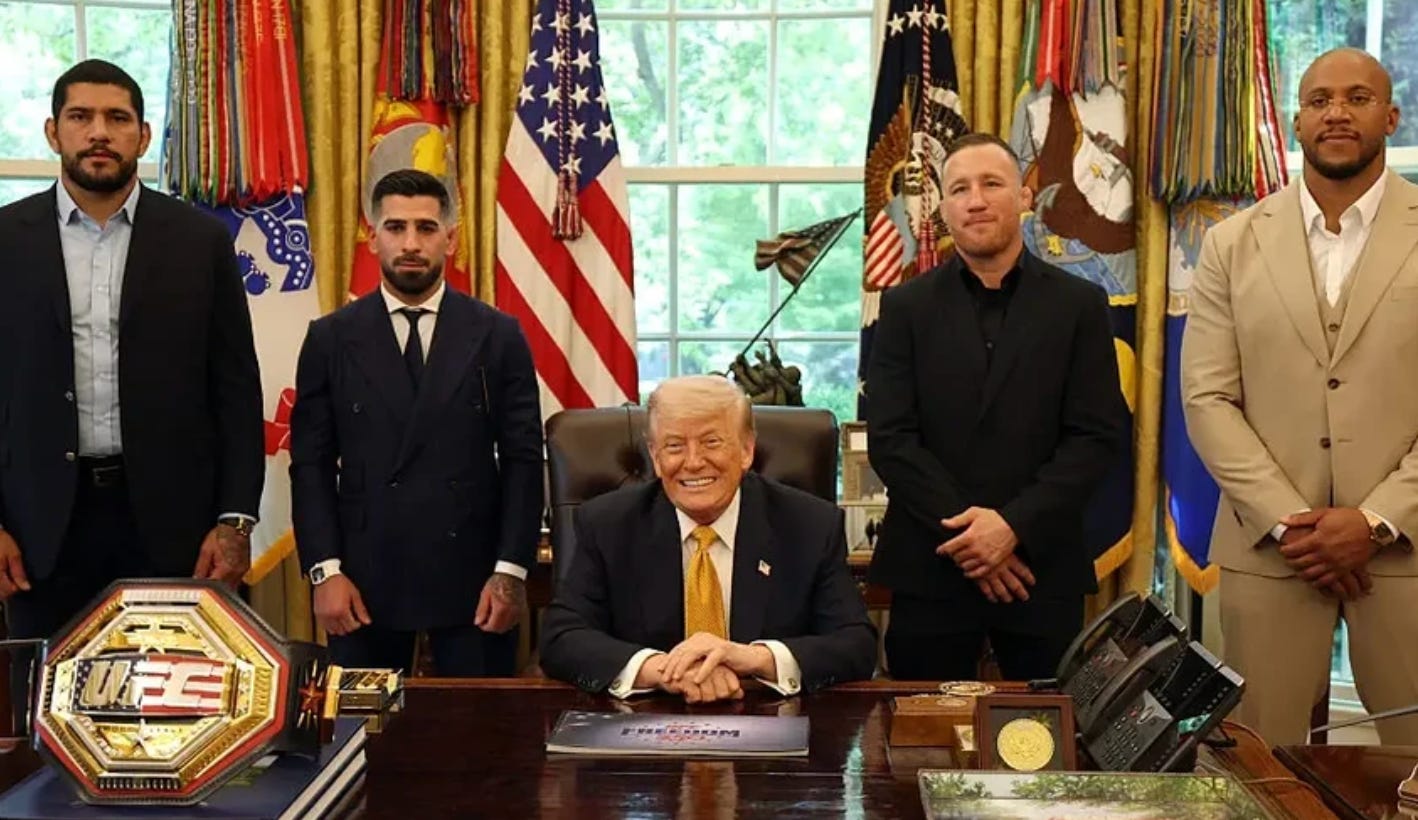
Yesterday afternoon in the Oval Office, Donald made something unusually clear. While promoting a UFC birthday event on the White House lawn, he acknowledged that his illegal and unconstitutional war of choice against Iran has driven prices higher. He did not deny it. He did not attempt to obscure it. Instead, he reframed it. He made the case that even if the economic consequences had been significantly worse, it still would have been worth it.
This is what he said.
We just hit a new high in the stock market. I expected the market would be down 20 or 25 percent. I was willing to do that. I thought oil prices would go to 200 or 250. It is at 100 now. And even if it went to 200, it would have been worth it.
That is the framework we are now being asked to accept. We are supposed to be grateful that prices are not even higher than they already are. We are supposed to accept that $100 oil is somehow a success because it could have been worse. We are supposed to believe that the outcome justifies the cost, even as that cost continues to rise for people who are already struggling.
Gas prices are now well above $4.50 per gallon. That increase is not theoretical. It is not abstract. It is something Americans encounter every time they leave their homes, every time they fill their tanks, every time they try to budget for the week ahead. And yet, from Donald’s perspective, none of this represents a meaningful burden.
He does not experience the consequences of his own decisions. He does not worry about grocery bills or rent or interest rates. He does not have to make tradeoffs between necessities. He is insulated from all of it. And because he is insulated, he can afford to frame rising costs as acceptable, even inevitable.
But that logic collapses under even minimal scrutiny. The fact that a situation could have been more severe does not make the current reality acceptable. It simply reframes the problem in a way that lowers expectations. It conditions people to tolerate outcomes that, under normal circumstances, would be considered unacceptable.
At the same time, Donald continues to point to the stock market as proof of success. The market is at record highs. That, we are told, is the metric that matters. But the stock market is not the economy. It is not a reflection of how most Americans live. It is not a measure of affordability or stability.
If anything, it raises a different question entirely. Why is the market performing so well while costs for ordinary people continue to rise? That disconnect is not incidental. It is structural. It reflects a system in which gains are concentrated and losses are distributed.
Part of that dynamic is driven by speculation and the ongoing expansion of the AI sector. Part of it, however, appears to be something else entirely. There is increasing evidence of volatility tied directly to Donald’s statements and policy shifts. Markets respond rapidly to his messaging. Prices move. Opportunities emerge. And those positioned to take advantage of those movements benefit accordingly.
Meanwhile, the priorities of this administration remain remarkably detached from the reality most Americans are facing. There is the planned UFC event. There is the expansion of a White House ballroom that has now ballooned from an initial estimate of $200 million to a projected cost of $1 billion.
That cost will not be covered privately, despite earlier claims. It will be paid by taxpayers.
According to Homeland Security Secretary Markwayne Mullin, the administration is also seeking additional funding for border walls along both the southern and northern borders. These projects are framed as essential, but their cost continues to grow, and their feasibility remains questionable.
This is what Mullins said on Fox State TV,
We are building miles of wall every single week. We expect to complete the primary wall soon, with additional phases to follow.
It is worth noting that the funding for these projects comes from the same source as everything else. The American taxpayer.
While resources are directed toward large-scale projects and ongoing military operations, the financial pressure on ordinary Americans continues to increase. Rising fuel costs are driving up the price of goods and services across the board. As a result, more people are relying on credit to cover basic expenses. That introduces additional costs in the form of interest, compounding the problem over time.
Despite this, the messaging from the administration remains unchanged. Americans are encouraged to travel. They are encouraged to spend. They are told that price fluctuations are temporary and that relief will come.
Transportation Secretary and MTV Road Rules contestant, Sean Duffy insists that Americans should still be taking road trips as Memorial Day approaches. This is what he had to say in Philadelphia this morning about rising fuel prices.
Prices go up quickly when oil rises and come down more slowly when it falls. That is how the system works.
That explanation is accurate, but incomplete. What it does not address is the reality that those price increases are not reversible in any meaningful sense. If you pay $4.55 for gas today, you do not receive a refund later when prices decline. The cost is immediate and permanent.
For many Americans, that reality makes discretionary spending increasingly difficult. Travel becomes less accessible. Tourism declines. Economic activity slows in sectors that depend on consumer confidence and disposable income.
At the same time, administration officials continue to insist that energy prices are under control. That assertion stands in direct contrast to the lived experience of millions of people. It also raises further questions about consistency.
Remember according to Donald Trump and Pete Hegseth, Iran’s nuclear capabilities were supposedly obliterated almost a year ago. Apparently, that was not the case, because now we are being told they need to be obliterated again and, more recently, that we must eliminate Iran’s nuclear ambitions altogether, which is both aspirational and, frankly, impossible.
Here is the problem. As I mentioned earlier, Donald claimed that, given how easily the United States was able to enter and exit Venezuela and remove its president, Nicolás Maduro, the same approach could be applied to Iran. He suggested that we could go in, make the necessary changes, and leave just as quickly.
That comparison does not hold. What happened in Venezuela was not a war. It was a targeted operation with a very specific objective, and that objective was not regime change. We know this because Maduro’s vice president is now in power, and the same governing structure remains in place.
Donald now claims that he has achieved regime change in Iran. As far as I am aware, that was not even an articulated goal at the outset, or if it was, it was one of many shifting objectives introduced after the war had already begun. In any case, it has not happened. The 86-year-old Ayatollah has been replaced by his son, a man in his fifties who is just as ideologically extreme, if not more so. The regime remains intact.
What is clear is that there always seems to be money available for targeted incursions like the one in Venezuela, and for prolonged wars in the Middle East. At the same time, this conflict in Iran is costing more than a billion dollars a day and driving prices higher across the board. Yet, as is so often the case, there is no shortage of funding for wars, military operations, or vanity projects, including gold statues, massive arches, and increasingly expensive additions to the White House.
At the same time, support for basic needs are reduced.
Agriculture Secretary Brooke Rollins recently announced a crackdown on SNAP benefits, citing fraud concerns.
…people who are receiving the benefits that shouldn't be, but there's also a lot of retailer fraud, the people, the stores that take the EBT cards, the snap cards, and
we're cracking down on that with a big announcement today…
She claims fraud, which is often the justification Republicans use when they decide they no longer want to fund programs that feed hungry children. Somehow, whenever the Trump regime talks about cutting spending, those cuts consistently fall to the serious disadvantage of the most vulnerable.
There is a lot happening, and it never seems to stop. Economic pressure is increasing. Policy decisions are producing ripple effects across multiple sectors. Messaging remains inconsistent.
Donald thrives on chaos, and that chaos allows him to get away with far more than he otherwise could. One of the most important lessons we should take from his illegal and unconstitutional war of choice in Iran, beyond the fact that it never should have happened, is how easily everything else gets buried.
The Epstein files still have not been released, and we can’t forget about that, along with the deeply troubling performance by Howard Lutnick before a House committee yesterday.

I am beyond disturbed by Donald's Dumb Down Dynasty and its hillbilly hierarchy. It reeks of the mental sewage of small minds. BASTA!
Endless self gratification. What’s Rubio up to?