

[Transcript edited for clarity, flow and length]
Watch Entire Conversation:
Listen to Martin’ s podcast on Patreon HERE
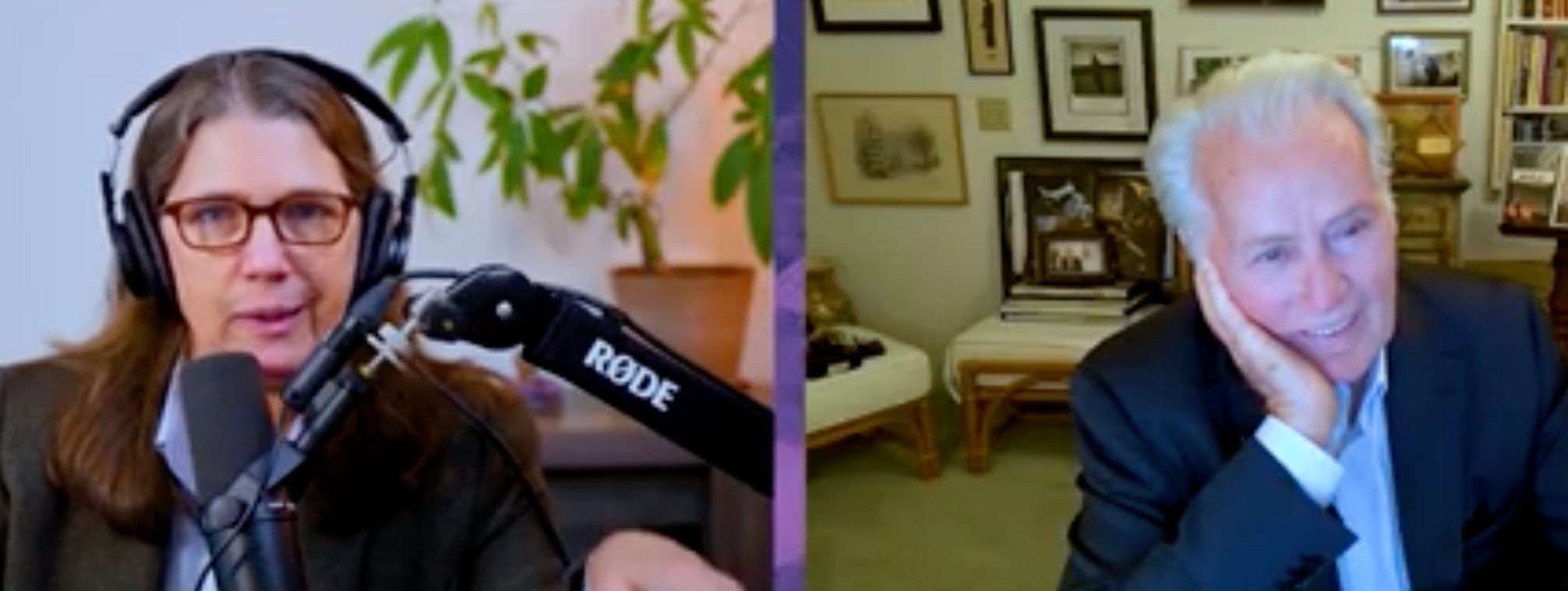
MARY TRUMP I’m delighted to have Martin Sheen here. His podcast is absolutely phenomenal—beautiful, meaningful, and everything we need right now. Martin, I have to ask: I’m guessing the powers that be didn’t exactly say, “Hey, Martin Sheen, make a podcast about poetry, religious faith, joy, family, and storytelling,” did they?
MARTIN SHEEN You’re wrong on that one. I wouldn’t have responded well to that anyway. But I have to credit—or fault—my producer Renée. She’s been after me for years to stop wasting my time and do something meaningful. I grew up on radio, before television. Radio inspired us to use our imaginations. We never knew what anyone looked like. That stayed with me my whole life. I knew Garrison Keillor and listened to Prairie Home Companion endlessly. Then one day on The West Wing set, I did an impersonation of him, and Alison Janney said, “Haven’t you ever heard me on it?” She was a regular for years.
That inspired me. If I’m old enough to remember things from the last century that people in this century might find interesting, I should share them. We write stories about shows, adventures, family members. We interview the kids, talk about films. Renée edits them, we record, they add music. It’s like a radio show. We have a section called “Consider This” where we include quotes from famous and infamous people—Truman, Voltaire, Frank Capra. And we do a lot of poetry, mostly dead poets because they’re cheaper and quite good, some of those guys.
MARY TRUMP The format feels so lived-in and comfortable, with wonderful rhythm. You blend storytelling from your life as an actor, activist, and man of deep faith. And then you read from poets like Tennyson, Keats, Walt Whitman—my favorite American poet—Blake, Gerard Manley Hopkins. As a literature major, listening to you read these poems feels like coming home.
MARTIN SHEEN Thank you. I’ve always been inspired by poetry, particularly as an actor through Shakespeare. It’s prose and poetry. But I love the written word. I see poetry in the simplest and most complex things. Poetry is necessary for our discourse. I call it a proxy language. It allows us to go to deeply personal places and express universal ideas and feelings. That’s why it attracts so many people. Poetry allows us to hide ourselves and reveal ourselves simultaneously. When we hear a good poem—we’re working on Mary Oliver right now with her environmental work and deeply personal poems about life, relationships, nature it crosses all boundaries. For us, it brings a halt to proceedings and says, “Consider this.” That’s mainly what we present.
MARY TRUMP Where did you go to school?
MARY TRUMP I went to Tufts undergrad, then Columbia for a master’s in English literature, then my doctorate in psychology at the Derner Institute.
MARTIN SHEEN And you have a law degree too?
MARY TRUMP No, no. My wife does. I drew the line at one advanced degree.
MARTIN SHEEN Well, you were drawn to poetry as a means of expression. That’s the purpose of our podcast, we love poetry and try to share what we think an American English-speaking audience would respond to. It’s never dark, always real.
MARY TRUMP I’d argue it’s always inspiring because it’s a feat in these days to create consistently uplifting, upbeat, ultimately inspirational content. At no extra cost, which is generous.
MARTIN SHEEN We’ve only paid for one poem, and Renée doesn’t want me to mention it, but it’s one of my favorites: “I’m Waiting” by Ferlin Getty. He passed away at 101 or 103. We loved that poem and wanted to do it, but it cost us. He was worth every penny.
MARY TRUMP Sometimes the best things in life aren’t free.
MARTIN SHEEN They’re very expensive.
Your family history is remarkable. You’re one of nine sons and one sister—quite something. Your parents and many siblings were immigrants. Your father was from Galicia in Northern Spain, born July 2, 1898, the very day the United States declared war on Spain. He had difficulty entering as a Spaniard, so he went through Cuba as a Cubano. Your mother was from County Tipperary, Ireland, from a family involved in the independence movement. They met in a citizenship class in Dayton, Ohio. Your mother taught him English. She had twelve pregnancies—ten survived, nine boys, one girl. Only one was born in Ireland. Your father got transferred to Bermuda, and six more children were born there. You were the seventh surviving son, the first “Yank,” they called you.
MARTIN SHEEN My parents both came from countries with civil wars. My father couldn’t belong to a union in the factory where he worked, so unionism was very important to me. I started a union when I was fourteen at a local golf course—caddies. I got fired and rehired almost immediately because the members realized they’d lost a very good caddy.
MARY TRUMP That’s why you should be good at whatever you do.
MARTIN SHEEN Exactly. This long story about activism comes from where you come from and what you stand for. Dan Berrigan was a great inspiration. He said, “Don’t just do something, stand there.” We’d just be present. If we were ordered to move and didn’t, we were arrested. It was normal. I didn’t expect to change the world. I expected to change myself, and that happens. If you believe strongly in an issue—nuclear weapons, homelessness, high gas prices—they’re all related to a central theme: justice, compassion, and community.
MARY TRUMP You’ve been arrested over sixty times. I haven’t achieved that distinction.
MARTIN SHEEN You don’t know what you’re missing. Through those arrests and activism, we developed our closest, most meaningful relationships.
MARTIN SHEEN I was raised Catholic through high school, let it slide in New York, thinking I was above it, then got yanked back. Dan Berrigan drove me back to Catholicism, but Mother Teresa kept me there.
MARY TRUMP You talk very openly about your faith’s importance. You recently had Father John Deer as a guest. Your rapport is wonderful, and your stories about getting arrested together are inspiring. Both of you talk about faith’s importance, especially in this moment for religion in our country. I’m not religious, but it’s important to remember how powerful religion can be for good.
MARTIN SHEEN I’m interested in spirituality more than religion because religion divides us through revealed belief. What unites us is a common need for transcendence and community. I left practicing religion in my early twenties, then Pope John XXIII initiated Vatican II. It changed the world, and I came back. The church I was raised in was pious and judgmental. Vatican II opened doors and let in fresh air and ideas. It’s still changing. We’re fortunate to have had successive popes teaching peace and social justice. Pope Francis, for almost twelve years, was a great source of inspiration.
The faith itself is rooted in the great mystery. Throughout 2000 plus years and thousands of canonized saints, the church has never condemned a single soul—not even Hitler. The church has no authority to say who is saved. That’s God’s business. We’re called to love our enemies and celebrate universal community. The word Catholic means universal. In my lifetime, it’s become more universal, human, and relevant. Still problems since men run it, but hopefully someday women priests will serve, since there are far more women saints than men. Women in the gospel were first to administer to Jesus after he was murdered while men hid.
MARY TRUMP And activism as well. Women often lead but are denied power.
MARTIN SHEEN Those in power don’t have the right to it. As long as we’re connected compassionately, spiritually, emotionally, and care for one another, we’ll be fine—absolutely fine.
MARY TRUMP People like Jane Fonda continue activism lifelong. I don’t see as many younger generations stepping up.
MARTIN SHEEN Well, we only have so much time left. Rachel Maddow covers protests and demonstrations, showing many unheralded young people—students, working people, young mothers, professionals. Just last week, they surrounded the Kennedy Center saying, “Get through us first.” Many young people were there. I’m encouraged. It’s hard for me to get out physically. I’m not a young guy anymore, and I have to be careful about getting arrested because it concerns my family. But I’m spiritually present.
MARY TRUMP I think you’ve been arrested enough. Let somebody else get arrested.
MARTIN SHEEN When actively involved with anti-nuclear protest, homelessness, and environment work, everyone knew where you were. It was sometimes easier than being outside with all that responsibility—letting family know you’re okay. The arresting part was sometimes the easiest. You sang hymns, refused to get up, they carried you away. That’s where you landed.
MARY TRUMP I wanted to ask about working with Joe Papp on The Normal Heart. That’s a beautiful story about how acting challenged your assumptions about yourself and masculinity.
MARTIN SHEEN Joe Papp was a towering inspiration and the most credible force in American theater. He founded the New York Shakespeare Festival and the Public Theater, nourishing careers of George C. Scott, De Niro, Al Pacino, and many others. During the AIDS crisis, Larry Kramer wrote The Normal Heart. Larry founded the Gay Men’s Health Crisis. Joe produced it at the Public Theater—tremendous success. Joe asked if I’d take the play to England in 1985. I said yes without hesitation.
We saw a Los Angeles production with Kathy Bates and Richard Dreyfus. He kissed his partner in a passionate kiss, and I slid down my seat. My wife asked, “What’s wrong?” I said, “I can’t do that.” She said, “You’re an actor. You pretend to be somebody.” At that time, kissing was considered dangerous. Many actors said no kiss. I had regrets about exposing the feminine part of my character. I didn’t want anyone thinking I was vulnerable or possibly gay. I was hoping Joe would change his mind.
He called and said he’d been diagnosed with cancer and couldn’t direct, but asked if I’d do it anyway. I said yes without hesitation—I wanted to honor him. It was one of life’s great experiences because I confronted that image of myself. In every scene, I tried showing my physique, my arms, my muscles, how deep my voice was, how macho I was.
One night during a critical scene, a character attacked me. He broke free and came at me. In that moment, I fled across the stage and became, as another actor described it, “the biggest gay man in all of London” and hid behind the biggest man on stage. And it’s true. It became a staple every night. I was forced to run. As an actor, I couldn’t improvise—I had to run like that. I became the biggest, proudest gay man on the London stage that year. For me, it was deeply personal and groundbreaking. Janet was right: you don’t become someone; you pretend and surrender to what gives your character credibility.
When I returned to New York, Joe said, “I heard you changed the ending.” I found where Larry got the title. I inserted it at the end with Nabokov’s line: “What was true of Diogenes is true of the normal heart—the era bred in the soul of each woman and each man craves what it cannot have, not universal love, but to be loved alone. That’s where God comes in.”
Subscribe to the Martin Sheen Podcast on Patreon to hear more stories about faith, poetry, activism, and the intersection of art and justice. New seasons of beautifully crafted twenty-minute episodes remind us that there is immense joy in storytelling, belief, and community Here .

I love and admire Martin Sheen but as I recall, the Catholic church created the Inquisition. And did a few other things that condemned people. Nice conversation.
That is do depressing. He remembers things from 1995?