

Hi, I’m Mary Trump, Donald’s niece. That means, unfortunately, that my uncle is President of the United States. More importantly, I’m also a writer, activist, clinical psychologist, and the founder of Mary Trump Media. For years, I have been speaking out about Donald’s unfitness for office and the corruption of the party that continues to enable him.
What is obvious to anybody with eyes is that Donald continues to demonstrate the fact that he is psychologically, emotionally, cognitively, and physically in decline. This has been increasingly evident over the last couple of months. We’ve seen off the chart press conferences and cabinet meetings at the White House, his deeply unhinged remarks during rallies and other public events, and his middle of the night social media rants.
Donald’s communications have always been full of grievance, whining, and innumerable lies, but they have become not only increasingly provocative, his genocidal threats against Iran come to mind, but also increasingly focused on weird obsessions like his hatred of windmills, his fear of magnets, and his despair over shower heads with low water pressure. These show that he is increasingly self aggrandizing and detached from reality, which is to say delusional. He often does not seem oriented to time and place.
I can’t always understand exactly why Donald becomes obsessed with the things with which he is obsessed. I don’t know why he hates wind energy so much, beyond, of course, the fact that it is competition for his oil buddies. I also don’t really understand why he keeps making the demonstrably false claims that windmills kill birds, fish, and whales. I don’t know why he is obsessed with water pressure.
Every once in a while, though, Donald tells on himself.
A few months ago, during remarks at Davos, Donald gave us a remarkable window into what is going on in that terrifying head of his. This was in front of world leaders.
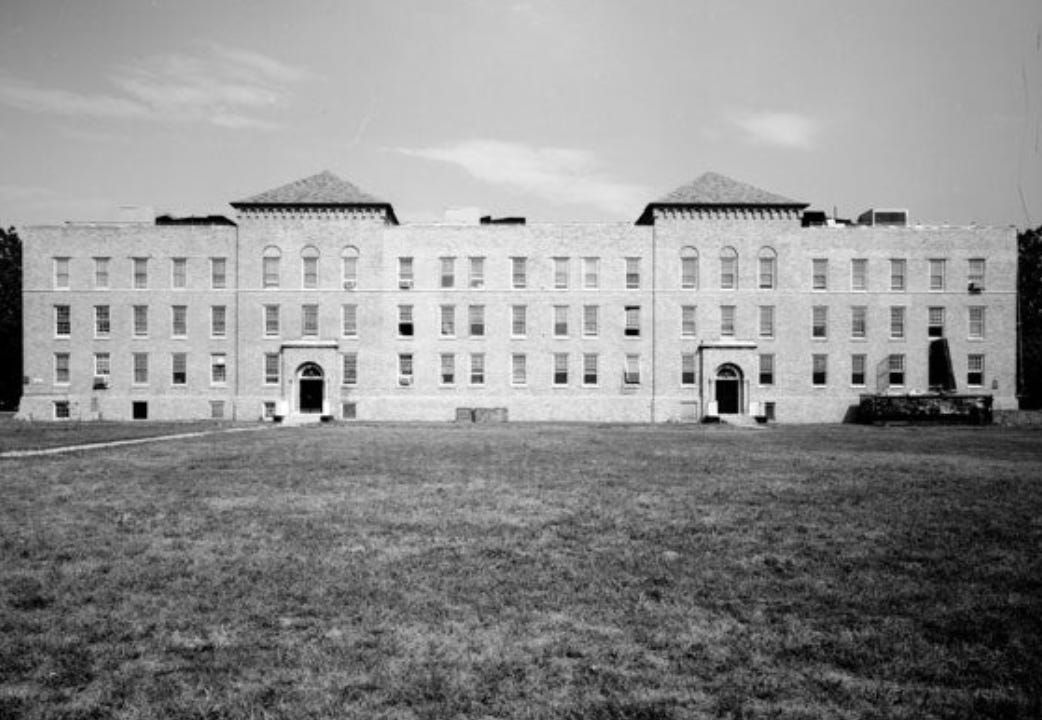
Donald: We had in my area in Queens, I grew up in Queens, at a place called Creedmoor. Did anybody know that it was big? I said, Mom, why are those bars on the building? I used to play a little league baseball there at this place called Cunningham Park. I was quite the baseball player. You wouldn’t believe it, but I said to my mother, Mom, she would always be there for me, she said, Son, you could be a professional baseball player. I said, Thanks, Mom. I said, Why are those bars on the window? Big building, powerful building. It loomed over the park. Actually, now I think that’s a pretty unfriendly sight. I’ll never forget it. I don’t know if it’s still there because they got rid of most of them, but I’d say, why does the building have those bars? It wasn’t normal. You’re used to looking at a window. With this one, you’ll look at all these steel, vicious steel, tiny windows, bars all over the place. Nobody was getting out. It’s called a mental institution. That was an insane asylum.
Creedmoor is a psychiatric hospital. Donald, of course, misspoke. He did not grow up in Creedmoor, although some might argue that he probably should have.
Yes, that is a direct quote of something Donald said on the world stage while representing the United States of America. Where to start? I’m pretty sure that is not the kind of thing those world leaders were at Davos to hear, although perhaps it was more welcome than hearing how he is going to take over Greenland.
Let’s try to analyze this a little bit. Donald is riddled with anxieties. He has fears that are so deep and unacknowledged that they can never be assuaged. As we know, he talks often about insane asylums, particularly in the context of immigration, because he seems to exist in a hellscape in which malign powers are flinging open wide the doors of their asylums and pointing the criminally insane toward our southern border.
One of his rationales for justifying the egregious assaults by ICE and Customs and Border Protection agents on immigrants, undocumented workers, and American citizens is that President Biden welcomed such people in. But what is this about Creedmoor, and why is he so obsessed with the bars on the windows?
I think, in part, it’s because Creedmoor did sort of loom large in our lives in Queens. We often passed it on our way out east to Long Island. Small detail, and maybe it was an honest mistake, but the park next to Creedmoor is Alley Pond Park. Cunningham Park, which was on the border of Jamaica Estates, where Donald grew up, and Fresh Meadows, was the park where we most often went to play sports because it was just down the road from his house.
Creedmoor was a massive psychiatric hospital complex in the 1960s and 1970s, so yes, it had a reputation. But why is Donald so focused on revisiting the terror it seems to have caused him? And why is he bringing my grandmother into all of this, my grandmother who actually was never there for him?
This rant has me thinking about the fact that Alzheimer’s runs in my family. Of course, I’m hoping it skips my generation, or at least I’m hoping it skips me. On the one hand, I sometimes see similarities between Donald and my grandfather, Fred Trump, who developed Alzheimer’s sometime in his late seventies or early eighties, which is to say when he was around Donald’s age. But there are many, many differences, too.
What they have in common is that they do not always seem, as I said before, oriented to time and place. The first time I saw this with my grandfather, we were at an event in Brooklyn at which he and my grandmother were being honored. It was very well attended and it was outside. My grandfather was standing next to my uncle Rob when he grabbed Rob’s arm and suddenly looked like a deer in the headlights.
I had never seen my grandfather look like that before. He looked terrified, as if he had no idea where he was or who he was with.
I’m beginning to see that look in Donald’s eyes sometimes.
That might be where the similarities end, though. By the time my grandfather was in his mid eighties, he started forgetting everybody he knew. Sometimes these were people he had known for decades, including his grandchildren, to the extent that he cared about them at all, but also, increasingly, his children.
I was with him and my Aunt Maryanne at Mar a Lago the first time my grandfather failed to recognize her. Of course, my aunt was a terrible person, but despite this, it was still very painful to watch when she realized that her father no longer knew who she was.
The other thing that happened with my grandfather is that, despite the fact that his entire life he had been a straight up sociopath, a cutthroat businessman, and a cold, unaffectionate father and grandfather, he actually became sweet, like a kitten. In fact, he was never kinder to me than when he had completely forgotten who I was. He used to refer to me as “the nice lady.”
I don’t see any such softening with Donald. In fact, I would argue that he is getting more cruel and more belligerent as he becomes more out of control. He is more prone to lash out. His impulse control is eroding at an alarming rate.
This happened with my grandfather, too, but there is an important difference. My grandfather always had really good impulse control. Donald has never had good impulse control. And my grandfather’s lack of impulse control exhibited itself in very private settings. It almost always happened only with my grandmother.
Donald, on the other hand, is completely unhinged, often in very public places. I think part of this is because the more threatened he feels, the more he feels that the walls are closing in on him, or the more he feels that he can no longer control the narrative, the more he has to try to regain some control.
Of course, this is just making him more dangerous.
We can never, ever trust anything Donald has to say. He is always going to be looking for another way to get somebody to capitulate to him, whether through threats or through the actual use of force, just as he told other members of NATO that he would use force against Greenland. We can’t take him at his word because he is not making decisions based on facts on the ground. He is making decisions based on his very deep and increasingly terrifying insecurities.
And that is where the comparison between Donald and my grandfather becomes most important.
My grandfather essentially was in his house with his wife. He was no longer making decisions that had an impact on anybody else. Whatever was happening to him, whatever he was forgetting, whatever control he was losing, the consequences were largely contained within his own life and his own family.
Donald is President of the United States.
His decisions have a serious, deleterious, and terrifying impact on all of us. His inability to control himself does not remain behind closed doors. His fears, grievances, obsessions, and insecurities become public policy. They become threats against other countries. They become decisions about the use of force. They become the words of the President of the United States spoken in front of world leaders.
That is what makes the contrast with my grandfather so stark. I watched my grandfather lose his orientation to time and place. I watched him fail to recognize people he had known for decades. I watched his impulse control erode. But by that point in his life, he was no longer in a position to make decisions that could affect millions of people.
Donald is.
He is increasingly belligerent, increasingly cruel, increasingly prone to lashing out, and increasingly desperate to regain control whenever he feels threatened. At the same time, he is occupying the most powerful office in the world.
That is what we’re up against.

Donald’s malignant narcissism is coming into full bloom. As a nurse my experience with malignant narcissists with Dementia is the “I’ll show you by burning the house down and taking all of you with it” If they are going down everything you care about they will destroy to hurt you.
Mary, I’ve always respected your views on Donald Trump. Having been a therapist for over 40 years I recognized the pathology in your uncle’s comments and actions early on when he was holding rallies prior to his first presidency. One of the first things I saw was his physically mocking a man with a disability. At that moment I was done with him. Shortly afterwards he began his blustering about how great he is. I read your first book about him being the most dangerous man in the world. It’s nice to be validated especially when he was gaining a following.
I, too, appreciate the work you are doing. Your thoughts are real and realistic. ♥️