

[Transcript edited for clarity, flow and length]
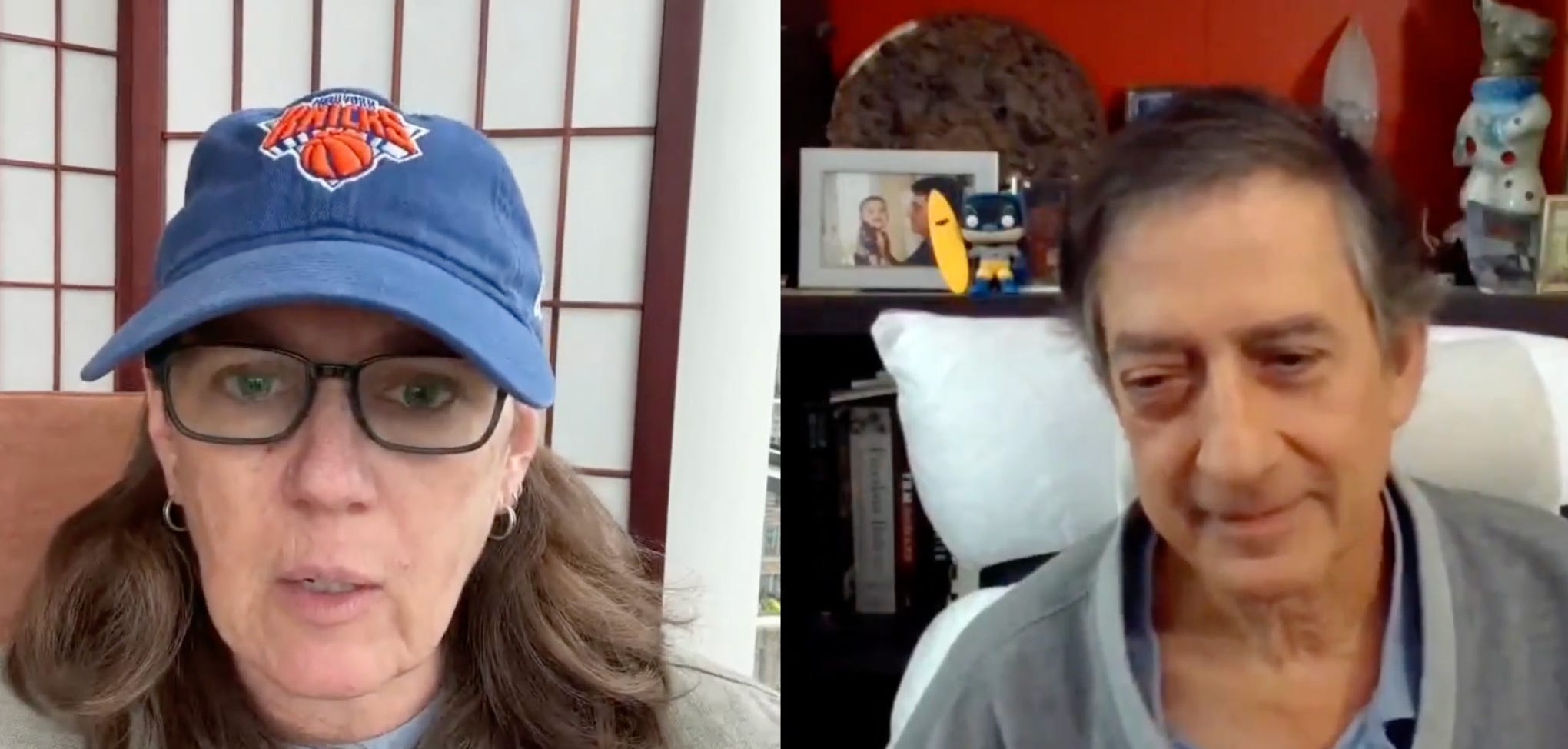
Mary Trump: I got to chat with Michael Tomasky, Editor in Chief of The New Republic, about his new novel, Killing Baby Hitler, which is a fascinating, genre bending look at a philosophical hypothetical that I’m sure you can understand potentially relates to the times in which we’re living.
We also talked about the corrosive state of corporate journalism in America.
Please enjoy.
Mary Trump: I have questions, though. Obviously, we don’t want to give too much away about the book, but what I will say right at the outset is that everybody should go read it.
It’s very difficult to categorize genre wise, but I found it fascinating, relevant, and philosophically challenging.
I wanted to start with what prompted you to write this book. If you could also tell us a little bit about how it’s set up, people can better understand why it is so relevant to these extremely fraught and complicated times in which we find ourselves.
Michael Tomasky: Sure. First of all, thanks so much for having me. It’s nice to be with you, Mary, and with everybody.
So why did I write it?
I started thinking about it in late 2022. The idea of Killing Baby Hitler obviously isn’t original to me. It’s a hypothetical people have discussed from time to time.
One morning, it just struck me that it would be a good way to explore many of the issues we’re dealing with now in real life.
So I sat down and started writing. My New Year’s resolution was simply to begin writing on New Year’s Day in 2023, get a couple hundred words on the page, and see where it led.
I honestly had no idea what the plot of the novel was going to be the day I started writing it. But as I kept working, it gradually came to me.
First, I realized that if the story involved time travel, it needed to take place at some point in the future when time travel might theoretically be plausible. I chose the year 2141 more or less at random.
That meant I had to build an entirely new world set in 2141 and imagine what it might look like. Those sections of the book describe that future world and what I would call stages of human regression rather than progress between now and then.
I paint a picture of where I fear our country, and really the world, could end up over future decades based on what we’ve experienced during the last decade in the United States with Uncle Don, but also with the rise of authoritarian leaders around the globe.
It’s a fairly grim vision of the future, but I also think it’s a plausible one.
The book has elements of science fiction, but not in a Ray Bradbury sense. It’s more in the spirit of Kurt Vonnegut.
I hope that doesn’t sound too presumptuous.
Mary Trump: It doesn’t.
Honestly, I think that’s an apt comparison.
Michael Tomasky: A few friends have said the same thing. In fact, Kurt Andersen, who generously provided a blurb for the book, described it as Vonnegut esque.
I’ll happily take that any day of the week.
Mary Trump: Who wouldn’t?
For people who may not know how publishing works, this book came out recently, but you actually finished writing it many months before publication because it had to go through editing, copyediting, production, and everything else that comes afterward.
Obviously, a great deal has happened since you completed it, things you couldn’t possibly have predicted with certainty.
There are aspects of this novel that now seem remarkably prescient.
As I was reading it, I kept thinking about how impossible it would have been for you to know exactly how many of these developments would become part of the reality we’re now living through.
To me, that demonstrates how deeply understanding history and being immersed in current events can make someone appear almost clairvoyant.
Michael Tomasky: There are definitely some things in the book that turned out to be far more accurate than I ever expected.
I wrote most of it during 2023 and 2024, largely before the 2024 election.
At that point, I honestly didn’t think Donald Trump had a serious chance of being elected again, so I was writing under the assumption that Joe Biden, or at least another Democrat, would be president.
There’s a section in the novel, about twelve or fourteen pages, where I describe the dissolution of the United States over the course of the 2030s, 2040s, 2050s, and 2060s.
A surprising amount of that feels much closer to reality than I imagined it would when I wrote it.
I’ll give you one example.
There’s a passage in which the Republican elected president in 2048 decides to tear down the Lincoln Memorial and replace it with the Nathan Bedford Forrest Mixed Martial Arts Center.
Nathan Bedford Forrest, of course, was the first Grand Wizard of the Ku Klux Klan and a Confederate general.
I think readers can connect the mixed martial arts reference for themselves.
This was obviously written long before the Claw was built on the Ellipse.
I don’t spend my days congratulating myself, but I’ll allow myself a small pat on the back for that one.
Mary Trump: I think it’s well deserved.
If it’s okay, I’d like to read one paragraph because I found that entire twelve or fourteen page section to be one of the most resonant parts of the book.
This is what Michael writes:
But history is lit on a series of matches that are struck at unpredictable times by unanticipated forces. And so it was that fate decreed that 2060 would be the year that that long smoldering match would ignite. The Democrats had been in power for eight years. This broke a pattern that had obtained for some time, with the parties trading power every four years. But the Republicans got a bit more bonkers than usual the last time they were in, passing ostentatious tax cuts for the rich, and for the first time only for the rich, on the grounds that only the rich knew how to invest the windfall responsibly, and pushing through what was in essence a set of Nuremberg Laws with respect to transgender people. Your average American wasn’t yet quite ready to die for her transgender brothers and sisters, but very few people wanted any part of something that reeked so obviously of Nazi Germany.
Two things stand out to me.
First, the prescience we were just discussing.
Second, this book is not only incredibly thought provoking, it’s also very clever and, at times, genuinely funny.
Another aspect I found fascinating is the world building.
We begin a century in the future, then travel back to late nineteenth century Vienna because we’re talking about the possibility of killing Baby Hitler.
That must have been an enormous amount of fun to write.
Michael Tomasky: It really was.
I’ve read a great deal of history, including several biographies of Hitler and a lot about the Austro Hungarian Empire and the First World War.
I already knew the broad historical framework, but bringing nineteenth century Austria to life was enormously enjoyable.
Several friends who have read the novel commented on something I hadn’t consciously thought about while writing it.
They said the book vividly captures what life in 1889 must have smelled like.
Mary Trump: I’m thinking in particular about the boat.
Michael Tomasky: Exactly.
You start thinking about practical realities. What happened to all the horse manure in those days? Horses filled the streets. People didn’t brush their teeth the way we do now.
Mary Trump: Or wash their hands.
Michael Tomasky: Exactly.
Life would have been very pungent.
Without giving too much away, I’ll say this much because I’ve mentioned it in other interviews.
The characters don’t succeed in killing Baby Hitler.
However, they do succeed in changing the course of his life, which in turn dramatically alters the course of twentieth century history.
The novel then follows this alternate version of Hitler, who eventually ends up living in America, where some very strange and very funny things happen to him.
Because he never becomes Hitler, Stalin makes different decisions, European history unfolds differently, and American history unfolds differently.
I think readers who enjoy history will have a lot of fun with that.
