

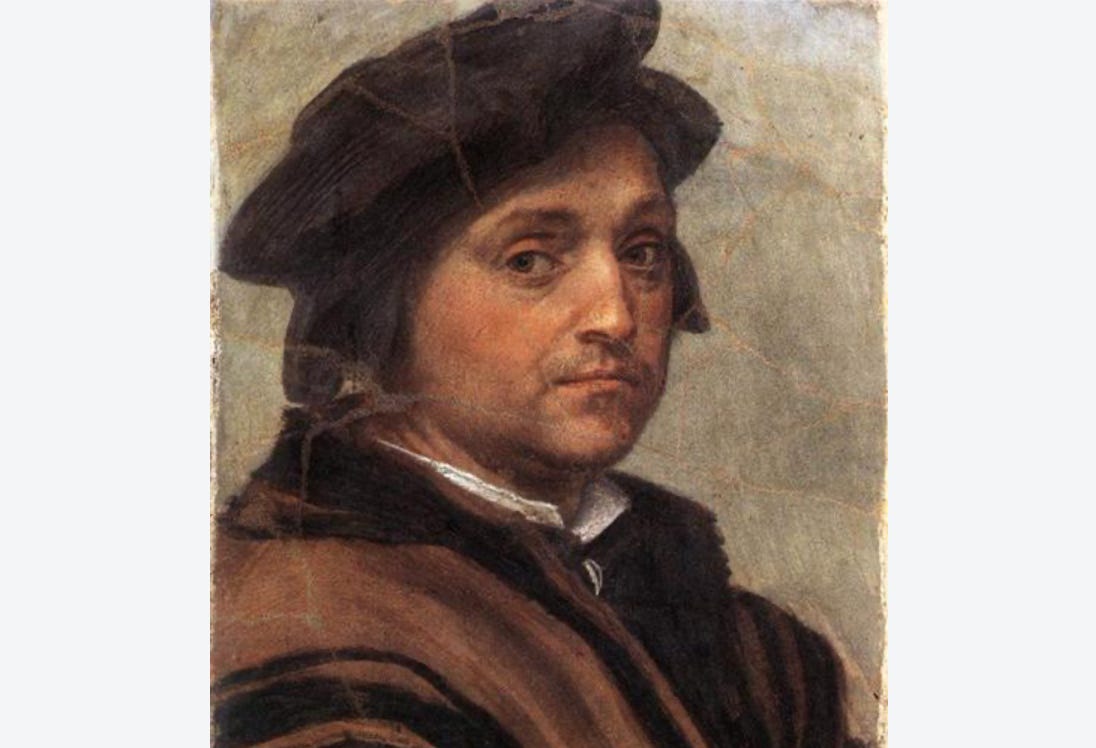
In Life of the Artists, Giorgio Vasari writes of the Italian Renaissance painter, Andrea del Sarto:
There was a certain timidity of mind, a sort of diffidence and want of force in his nature, which rendered it impossible that those evidences of ardor and animation, which are proper to the more exalted character, should ever appear in him.
Del Sarto (1486-1530), a Florentine painter, was widely admired during his lifetime for his nearly flawless technique (he painted, it was said, senza errori, without error). His reputation has subsequently been eclipsed by his more renowned, and skilled, contemporaries who included Leonardo da Vinci, Raphael, and Michelangelo, as well as by his immediate predecessor, another Florentine, my favorite of all Italian Renaissance painters, Domenico Ghirlandaio.
Vasari, a gossip as much as a biographer, has a theory about del Sarto’s failure—he lays the blame squarely at the feet of the painter’s wife, Lucrezia,
a most beautiful girl who, though born of a poor and vicious father, carried about her as much pride and haughtiness as beauty and fascination. She delighted in trapping the hearts of men, and among others ensnared the unlucky Andrea, whose immoderate love for her soon caused him to neglect the studies demanded by his art.
Her beauty, Vasari tells us,
appearing to [del Sarto] to merit thus much at his hands, and his love for her having more influence over him than the glory and honour towards which he had begun to make such hopeful advances. . . . he soon became jealous, and found that he had besides fallen into the hands of an artful woman, who made him do as she pleased in all things.”
She was also “faithless, jealous, and vixenish with the apprentices.” Vasari, who often relied on innuendo and hearsay when compiling his short biographies, had been one of del Sarto’s apprentices so, in this instance, perhaps, he knows whereof he speaks.
Vasari tells us that after del Sarto’s work attracted the attention of the French King, François I, he moved to Paris to work for the King’s court. Despite his success there, Lucrezia wrote begging for him to return using, in Vasari’s characterization,
sweet words well calculated to move the heart of the luckless man, who loved her but too well, she drove the poor soul half out of his wits . . . [H]e resolved to resume his chain, and preferred a life of wretchedness with her to the ease around him, and to all the glory which his art must have secured to him.
Despite having pledged to return to Paris and the King after a brief visit home:
Andrea del Sarto remained in Florence and from a highly eminent position he sank to the very lowest, procuring a livelihood and passing his time as he best might. . . . Andrea now began to feel, not that the beauties of his wife
had become wearisome, but that the mode of his life was an oppression to him. His error had become in part apparent to his perceptions he saw that he could never lift himself from the earth though, perpetually toiling, he did so to no purpose.
Much of what Vasari recounts about del Sarto is believed to be apocryphal. Regardless of the accuracy of the account, it was the source material for Robert Browning’s portrait of the painter.
In the eponymous poem, the doomed relationship between del Sarto and his wife is the frame within which Browning explores themes that are of more interest to him: the relationship between artist and his art and the destructive power of complacency.
His Andrea del Sarto is a melancholy man who has lost his way, and has indeed come to understand that his wife is not faithful and his marriage is not a source of comfort let alone inspiration:
But do not let us quarrel any more,
No, my Lucrezia; bear with me for once:
Sit down and all shall happen as you wish.
You turn your face, but does it bring your heart?
I’ll work then for your friend’s friend, never fear,
Treat his own subject after his own way,
Fix his own time, accept too his own price,
And shut the money into this small hand
When next it takes mine. Will it? tenderly?
. . .
A common greyness silvers everything,—
All in a twilight, you and I alike
But more important to Browning’s project is del Sarto’s grappling with recognition—and his unwillingness to accept—that the extraordinary talents he possesses are not enough, have never been enough, in and of themselves to elevate his art to the level of the sublime. His dawning awareness that he is ultimately the only one responsible for having squandered his potential, and the reasons for his having squandered, remains beyond his ability to acknowledge.
No sketches first, no studies, that’s long past:
I do what many dream of, all their lives,
—Dream? strive to do, and agonize to do,
And fail in doing. I could count twenty such
On twice your fingers, and not leave this town,
Who strive—you don’t know how the others strive
To paint a little thing like that you smeared
Carelessly passing with your robes afloat,—
Yet do much less, so much less, Someone says,
(I know his name, no matter)—so much less!
The lines that initially struck me, and that I initially misunderstood taking them out of context were:
I do what many dream of, all their lives,
—Dream? strive to do, and agonize to do,
And fail in doing.
Those lines, and the tone of resignation that runs throughout the poem, reminded me of my father and the fact that his extraordinary accomplishments ended up being for naught. As he floundered, his unaccomplished and unworthy younger brother usurped his position and his fortune.
While Andrea del Sarto is about lost potential, ill-advised compromise, and the consequences of both, it is also a meditation on the idea that greatness without effort is unsustainable, which has much relevance to our current circumstances.
American exceptionalism is based on the belief that this country is de facto superior to other countries, that our way of being—our culture, our beliefs—should never be challenged and changed. This has lead to complacency and a failure to challenge the status quo. Worse, it has led to an insupportable arrogance and a steady degradation of the things upon which our ideas of being exceptional are based.
If you believe you possess a greatness that is immanent, whether as a country or an individual, there is no need to strive to be good. One of the diseases that ravaged my family was the delusion that Donald of all people was great, while somebody like my father was a loser. When families operate in service to perpetuating such delusions, you get a thin-skinned, constantly aggrieved bully. When countries operate in a similar fashion, we get a weakened system that bends constantly towards one person’s dysfunction—and the potential for ruin.
As Browning’s del Sarto exclaims:
Ah, but a man’s reach should exceed his grasp,
Or what’s a heaven for?
And the grudging recognition that he has failed in this, too:
All is silver-grey,
Placid and perfect with my art: the worse!
And we, too, are so much the worse for it.

This juxtaposition is so interesting. And now we have “a weakened system that bends constantly towards one person’s dysfunction…” How far can it bend until it snaps?
I do not remember ever reading this poem, though I knew about the artist -- overshadowed by his peers. Former English and art teacher, here, and I thoroughly enjoyed your discussion of the poem. What a perfect way to start my week! Your father seems more real and human to me than your uncle, his wife or any of his children.