

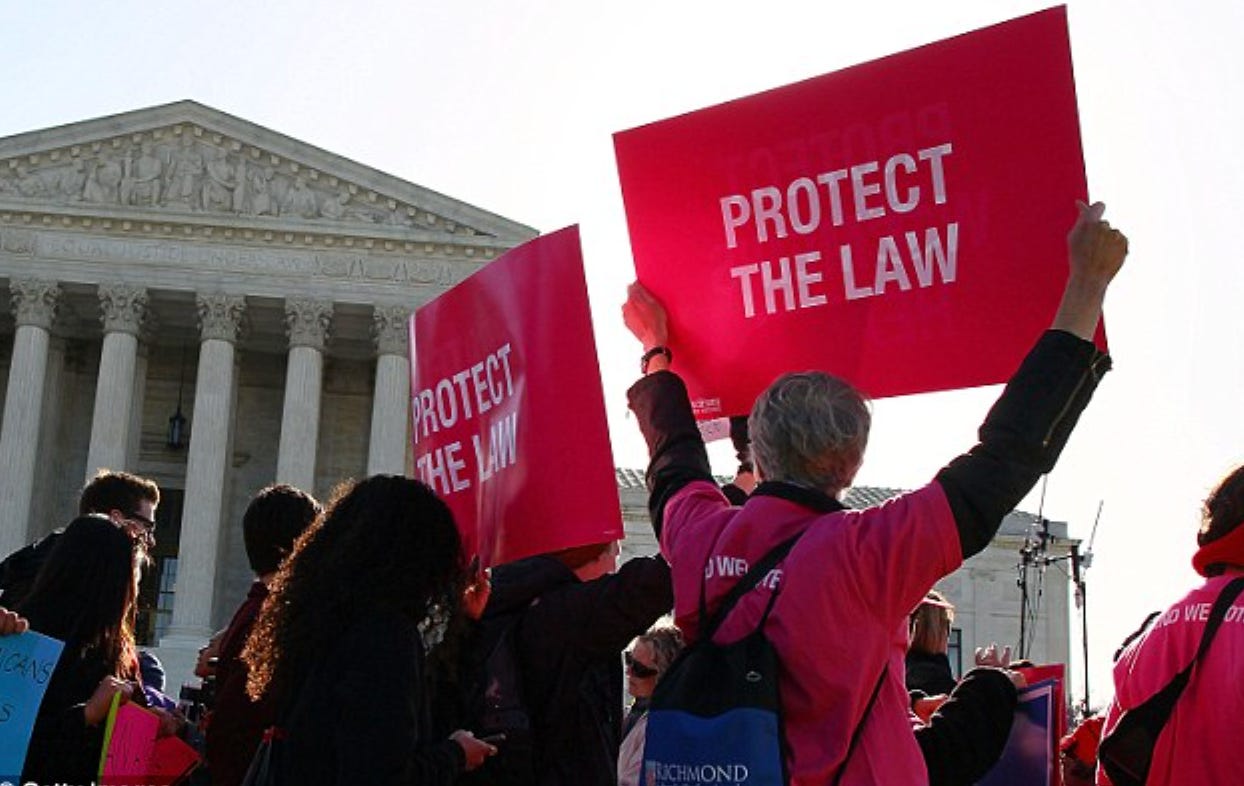
One of the more revealing moments in Washington this morning did not happen during oral arguments or after the Supreme Court. It happened in real time when Speaker of the House Mike Johnson, while speaking to reporters, learned that the Court had just handed down its decision on birthright citizenship.
Johnson: As a constitutional lawyer, I got lots of opinions on this. Okay. Understand what the framers did and when we added this to our constitutional order, I understood what the intent was. I think anybody who looks at this... Oh, dear. What they rule?
The reporter then informed Johnson of the Court’s ruling.
Children born in the United States to parents unlawfully or temporarily present are subject to the jurisdiction of the United States and are citizens at birth under the 14th Amendment Citizenship Clause.
Johnson’s response was, to put it mildly, extraordinary.
This is how Johnson responded:
I need to read the opinion, okay? But obviously that’s, I mean, you could say that’s a textualist originalist view. However, I do think that this has been grossly abused in recent years.
Grossly abused?
Mike Johnson claims to be a constitutional lawyer. Frankly, I think he needs to have his law license revoked. The idea that somebody who presents himself as a constitutional scholar would object to the Supreme Court doing the one thing it is actually supposed to do, uphold the Constitution, tells us an enormous amount about where we are as a country.
Yes, indeed, the Supreme Court struck down Donald’s executive order attempting to end birthright citizenship for children born in the United States because it very obviously violated the Fourteenth Amendment. The language of the amendment is not ambiguous. It states that anybody born in the United States of America, regardless of the citizenship status of their parents, is a citizen of the United States. It is right there in black and white.
Unfortunately, we also learned something deeply disturbing today. Four of the nine justices on the Supreme Court, four members of the corrupt, illegitimate supermajority, were apparently willing to ignore that plain constitutional language. Looking at you, Samuel Alito, Clarence Thomas, Neil Gorsuch, and Brett Kavanaugh.
Apparently, they either cannot read the Constitution or they believe that an incompetent, corrupt, anti-American, traitor can simply sign an executive order and erase one of the most important constitutional amendments ever adopted.
That is also where we are as a country.
Writing for the majority, Chief Justice John Roberts reaffirmed exactly what the Constitution has said for more than 150 years.
Chief Justice Roberts: Children born on U.S. soil to undocumented immigrants, as well as to parents here legally on temporary visas, are citizens at birth.
He continued:
Citizenship then and now was the right to have rights, to freely participate in our political community. The framers of the Fourteenth Amendment extended that promise to every freeborn person in this land. We keep that promise today.
Again, that is not judicial activism. That is not a novel interpretation of the Constitution. It is simply what the Constitution says.
This case began on one of the darkest days in modern American history, Donald’s first day back in office on January 20, 2025. Within hours of returning to the White House, he signed an executive order declaring that babies born in the United States would no longer automatically receive citizenship if their parents were undocumented or were in the country on temporary visas, whether student visas, work visas, or tourist visas.
The implication, of course, was never subtle.
Although the order was written broadly, everybody understood who Donald wanted people to picture. Everybody understood which families were being targeted. Everybody understood that this was yet another attempt to exploit racial resentment under the guise of immigration policy.
My own family illustrates just how absurd Donald’s position really is.
My grandfather benefited from the Fourteenth Amendment. Both of his parents were German citizens when he was born in the United States during the early twentieth century. My grandmother remained a Scottish citizen when Donald was born.
By Donald’s own logic, members of our own family would have been denied the constitutional protection he now seeks to strip away from millions of other Americans.
That is one of the reasons it is impossible to separate this executive order from the racism underlying it. This was never a neutral constitutional argument. It was never about faithfully interpreting the Fourteenth Amendment. It was about targeting certain groups of people while conveniently ignoring others whose circumstances happened to be remarkably similar.
Once again, we find ourselves celebrating something that should never have required celebration in the first place.
We are relieved because the Supreme Court upheld the Constitution.
Think about how extraordinary that sentence is.
We have reached a point where Americans feel compelled to celebrate the Supreme Court for doing its most basic job because we can no longer assume that the Court’s corrupt, illegitimate supermajority will faithfully uphold either the Constitution or the rule of law.
When I first saw the decision, I believed it was a six-to-three ruling, with Justices Alito, Thomas, and Gorsuch once again demonstrating a breathtaking willingness to abandon their oath to uphold and defend the Constitution. Their position appears to rest on the astonishing premise that the Fourteenth Amendment no longer means what it plainly says. Apparently, racism has ceased to exist, and the constitutional protections enacted to combat it have therefore become unnecessary.
That argument is not only historically indefensible, it is fundamentally incompatible with the text, history, and purpose of the Fourteenth Amendment itself.
Then I realized something even more troubling.
Justice Brett Kavanaugh also joined the dissent, although he relied on somewhat different reasoning. Rather than treating the case primarily as a constitutional question, he viewed it largely as an issue of statutory law.
The distinction, however, offers very little comfort.
The reality remains that four members of the Supreme Court were prepared to reach a result that would have dramatically weakened one of the foundational guarantees contained in the Fourteenth Amendment.
That should alarm every American, regardless of political party. It should remind all of us that constitutional rights remain secure only so long as there are enough people willing to defend them. And, increasingly, that is not something we can simply take for granted.
What should chill every one of us is not simply that Donald attempted to overturn birthright citizenship by executive order. It is that four members of the Supreme Court of the United States were willing to entertain the possibility that he could.
That is where the real danger lies.
We are living through a period in which constitutional protections that generations of Americans assumed were settled are once again being questioned by the very institution charged with protecting them. The Fourteenth Amendment survived today, but the margin is far narrower than any of us should find comforting.
We are one vote away from a very different country.
That reality should fundamentally change the way Democrats approach every election moving forward.
Nobody running for president, the Senate, the House of Representatives, a governorship, a state legislature, or even a local school board should receive our support unless they are willing to commit publicly to reforming this anti-American, anti-constitutional Supreme Court. Defending democracy cannot simply be a campaign slogan. It must become an affirmative governing agenda.
The current Court has accumulated extraordinary power while operating with remarkably little accountability. That has to change.
Meaningful reform begins with ethics.
Unlike virtually every other judge in the federal judiciary, Supreme Court justices continue to decide for themselves when they should recuse from cases involving obvious conflicts of interest. They decide for themselves whether accepting lavish gifts from billionaires presents an ethical problem. They decide for themselves whether the public deserves transparency.
That system is indefensible.
No institution that possesses this much authority should be permitted to police itself. We need real, enforceable ethics rules that are mandatory rather than voluntary. We need meaningful disclosure requirements. We need independent oversight instead of relying upon the personal judgment of justices who have repeatedly demonstrated that they are unwilling to hold themselves accountable.
Ethics reform, however, is only the beginning.
We also need to have an honest conversation about term limits.
We need to examine the nomination process itself and ask whether it continues to serve the interests of a constitutional democracy. We should also examine how one political party was able to hold hostage a duly elected president’s Supreme Court nomination while later rushing through confirmations under entirely different standards.
Those are structural failures. Pretending otherwise only guarantees that they will happen again.
At this point, I believe we should add at least six seats to the Supreme Court.
That is not about revenge.
It is about restoring democratic legitimacy to an institution that increasingly functions as an ideological super-legislature rather than an impartial constitutional court. It is about preventing a small group of unelected individuals from exercising near-dictatorial authority over every aspect of American life for decades to come.
The urgency becomes even greater when we consider what is likely to happen over the next several years.
Justices Samuel Alito and Clarence Thomas will almost certainly retire while Republicans control the White House if nothing changes politically. Donald would undoubtedly replace them with much younger Federalist Society ideologues committed to the same extremist judicial philosophy, extending this supermajority’s influence for another generation.
That is precisely why Democrats cannot continue treating judicial reform as an uncomfortable subject to be avoided.
It must become a central issue.
It must become a rallying cry.
The Supreme Court today represents the views of a small minority of Americans. It increasingly issues decisions that reflect the ideological preferences of fewer than one-third of the population while exercising enormous authority over the lives of every person in this country.
That is neither sustainable nor healthy for a constitutional democracy.
America deserves a Supreme Court that reflects the nation it serves.
We deserve a Court that understands we are living in the twenty-first century, not attempting to recreate the nineteenth. We deserve justices who recognize that the Constitution is a guarantee of liberty and equality rather than a tool for restricting both.
Today’s decision is unquestionably a victory.
Birthright citizenship remains protected because the Fourteenth Amendment remains the law of the land. Millions of children born in the United States will continue to receive the constitutional protections they have always been guaranteed.
That is worth celebrating.
But relief should never be confused with security.
The larger story is not simply that Donald lost this case. The larger story is that he came disturbingly close to succeeding. Four members of the highest court in the land were prepared to endorse, either directly or indirectly, an effort to undermine one of the clearest constitutional guarantees ever written.
That should remind us that democracy is not self-executing.
The Constitution cannot defend itself.
Courts cannot be counted upon to defend it automatically.
Ultimately, the responsibility falls to us.
It falls to voters who understand what is at stake. It falls to elected officials willing to confront institutional failures rather than simply complain about them. And it falls to a Democratic Party that must finally recognize that restoring constitutional government requires more than winning elections. It requires reforming the institutions that have made minority rule possible.
Today, thankfully, the Fourteenth Amendment still stands.
Tomorrow, there is no guarantee.
That is why this decision cannot be treated as the end of the story. It must be treated as a warning.
The Constitution survived today.
The question is whether we are willing to do what is necessary to make sure it survives the next time.

There are 13 US Circuit Courts, organized mostly by geography. Accordingly, we should have 13 US Supreme Court Justices, one per each circuit, ideally appointed to represent their constituents. No political appointees allowed. How hard is that to rationally consider?
Can we impeach these traitors and racists? Is there any way to get rid of them? They are ruining our country.