

Watch Full Video Here:
[Transcript edited for clarity, flow and length]
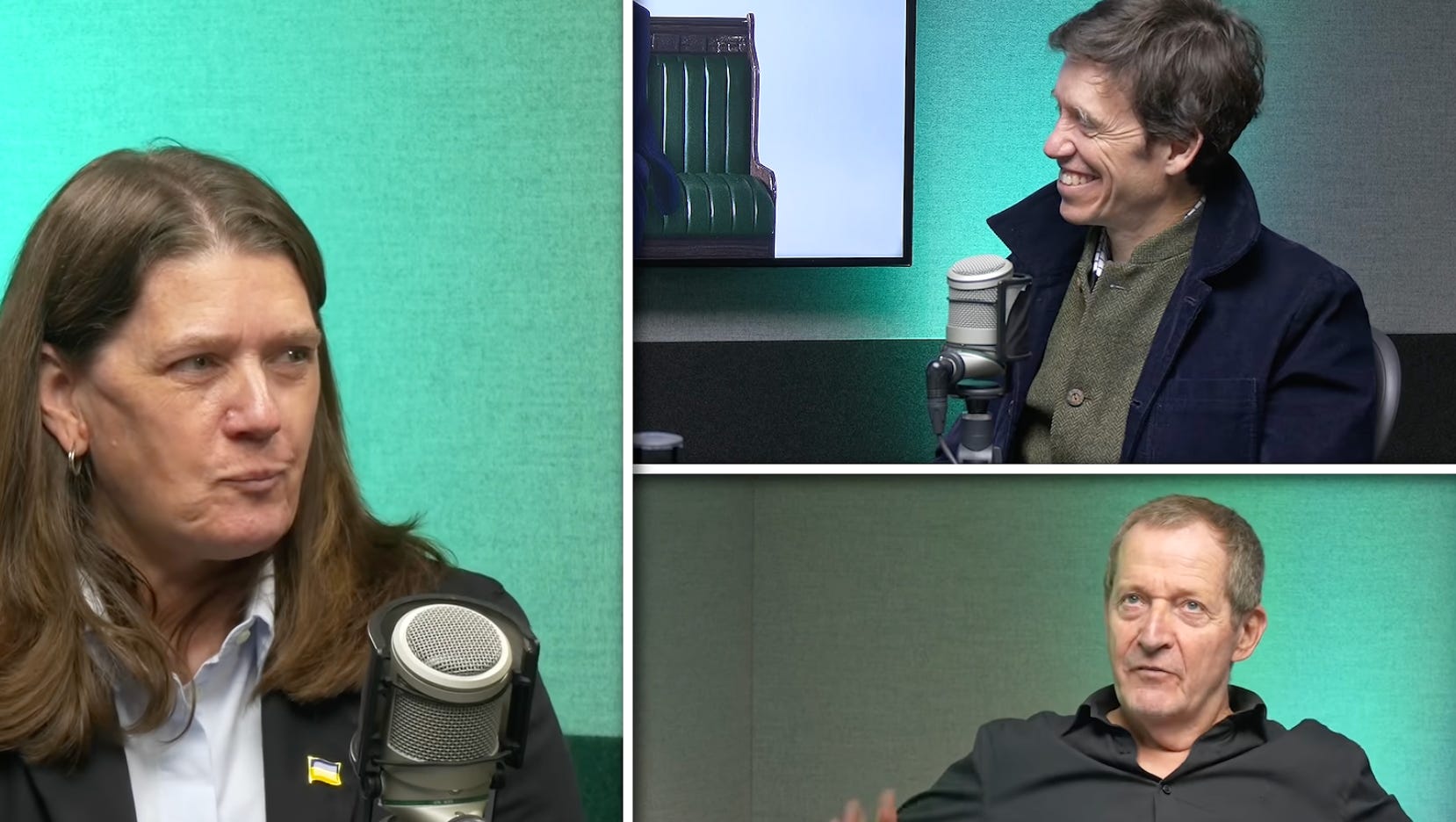
I had a great interview with Alastair Campbell and Rory Stewart from "The Rest is Politics" when I was in the UK last week. Please enjoy.
Alastair Campbell: I think Donald Trump is narcissistic, mendacious, incompetent, corrupted, and a deeply maligning force in the world. History will judge him as the worst president in history. Today we are joined by someone who thinks on similar lines but who speaks from a much greater authority than I could ever hold because she has known him all her life. Mary Trump, his niece and the only woman in the world who can call him Uncle Donald. The picture she paints is not a pretty one, but it might help us answer this critical question: if he really is so bad, so empty, so cruel, so broken as a human being, what does this say about America and indeed our world that he became its president not once but twice, and worse the second time around?
Rory Stewart: Mary, I guess firstly, welcome. Can I start on a slightly different level: what does it feel like to get that kind of introduction? Is it a bit unsettling? Are you getting tired of having to talk about your uncle?
Mary Trump: The introduction was spot on. That is an excellent summation of where we are and that very important question: how did we get here? Maybe tired is not putting it strongly enough. I’m sick to death of having to talk about Donald Trump because he is still such a relevant presence in our lives. That is both tragedy and travesty. We have gotten to this place where we cannot ignore him. There was a time in American politics where that would have been the best thing to do, but we are beyond that now because he is having a very real, deleterious impact every single day throughout the world, and it is actually getting worse.
Rory Stewart: Was there a time when you thought you were done talking about it, and then realized it actually matters?
Mary Trump: In 2024, when I thought there was a possibility either Joe Biden or Kamala Harris would win, that possibility dissipated pretty quickly as the election got closer. I thought if Kamala Harris won, I am done. I would not have been done talking about American politics because we would have still been in the woods, but I would not have spoken about Donald again unless and until he reared his head again. Clearly that did not happen. So I still think it is necessary and I do not see a recent future in which it will not be.
Alastair Campbell: There is an extraordinary passage in your book where you describe your grandfather, Fred Trump Sr., as a high-functioning sociopath. What was he like?
Mary Trump: My grandfather was a constant presence in my life, but we were not close because he was not really close with anybody. He had no emotional depth and his priorities were his business, which is to say making a lot of money, and his family, which is to say making sure he had somebody to take over and extend his legacy. My grandparents lived in Jamaica Estates, Queens, and we lived in the next town over. When we were kids, my brother, I, and my older cousin, we were at my grandparents’ house every weekend. My grandmother was more of a presence, but we were not close either until well after my dad died when I was sixteen. There was no real emotional connection. We did not have long, deep conversations about anything. We certainly never talked about our feelings. So my grandmother was very closed off in ways and not emotionally available. I think she had a lot of physical ailments and also some emotional and psychological problems that were never addressed.
Alastair Campbell: “The Cruelty Is the Point.” What was it like feeling that? Did you feel it at the time that this was about being cruel, that if you wanted to be strong, you had to be cruel? And that was actually why your grandfather did not really care for your dad?
Mary Trump: The cruelty is the point was a phrase coined by journalist Adam Sewer, and it does go a long way to understanding how Donald behaves. He got that from my grandfather because for reasons I still do not quite understand, my grandfather needed his sons to be killers. They had to be tough. When you grow up in a family in which things like kindness, empathy, generosity, and sensitivity are considered weakness, that is getting you off on the wrong foot. Donald had my father as an object lesson. My dad was about seven and a half years older and was supposed to be the next in line to take over the family empire. He was kind and sensitive and funny and generous. He was an expert boatsman and fisherman. He got his pilot’s license when he was in college on his own. He was in the ROTC and then joined the National Guard. All of these things were completely anathema to my grandfather. So over time, even though my dad had started as the one my grandfather was grooming, he realized that my father was not the person he wanted. He systematically, over the next couple of decades, dismantled him entirely and humiliated him.
Alastair Campbell: And Donald plays a big role in that as a child.
Mary Trump: Yes. The lesson he learned was do not be anything like Freddy. Do not be kind. Do not be empathetic. Do not be sensitive. You have to pretend that you have no emotional needs and the only way to make it in this world is to kill everybody else off, metaphorically speaking, and literally now. That is who Donald knew he had to become so he also would not get killed off because that is essentially what my grandfather did to my father. He dismantled him to the point where he could not survive this life anymore. So that led to Donald’s tamping down any instincts he might have had that would have led to his being what my grandfather would have considered a loser. And there was nothing worse you could be in my family.
Alastair Campbell: When he dies and there are disputes over the will, your grandmother essentially said, “I would not worry too much. There is nothing there anyway.” As if your grandfather was just a conman. What did she mean?
Mary Trump: What she said to me word for word was, “Do you know what your father was worth when he died? A whole lot of nothing.” That is literally what she said about her own son who died at the age of forty-two. What she meant was he had nothing. He was worth nothing literally and metaphorically. That is the entire calculation in this family. Therefore you should also get nothing. In my grandfather’s will, we were not mentioned in it. We were referred to as the issue of Fred C. Trump Jr. We were not even named. So that is what they thought.
Rory Stewart: How large was the estate your grandfather left?
Mary Trump: It was worth about a billion dollars. Our expectation, if things had been fair, is that my brother and I would have split twenty percent of the estate because my grandfather had five children, but we got nothing because my dad was worth nothing.
Alastair Campbell: There is so much that is unbearable in this. I mean, there are so many extraordinary passages in this book. I just wanted to read one because it sort of captures something that is still true today. This was written at the end of his first term in July 2020. You wrote:
Donald today, as much as he was at three years old, is incapable of growing, learning, or evolving, unable to regulate his emotions, moderate his responses, or take in and synthesize information. Donald’s need for affirmation is so great he does not seem to notice that the largest group of his supporters are people he would not condescend to be seen with outside a rally. His deep-seated insecurities are created in a black hole of need that constantly requires the light of compliments that disappears as soon as he has soaked it in.
That is far beyond garden variety narcissism. Donald is not simply weak. His ego is a fragile thing that must be bolstered every minute because he knows deep down he is nothing of what he claims to be. He knows he has never been loved, so he must draw you in if he can by getting you to assent to even the most seemingly insignificant thing.
Alastair Campbell: And when you read that, you see Trump today. Just this week fighting with a tiger on AI because someone got killed by a tiger and he is basically saying I would have killed the tiger. I mean, we are talking about monstrousness here.
Rory Stewart: Take us back to the early days of Donald Trump. He was two and a half years old when your grandmother was hospitalized. You mention this was a critical period.
Mary Trump: My grandmother was advised not to have any children after my Aunt Elizabeth, but my grandfather wanted to have five children. So they had Donald and then very shortly after, my uncle Robert. And then nine months after Robert was born, my grandmother got very ill and had to be rushed to the hospital. Over the course of a couple of weeks, she had several surgeries, and for about a year, she was in and out of the hospital and either physically or emotionally absent because even when she was home, she was in a great deal of pain and could not participate in any child rearing. So that left Donald, who was two and a half, which is a critical period of emotional, psychological, and physical development for children, completely alone because my grandfather was not going to provide any of the actual caregiving that children that age need. That set Donald up to become the person we see today. Even when my grandmother recovered, she never made up for the ruptures that happened during that year and never developed an emotional closeness with any of her sons. But Donald was particularly vulnerable.
Alastair Campbell: And what about Donald Trump as a father? What sense do you have of his relationship with his children?
Mary Trump: I did not see much because his children basically belong to a different generation. Donnie is twelve years younger than I am, and Ivanka is I think sixteen years younger. I really only saw them at Thanksgiving and Christmas, but he was an entirely hands-off father. He had no real interest in his children. When Ivanka got older, he had this very odd attachment to her, but I cannot exactly say that it was paternal. She was constantly sitting on his lap, and I cannot really explain it, but I found it odd and off-putting. But he did not have any real emotional connection, certainly not to the two older boys.
Alastair Campbell: Has he ever read a book?
Mary Trump: No. And neither has my grandfather. The only reading I ever saw Donald do was newspaper clippings about himself. He has literally no intellectual curiosity whatsoever.
Alastair Campbell: Why has he been seemingly so successful in his own terms? Why has he been able to build the profile to win an election, then lose but pretend he has not, and then win again?
Mary Trump: He has literally no redeeming characteristics whatsoever. Strengths are different from redeeming qualities. The question of how this man who was objectively weak, insecure, unaccomplished, unintelligent, and failed, was allowed to accrue the kind of power, influence, and money that he has accrued is the question we are going to try to answer for the rest of our lives. I think it is a perfect storm of things. It is the decline of independent objective media, social media, which I think has eroded people’s capacity for critical thinking. It is the decline in our system of education, the cultural shift driven by the right in our country away from enlightenment principles and a lack of belief in science. There is a turning away from investment in the things that matter most: science, the arts, the humanities. And a focus on greed, the accumulation of wealth, and the ability of people on the right to convince people that things like the social safety net are bad and that the common good does not exist anymore.
Alastair Campbell: We interviewed Gavin Newsom and he said, “Without Rupert Murdoch, there is no Donald Trump.” Are you of that opinion?
Mary Trump: I would go back further. I would say if Richard Nixon had been held accountable for his crimes, we would not have Donald. If he had gotten convicted and gone to prison, that would have set a marker. That would have said, “We do not care who you are. Even if you are president of the United States, you are not above the law. Anybody else who committed the crimes he committed would have gone to prison.” In fact, everybody else in his administration pretty much went to prison. So why should he be exempted? And now we have our corrupt, illegitimate super majority on our Supreme Court, essentially making Donald Trump an imperial president who is constitutionally beyond the law according to them.
Rory Stewart: The great question for a historian is how did a mediocre man take power? Sometimes we use the word charisma to try to describe this. Is the problem that it is a charisma that does not work on you but you can sort of see it working on other people?
Mary Trump: You are exactly right. And I think that is why so many people who think the way we think have such a difficult time grappling with this because they do not experience the charisma, and yet that does not mean it does not exist. If you had the great misfortune of meeting Donald, and I do not know if this is true anymore because he has become so degraded over the last two years in particular, but the first moment you meet him, you would get it. He does have that innate ability to connect with people in a way that makes them feel seen and understood. A lot of politicians have that ability. He is this wounded victim and he wants you to feel bad for him and then become responsible for assuaging his pain. It is very manipulative and entirely unconscious, but it is effective.
Rory Stewart: Can you give an example from your own experience?
Mary Trump: I had not seen him in about ten years or something when I went to the White House for my aunt’s birthday party in April of 2017. It was weird, unsettling, and awful. When I first saw him right before we went into the dining room, he pointed at me. He said, “I specifically asked for you to be here.” I was like, “No, you did not.” But if I had not known that he was full of it, I might have felt like, “Oh, well, that is sweet.” That is what he does. And there are clearly plenty of people on the planet who are susceptible to that kind of charm or charisma because he is objectively now a very, very wealthy, very powerful man.
Alastair Campbell: One thing that is difficult to understand is how the corruption can just be happening in plain sight. You say he has no sort of normal paternal relationship with his sons, but my God, he is making them rich. Has he got a similar succession thing going on in his head that your grandfather had?
Mary Trump: No, actually, which is interesting because my grandfather really did care about his legacy and really did want his empire to exist in perpetuity. For Donald, he is a nihilist. He does not think anybody can exist after him. I also do not think he believes he is going to cease existing ever. There is a reason he has not picked a successor to be the next Republican president because nobody could be as good as he is. He will just keep being president. With his sons and their wealth, that is just a reflection. It just reflects well of him if they are really rich too.
Rory Stewart: When he came in for the second time, some commentators said he is an isolationist who just wants Europe to pay more for Ukraine. But what it turned out to be is Europe should fail. He was going to invite Putin to Alaska. He is going to lift sanctions on Russian diesel. It is not that he wanted Europe to pay for it and succeed. It seems he expected Europe to fail.
Mary Trump: That touches on two things that are important to him: money and humiliation. During his first term, he was talking to police cadets and saying, “Hey, when you have a suspect and you are putting him in the back of the police car, do not worry if he hits his head.” And now we have ICE agents, a government agency, murdering American citizens in the streets and nothing is happening. Now we are in a war of choice against a country that did not provoke us. Now we are abandoning our democratic ally so Donald can enrich himself with this deal with Russia. So it just gets people used to things. The reason this is happening now is because one of the few things Donald is good at is softening the ground, making the unacceptable acceptable over time.
The corruption is way out in the open, and we have been told forever that with Donald, it is baked in. That is just who he is. So there is no judgment and it is dangerous and that is a failure on the part of the media. We have this guy who only cares about money and power using his greed and his desperation to humiliate our allies so that he can feel like he is like Putin, he is like Xi, he is like Kim Jong-un. He is president for life. He is a totalitarian dictator.
Alastair Campbell: Is he jealous of them? Do you think he has flipped sides or do you think he was always on Putin’s side?
Mary Trump: Oh, absolutely he is jealous of them. He has been on Putin’s side since the eighties, I believe. The betrayal of Ukraine is just obscene. Donald has made it clear from the beginning that he is not really interested in protecting Ukraine. He has dragged his feet. As soon as there is any pushback from Putin, he is making it very clear whose side he is on.
Rory Stewart: When Donald Trump is no longer with us, there will be people in Europe who just hope that everything can go back to how it was. But the thing is, his awfulness has actually revealed the truth about a certain American view, which is pretty permanent. What he has shown by showing American power and vulnerability, by showing that he does not really care about universal values, makes it very difficult for anyone who follows him to rebuild the kind of trust that existed before. And when you hear Marco Rubio, when you hear JD Vance, when you hear Stephen Miller, when you hear Hegseth, you think it is not just Donald Trump. There is something out here that Europe and Canada need to be serious about.
Mary Trump: I agree. I take no pleasure in agreeing with you, but it is true and we do not do ourselves any favors by pretending otherwise. It is not just Donald. Donald has been enabled at every step of the way. If there had been a mechanism in place that the Republican Party had been willing to use to contain him, to restrain him, we would not be having this conversation. There are thousands of co-conspirators here who need to be held just as accountable as Donald, and they will be the ones waiting to be next in line to continue this path we are on. In America, we cannot go back. We need to completely reshape, remake, and reimagine who we are as a country, because right now there is literally no reason I can see that any of our allies would ever trust us again, unless we do very hard work in the next couple of generations, not just to undo the damage, but to prove that we can be trusted. That is going to require some serious soul searching and a willingness to step back and acknowledge what we have done.
Rory Stewart: I am fascinated by the way that Donald Trump talks about men. His constant commentary on how handsome they are. He was checking out some guy’s ass the other day. What does that suggest to you?
Mary Trump: I have a terrible gaydar actually, but what I do know is that he talks more admiringly about men physically than most straight women I know. So it is very alarming, but I think it is just a sign of how his impulse control is eroding. He cannot help it. He has no filter anymore. He has never had much impulse control, but it is completely gone. We see all sorts of signs of disinhibition. He was at a rally and he just threw a glass of water on the floor for no reason. And now he is talking about men’s asses and checking them out in front of thousands of people. It is deeply weird, especially since he has been known since Roy Cohn was diagnosed with AIDS back in the eighties, his notorious lawyer, for being a virulent homophobe. So your guess is as good as mine, but I think it might be diagnostic.
Rory Stewart: Let us finish on the diagnostic thing. You did a doctorate in clinical psychology. What insights does that give you into your uncle, and also what are the limits of trying to do a psychological diagnosis on a family member?
Mary Trump: The advantages are the fact that in addition to the clinical training, I have the personal insight and experience with this family. The book itself, I consider it a psychological history of a family. It is more about the family system and the impact it had on his psychological development. The limits are that diagnosis is a process. You cannot just diagnose somebody because you have seen them a lot. You need to test them. But I think the biggest limit, even though I have a pretty clear assessment of what his clinical profile looks like, is that it kind of does not matter anymore. Look at what he is doing. Look at the impact he is having. Does it matter if he is a malignant narcissist or a sociopath? I do not think it matters anymore because we are dealing with the fallout of his very troubled upbringing and what that has not just done to him, but to the rest of us as a result. We are just living in his world and we have got to figure out how to get out of it.
Rory Stewart: What do you think his psychological profile is, as a clinical psychologist?
Mary Trump: I think Donald presents as somebody who probably has some kind of learning disorder. From what I understand from my experience, he drinks dozens of Diet Cokes a day. He is probably sleep disordered and has some kind of dependence on caffeine. He has multiple personality disorders. He has dependent personality disorder, narcissistic personality disorder, probably a couple of others, and antisocial personality disorder, and that is on a spectrum. He is way on the sociopathy side of that spectrum because as we know, he has no empathy. He has no problem breaking the law, breaking the rules, and he is cruel. He is a deeply psychologically disordered person who has never been formally diagnosed, therefore never been treated. All of those conditions have been deteriorating over the last seven or eight decades, which is terrifying.
Alastair Campbell: : Mary, thank you for joining us.

Dear Mary, please notice that all public figures in every human culture would benefit greatly from an intensive course in sitting down and shutting up.
Hi Mary, I listened to it yesterday with great interest. I really appreciated your insights into the Donald. It sounds like your father was treated horribly by his father and brother. Your insights also helped me make sense of this horrible human being who is POTUS. Unfortunately I believe we get the Politicians we deserve. Best wishes to you.