


[Transcript edited for clarity and flow]
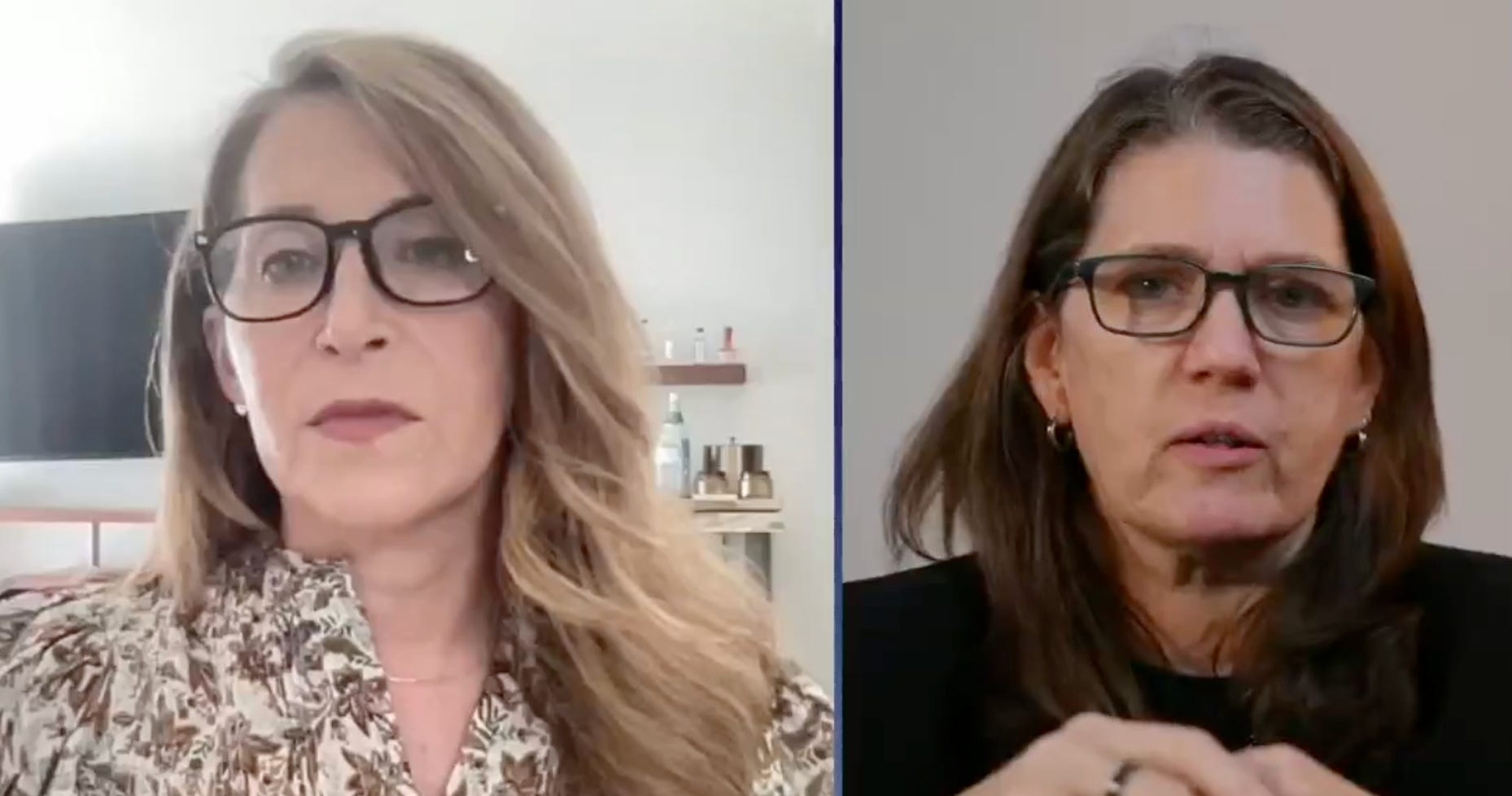
Big Tent USA invited me to sit down with Jessica Yellin, former White House correspondent for CNN, journalist, and founder of News Not Noise. We had a fascinating, wide-ranging, in-depth conversation about Donald’s state of mind, the state of America, and what a path forward looks like, not only for American politics but for the American people.
Jessica Yellin: I want to start with what’s happened this week at the NATO summit. There’s so much we could discuss, but just yesterday Donald appeared to call Volodymyr Zelenskyy “Putin.” He referred to the Islamic Republic of Japan. For months we’ve consistently seen bruising on his hands, reports of swelling in his legs, and he frequently appears to be falling asleep in public.
As a psychologist, and as someone who knows him personally, how do you assess his current mental and physical state?
Mary Trump: I think the most important way to understand where Donald is emotionally, psychologically, physically, and cognitively is to recognize that we’re looking at a perfect storm.
He’s somebody who has lived for decades with longstanding, undiagnosed, and untreated psychiatric disorders. As with many illnesses, including psychiatric illnesses, when they’re left untreated, they worsen over time.
We also know, from Donald himself, that he is continually being asked to take cognitive assessments, which suggests there may be concerns about cognitive decline. Alzheimer’s disease runs in my family. I’m desperately hoping it skips my generation, but there is a very strong genetic component. There are many moments when I see striking similarities between Donald’s behavior and my grandfather’s behavior as Alzheimer’s progressed.
As you mentioned, there’s the hypersomnolence. He simply cannot stay awake during the day unless people are talking about him. That appears to be the only thing capable of keeping him alert.
We also see increasing impulsivity, which can be another symptom of cognitive decline. My perspective comes partly from my background as a clinical psychologist and partly from having watched what happened to Donald’s father.
Then there are the obvious physical symptoms: the swelling in his hands and ankles, the bruising, and his growing difficulty walking normally. There is so much happening simultaneously that it shouldn’t surprise us he’s becoming increasingly erratic, belligerent, and violent.
Jessica Yellin: Violent.
Mary Trump: Yes. Just listen to his rhetoric about Iran. It’s completely unhinged.
Jessica Yellin: There’s a bloodlust to it that’s deeply unnerving.
I’m curious what you think the public most misunderstands about Donald Trump.
Mary Trump: I think part of the misunderstanding comes from the fact that people are being encouraged to misunderstand him.
We’ve heard former supporters, including people like Marjorie Taylor Greene, say that Donald isn’t the same man they once knew. The truth is almost the opposite. Because of his cognitive and psychological decline, we’re actually seeing more of who he has always been. He’s simply no longer capable of hiding it as effectively as he once could.
The other thing people consistently overestimate is his strength.
Donald is an extraordinarily weak person. One of the reasons he’s been allowed to continue behaving this way for so long is that people confuse the enormous power of the office he occupies with personal strength. Those are two entirely different things.
He possesses tremendous institutional power, but as an individual, he is profoundly weak. Unfortunately, too many people have been intimidated by the office and, as a result, missed countless opportunities to challenge him directly.
His vindictiveness is actually one of the clearest signs of that weakness.
Jessica Yellin: You’ve often said that if we understand Donald’s psychology, we’ll understand how to deal with him. How does what you’ve just described explain the election lies, the loyalty demands, the rage whenever he’s criticized, the constant lying, and the greed?
Mary Trump: It’s a really important question.
The explanation sounds almost too simple, but I genuinely believe it’s the truth.
Donald has always been, and remains today, a terrified little boy.
As an adult, the thing he fears most is being exposed as a loser, being seen for who he truly believes himself to be.
In my family, being considered a loser, according to my grandfather’s definition, was essentially a death sentence, literally or metaphorically. Donald witnessed what happened to my father, who was the oldest son and more than seven years older than Donald. He internalized that lesson at a very deep level.
So Donald spends every waking moment trying to avoid being exposed as the failure he believes himself to be.
More fundamentally, however, Donald is what I’ve long described as a black hole of need.
The tragedy for him, and for the rest of us, is that the thing he has always wanted most is to be loved. Because of the way he was raised by a sociopathic father and a deeply dysfunctional family, he became incapable of accepting genuine love.
That leaves him endlessly trying to fill the void with more money, more power, more praise, more threats, and more violence.
None of it is ever enough.
Take the military parade he staged for his birthday, that astonishingly expensive spectacle on the White House lawn. That was another attempt to fill the emptiness inside him.
He probably woke up the next morning feeling exactly as empty as he did before.
Jessica Yellin: Today he’s covering part of the North Portico with construction while redesigning the White House yet again. It’s almost as though he can’t stop changing something that belongs to the American people.
If someone understands narcissism, they know it can’t simply be fixed. But it can sometimes be managed. We’ve seen Donald react strongly to ridicule and to having his incompetence exposed.
Why do those approaches work better than ordinary criticism?
Mary Trump: That’s such an important question because so many people have fundamentally misunderstood how to deal with him, and that misunderstanding has only increased both his power and the damage he’s capable of causing.
The worst mistake you can make is allowing Donald to believe you think he’s strong.
Calling him a criminal, a thug, or even a rapist doesn’t necessarily affect him because he often interprets those labels as evidence that he’s tough.
We’ve seen that repeatedly. Every time he escaped accountability, portions of his political base became even more devoted to him.
At the same time, we’ve watched universities, prestigious law firms, NATO allies, and major media organizations capitulate.
Every capitulation teaches him he can push farther.
One thing Donald has always been remarkably good at is testing boundaries. He keeps pushing until somebody finally says no. Unfortunately, far too few people have done that.
Whenever a reporter asks a factual question he doesn’t like, especially if it’s a woman asking it, he loses control.
We need more of that.
I’ve often wondered why White House reporters didn’t coordinate their efforts. If he refused to answer one question, why didn’t the next reporter ask exactly the same question, and then the next?
He’s the President of the United States, not a king.
He owes the American people answers.
For far too long, he’s been allowed to avoid giving them.
The other tool we have is ridicule.
Donald is eminently mockable. He’s incompetent. He’s frequently out of his depth.
Whenever someone holds up a mirror and forces him to confront reality, he falls apart.
Jessica Yellin: I’ve often thought if I ever interviewed him, I’d simply ask the same question over and over with slight variations. Eventually he wouldn’t be able to escape it.
Why can’t he answer?
Mary Trump: Because so much of what drives Donald exists outside his conscious awareness.
If he were forced to confront the truth about himself, I genuinely don’t think he’d be psychologically capable of functioning.
He’s built extraordinarily powerful defense mechanisms to protect himself from that reality.
When somebody else points out the truth, he experiences it as an existential threat.
The missed opportunity came years ago, long before he became president.
Back in the 1980s, and again during the 2015 and 2016 campaign, journalists could have pressed him much harder because he couldn’t yet hide behind the presidency.
Nobody demanded evidence when he claimed to know more than military generals or insisted he substantiate his endless exaggerations.
Today, when he doesn’t like a question, he simply removes the microphone, walks away, and throws a temper tantrum.
Jessica Yellin: According to recent reporting, only a very small group of people are effectively running the government around him.
Has his inner circle become smaller?
Mary Trump: Donald has never evolved.
My grandfather created the myth that Donald was a brilliant, self-made businessman, then spent decades protecting him from the consequences of his own incompetence.
Once my grandfather decided Donald, rather than my father, would inherit the family business, Donald became completely insulated from failure. During my grandfather’s lifetime, he received more than $410 million through gifts, loans, and forgiven loans.
He’s never had to function independently.
In many ways, Donald has always been institutionalized.
He moved from the protection of Trump Management to the Trump Organization and ultimately to the White House.
He requires a tiny group of people to satisfy not only his material needs but also his emotional needs by constantly reassuring him that he’s wonderful, brilliant, popular, and successful.
The danger is that those people acquire enormous power in return.
When people say someone like Stephen Miller is effectively running much of the government, I think there’s truth in that.
That’s a frightening reality.
Jessica Yellin: Why do Republicans remain so obedient?
Mary Trump: I think there are several different groups.
Some people are simply cynical. They understand that if they donate enough money or remain loyal, they’ll receive enormous financial rewards through government contracts or political influence.
Others are genuinely afraid of Donald.
Personally, I’ve never understood that because I don’t see him as frightening. But fear clearly motivates some people.
Then there are the true believers.
Those are the people who genuinely embrace the cruelty, the racism, the misogyny, the anti-immigrant rhetoric, and the authoritarianism.
They’re helping build exactly the country they want.
Those groups present different dangers, but together they’ve made Donald far more powerful than he ever could have become alone.
Jessica Yellin: As we approach the election, what should Americans focus on?
Mary Trump: Donald desperately needs Republicans to win because he knows losing could finally expose him to accountability.
Ironically, his efforts to rig the system demonstrate weakness, not strength.
People who know they can win fairly don’t spend all their time trying to suppress votes or manipulate elections.
The response is simple.
Vote.
Vote in overwhelming numbers.
Despite everything this administration and the Supreme Court have done to make voting harder, we must overwhelm those efforts through participation.
If pro-democracy, pro-Constitution candidates prevail, we still have an opportunity to repair the damage.
If we fail, the challenge becomes much greater.
Jessica Yellin: What gives you hope?
Mary Trump: Looking away doesn’t help anyone.
Things are difficult. They’re frightening. Pretending otherwise serves no purpose.
At the same time, hope comes from other people.
Many powerful institutions have surrendered, but countless individuals have not.
People like E. Jean Carroll, Letitia James, dedicated public servants, neighbors protecting one another, and ordinary Americans standing up to injustice every day remind us that courage still exists.
Community matters.
History teaches us that some of humanity’s greatest advances have emerged from its darkest moments.
America has always possessed extraordinary potential.
We still have the opportunity to become the truly representative, multicultural democracy we’ve always claimed to be.
That possibility remains within our reach if we continue believing in one another and remember that, ultimately, the power belongs to the American people.
Jessica Yellin: That reminds us exactly what’s worth fighting for.
Thank you so much, Mary. I’ve admired your work for a long time, and your willingness to bring both your personal experience and professional expertise to these conversations helps people understand what’s happening and empowers them to act.
Mary Trump: Jessica, thank you. This has been such an incredible conversation. I don’t often have the opportunity to speak this deeply with someone who has such a profound understanding of what’s happening. I truly appreciate it, and I had a wonderful time.


Thank you for this transcript.
Mary, you appear to have hope that the country will get through this. I sincerely hope you are correct.
As far as the vulgarian changing? As MTG says? Nonsense. He's exactly the same person I saw lying to Tom Brokaw and sneering at "affordable housing," on The Today Show, 46 years ago. He may have gotten meaner; he is certainly less articulate, but that basic personality is just the same.
Thanks Mary. Your opinions and thoughts are always appreciated. Thank you for inspiring us to continue believing in hope for the future.