


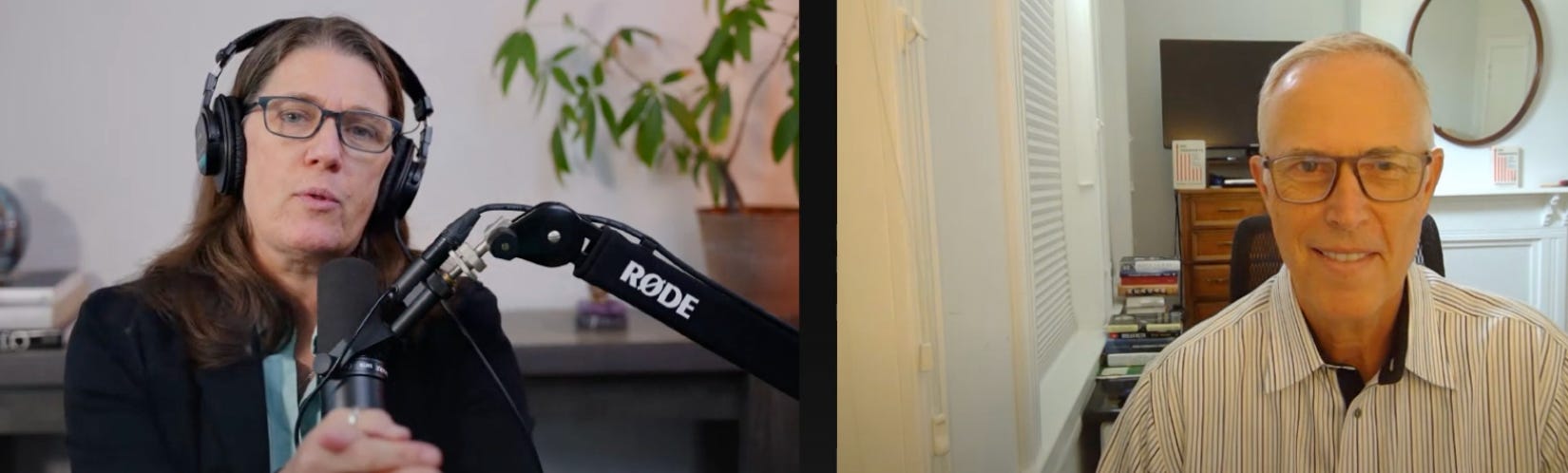
Watch entire conversation here.
[Transcript edited for clarity, flow and length]
Mary Trump: Representative Jared Huffman, it is so fantastic to be here with you. Meeting you and members of the Free Thought Caucus taught me a lot about what’s going on in Congress right now—both the troubling challenges we face and the good work being done to address them.
Rep. Jared Huffman: Mary, it’s great to be on your platform. We founded the Congressional Free Thought Caucus in 2018 with Jamie Raskin. We are really the tip of the spear in defending church-state separation against what amounts to a Christian nationalist theocratic onslaught. This theocratic threat is not hypothetical. These folks are entrenched throughout our government, and it is time for those of us who actually care about real freedom to take this threat seriously.
Mary Trump: I’ve long believed that the separation between church and state is one of the most important foundational concepts in our government. But this is fundamentally a bipartisan problem. It’s very difficult to have a conversation about Christian nationalism, which is interconnected with white nationalism and the America First movement, without being attacked as anti-Christian. You talk about this extensively in your phenomenal book, No Profits, which everybody needs to read.
Rep. Jared Huffman: Republicans have solved that problem by throwing all in with conservative Christian extremists. They are now the party that has fused Christian nationalism with their party platform. Yet most Christians in this country actually reject this. Meanwhile, Democrats have our own problem. Most of my Democratic colleagues don’t want to talk about it at all, even when it’s on a collision course with democracy. We have failed to embrace religious freedom as the message that ought to define where we’re meeting voters.
Mary Trump: You grew up in a very devout family. Could you talk about what started challenging your perceptions and the basis for those beliefs?
Rep. Jared Huffman: Most people of faith are born into their religion. For me, it was the Reorganized Church of Jesus Christ of Latter-day Saints. I was ordained into the priesthood when I was nineteen. But in college, I began to question many of the basic theological precepts. There wasn’t a traumatic event. I grew up in a loving, wonderful religious community that wasn’t political at all. But once you start questioning, it’s tough.
Losing your religion can be really hard. It took me years to figure out that the values I liked about my faith—goodness and decency—are available in all faith perspectives and in none. So I settled on humanism as my religious label. Humanists believe we have a duty to lead moral lives based on science, facts, and critical reasoning—not because of any inducement of an afterlife, but because we’re humans and we should be good.
Mary Trump: At UC Santa Barbara, you had a professor named Walter Capps who challenged your assumptions. That experience underscores the importance of getting outside the silo. Everyone seems so closed off from ideas that challenge us now.
Rep. Jared Huffman: We shouldn’t be threatened by debate. We should welcome it. Walter Capps taught a religious studies course when I was a junior. That chapter in my book, “Not Your Parents’ Culture War,” maps out the historic arc from the Moral Majority of the 1980s to today’s MAGA Christian nationalist movement. Back then, the premise was that a majority of Americans could be mobilized through democracy. But it didn’t work. They lost the culture war.
In 1999, Paul Weyrich, one of the architects, said something crucial:
We were wrong. For two decades, there was no moral majority. The American people will never agree with our hardcore fundamentalist agenda. We have to now shift to anti-democratic tactics.
That shift is how we got from the majoritarian Moral Majority to today’s Christian nationalist movement, which is openly at war with democracy, explicitly theocratic, and willing to use any means necessary, including violence.
Mary Trump: I want to talk about your first swearing in and the awkwardness around which book you would be sworn in on. That really resonated with me because it shows how deep this goes.
Rep. Jared Huffman: I’m still cringing hearing you recall that story because it was cringey. My first day in Congress, my eighty-three-year-old mom was with me. When I got up there with John Boehner, the speaker said, “Okay, who wants to hold the Bible?” I froze. I was a humanist who didn’t believe in any sacred text, but there was my religious mom, just beaming with pride. I didn’t want to break her heart. So I sheepishly put my hand on this big white Bible. I felt very sullied and cheapened.
But it was the beginning of an eye-opener because I was shocked at how religion and Christianity is just baked into so many traditions, customs, and procedures in Congress—different even than in the state legislature where I’d served.
Mary Trump: You are now openly the first humanist and atheist running openly in Congress.
Rep. Jared Huffman: Openly. That’s an important disclaimer. I would have kept it to myself. That was my plan. I’m the environmental guy. But when I watched Donald Trump weaponize Christian nationalism in 2016 and bring fringe religious fanatics into government, I couldn’t stay silent anymore. I had to step out of my environmental lane and become part of the fight to defend church-state separation. I felt like I couldn’t do that while being coy about my own belief, so I came out.
Mary Trump: That takes courage. You proved that you can be openly humanist or atheist in the United States and still win reelection. But many Democrats continue to be so afraid of making the distinction between regular Christian belief and Christian nationalism. This fear enables all of it.
Rep. Jared Huffman: I was certainly told that if you do this, it will be career ending. I’m seeing more people who are either non-religious or openly agnostic. I’m less of an oddball all the time. But you’re right that even my Democratic colleagues have a real dysfunction about this. I thought January 6th would be the wake-up call we needed to get over this taboo about scrutinizing Christian extremism. But most colleagues looked away, and that’s a big part of why I wrote this book.
Mary Trump: The decision made by the January 6th Select Committee not to include the role of Christian nationalism, even though it was overwhelming and crucial, is astonishing. Liz Cheney apparently had veto power. Could you talk us through this?
Rep. Jared Huffman: The evidence that Christian nationalism was at the heart of January 6th was overwhelming. The very first witness the committee interviewed was a cop who got beaten. He talked about how these people thought they were doing God’s work. They carried Christian symbols, talked about Jesus Christ. I could go on, but the evidence was overwhelming.
I tell in this book a story you haven’t heard anywhere else about how the Select Committee was on a course to talk about these things. The staff wrote reports. Most members were fine with including it. But Liz Cheney did not want to offend Christians, and she did not want to give Fox News material to undermine the committee’s credibility. That subject is just so culturally radioactive that it’s easier for most members to look away. That’s dangerous because this movement has grown stronger since January 6th.
Mary Trump: Failing to call out Christian nationalism was a huge factor in getting Donald back into the Oval Office. We’re constantly capitulating to those willing to use any weapon. The vast majority of Christians don’t want to be associated with Christian nationalists, but that case was never made.
Rep. Jared Huffman: Exactly. The vast majority of Christians reject these extreme beliefs and tactics. But we didn’t even get to have the conversation. Adam Kinzinger, an evangelical Christian on the committee, told me this coup was the whole story about Christian nationalism. He wanted this in the report. He thought it would be easy to explain these are views rejected by most Christians. But Liz Cheney carried the day. They just regrouped. Donald doubled down on these folks as shock troops in 2024.
Mary Trump: So much of this is based on the fact that people don’t know their history. Most founders were Enlightenment thinkers, deeply influenced by Enlightenment philosophy. It seems like the Dark Ages is what’s infiltrating right now.
Rep. Jared Huffman: The Enlightenment is being relitigated right now. A hundred years after the Scopes Monkey Trial, we’re trying to send public money to church schools that reject evolution and teach creationism. The fake history piece is central to Christian nationalism—that America was founded as a Christian nation and Christians were always intended to have special privileges.
Jefferson was very hostile to the prevailing religious orthodoxy. Ben Franklin invented the lightning rod, and clergy denounced his invention as interfering with God’s will. They wanted to keep sending people up church steeples to sprinkle holy water. Ben Franklin was trying to save their lives with science. Secular education, science, individual liberty, secular governance—these came from Enlightenment thinking that was part of this nation’s foundation.
Mary Trump: How do we wake people up? You point out that Christian privilege is just as entrenched as white privilege. And simultaneously, the “dumbing” of America is happening. Could you talk about that intersection?
Rep. Jared Huffman: On one hand, there’s this cultural taboo. You can’t question anything representing itself as Christian. This is how the movement advances. We’re branded as anti-Christian, as bigots. On the other hand, there’s an open war on institutions of knowledge—science, secular education, the National Science Foundation, public health, climate science. That’s a dangerous combination.
They’re at war with democracy. Many faith leaders I profile want to get rid of the 19th Amendment, rewrite the Constitution to put the Apostles’ Creed in the preamble, get rid of Article Six so only Christians can hold office. These are their own words. Many true believers are in the Trump administration right now—Russell Vought, Pete Hegseth, Speaker Mike Johnson. People don’t vet these folks because of that cultural taboo.
Mary Trump: Where do you see potential for turning this around?
Rep. Jared Huffman: You’re absolutely right that we need this reckoning with Christian nationalism. The chapter “Three Roads to Theocracy” explains the three Christian supremacist factions: the Radtrads, the Theobros, and the New Apostolic Reformation. Each believes there’s a religious duty to conquer government on behalf of Christians. But they hate each other. Each thinks the others are heretic or antichrist.
It’s no small feat that Donald Trump held this coalition together because he doesn’t belong to any group. They each see him as their instrument. It won’t be as simple for JD Vance or Marco Rubio, who belong to one faction. The friction will surface.
But there’s hope. More Christians are finding their voice calling out this movement. William Barber and Reverend Warnock have been exceptional at explaining why this is a bastardization of Christianity. The argument I make is that there may not be enough good Christians to win this fight. This movement is so far along that we’ve got to get the rest of us in the game. Thirty-five percent of the country is either non-Christian or non-religious outright. This is about our democracy and fundamental rights.
Mary Trump: You mention the Free Thought Caucus as an antidote to all this Christian entanglement in government.
Rep. Jared Huffman: The Free Thought Caucus is where we’re fighting this. Jamie Raskin and I founded it in 2018. I thought it would just be the two of us. It has grown to thirty-seven members, which makes us bigger than the Republican Freedom Caucus. The big difference is we actually care about freedom and we are fighting to defend church-state separation.
What folks can do after learning about this movement is urge every member of Congress you know to start speaking out, to join the Free Thought Caucus. Normalize conversation and critical inquiry about this subject. We can revoke the social license we’ve given to right-wing extremists to jam their religion into our government. There are also groups like Americans United for Separation of Church and State, the American Humanists Association, and the Secular Coalition fighting every single day.
Mary Trump: Every member of the House should be in the Free Thought Caucus. What exactly are you saying about your role in democracy if you think joining it is a bad thing? It shouldn’t be controversial.
Rep. Jared Huffman: That’s for sure.
Mary Trump: Please read No Profits: The Fight to Save Democracy from Christian Nationalism by Representative Jared Huffman. It is brilliant, necessary, and enlightening. You will understand why this issue is so critically important as we go forward. Representative Huffman, it is such an honor to have time with you. Thank you for everything you do and for writing this book.
Rep. Jared Huffman: Thank you, Mary. It’s great to be with you.
As democracy faces unprecedented challenges from those who would use religion as a tool for political power, voices like those of Mary Trump and Representative Jared Huffman remind us that the separation of church and state isn’t about hostility toward faith—it’s about protecting both democracy and genuine religious freedom.

They are the biggest threat to this country.
So, Mary, where do you stand on James Talarico? He's religious, but definitely not a Christian Nationalist.