

[Transcripts edited for clarity and flow]
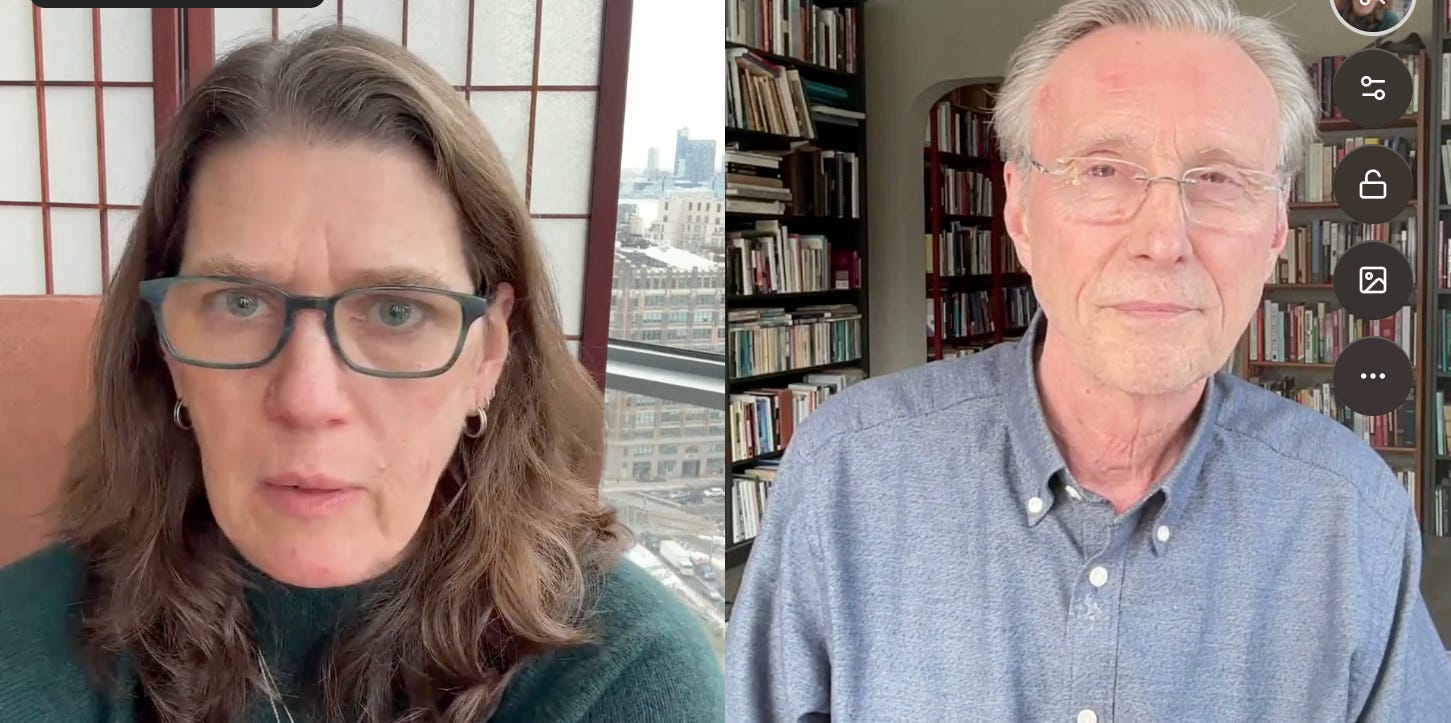
Mary Trump: Tom has a brilliant Substack called The Hartmann Report, is the number-one progressive talk show host in America, and has written so many books you must read it would take our whole time for me to list them. Number-one New York Times bestseller, and a brilliant analyst of our time through the lens of history and what we’re dealing with right now.
Mary Trump: So, in discussing the media, we’re often told that the problem is that—and I think this is a legitimate concern—that information is siloed and people stay in their silos. But the deeper underlying problem is what you just said: it’s the kind of information. Some of the silos are sort of middle-of-the-road news, and then the kind of information a third of the country is getting is straight-up propaganda.
Mary Trump: Two questions. One is, I think we know how we got here. We got here because the Democratic Party, or the left of this country, did nothing to push back against… First of all, they did nothing to build their own media infrastructure, and did very little, if anything, to push back against the lock that right-wing money had obtained over media—especially local media, which is another issue. And what do we do about it? I mean, thankfully we have voices like yours that have been out there for a while laying the groundwork, but it seems to me we’re at a really pivotal point here where it’s independent media or nothing.
Thom Hartmann: Yeah. It seems we’re going through this transition from the industrial age, basically, to the information age—to the data age, to the digital age. And so the solutions that worked, at least prior to the Reagan Revolution, to produce a positive consensus about America—the Fairness Doctrine, the Equal Time Rule—they don’t apply to online stuff. They don’t apply to cable TV. And so there’s a problem there.
Thom Hartmann: I started doing news at WITL, I think in ’68, and we were operating under the Fairness Doctrine. The Fairness Doctrine—most people think it said, “If you have Rush Limbaugh, you have to have Thom Hartmann.” It didn’t. It said you have to do what’s called programming in the public interest. And the main way that was determined was if you carried actual news at the top of the hour every hour—real news.
Thom Hartmann: And in order to help radio and television stations keep their licenses, ABC, NBC, CBS were all losing money in their news divisions, because they had to produce this robust, honest kind of Walter Cronkite news that told the truth. And when Reagan blew that up in ’87, it was less than six months before CBS moved their news division under their entertainment vice president and flipped it into a profit-making thing. And then within a year, ABC and NBC had done the same.
Thom Hartmann: So, number one, I would say bring back at least that provision. But again, that’s only going to deal with broadcast news. Still, you’ve got Sinclair stations out there. You’ve got radio stations out there. If people were actually getting news at the top of the hour on radio and real news in the primetime slots in the evening, I think it would be a good step.
Thom Hartmann: But we’ve got to figure out… France right now is going through this whole thing about how do we deal with disinformation online? And they’re cracking down. I mean, they’re coming after some of these big companies—X and Google.
Thom Hartmann: And I’m real ambivalent about it, Mary, because on the one hand, if we give the government the power to essentially censor media, including digital media, then what happens when the government’s taken over by somebody like your uncle? And he decides, “I will be the arbiter of truth and I’m going to wield this awesome power.” On the other hand, if you do nothing, then you’ve got a situation where a handful of right-wing billionaires basically control the media.
Thom Hartmann: Cumulus is a network that owned about 900 radio stations around the country, and they got bought out by these billionaire brothers. And Bernie was a regular on my program for 11 years—he did an hour every Friday. Bernie invited one of these brothers to his office, and me, and we sat down together. And Bernie was like, “You guys own 900 radio stations. I’ve got kind of a dog in this fight because I’m on Tom’s program every Friday, but have you ever thought about putting a progressive on some of your stations? I mean, you’ve got right-wing talk radio on at least 500 of your stations.”
Thom Hartmann: And this guy said, “I will never put anybody on the air who says that my taxes should go up. That’s my red line.”
Thom Hartmann: And I’d never seen Bernie’s jaw drop, but it did. I mean, he was just like, “I can’t believe he just said that to us.” Wow. I mean, these guys who control the media…
Thom Hartmann: And then you’ve got the algorithms. I remember about 10 years ago, or more or less, the number one progressive website was AlterNet.org, and it was a nonprofit. It was run by a guy named Jan Ritch-Frel—who’s an old friend. And Google changed their algorithm so that they no longer considered AlterNet to be news. And within a month, AlterNet lost 70% of their viewers—or their readers. And within six months they were bankrupt, or within a year they were bankrupt, and they were sold to a for-profit company that now runs it—and also runs Raw Story. So it’s like there’s all these moving pieces, and all this stuff that fits together and doesn’t fit together.
Thom Hartmann: And how do you make it work? I don’t think there are any easy answers. But the biggest problem that we have is that the right-wing billionaires who are involved in media—whether it’s The Washington Post, the LA Times, CBS, now that this family is also trying to get CNN—very aggressively working on that—they have a specific agenda. There are no equivalent left-wing billionaires. None.
Thom Hartmann: I wrote a piece for The Nation magazine four or five years ago begging Tom Steyer to buy Clear Channel out of bankruptcy. It was for sale for only $1.1 billion—935 radio stations in every major market in America. And he was like, “No, can’t do it. Sorry.”
Mary Trump: Wow. I mean, honestly, I can think of a handful of people for whom, if they pooled the resources, that would be the equivalent of what you and I find under our couch—
Thom Hartmann: Cushions.
Mary Trump: It’s just incredible. And I think it kind of speaks to this whole idea that is never addressed: that acquisitiveness is as much a mental illness as any other illness of excess, but it’s not diagnosed that way at all.
Thom Hartmann: Hoarding syndrome. It’s a subset of OCD.
Mary Trump: I’m sorry?
Thom Hartmann: I think it’s hoarding syndrome. It’s a subset of OCD. And I think a lot of these billionaires have a serious case of it. If they’d been born poor, they’d have an apartment floor-to-ceiling newspapers and tin cans.
Mary Trump: That’s very interesting. I’ve never thought of it that way. I think of it more as addiction, but I mean, that is a kind of addiction under OCD. But despite that—despite whether it’s a subset of OCD or a subset of some other kind of addiction—the problem is, at least in America, it’s what we’re all supposed to want for ourselves: unlimited wealth.
Mary Trump: And I think unless and until we fix that problem, which isn’t going to happen anytime soon—we are at the mercy of these people, because I don’t entirely know that there is such a thing as a left-wing billionaire. I think that’s a mutually exclusive term—or, sorry, an oxymoron.
Thom Hartmann: Outside of maybe George Soros, who—I’ve met him, he’s a sincere guy—but he doesn’t have that much money, frankly.
Mary Trump: Who’s to blame for everything, apparently.
Thom Hartmann: Yes. Well, and in part, that’s because he’s Jewish.
Mary Trump: Right. I’ve never gotten a check.
Thom Hartmann: Me neither.
Mary Trump: Yeah. I just want people to know that.
Mary Trump: So I want to shift gears a little bit because this has been yet another crazy week in America and in the world, best exemplified by what I think was supposed to be a State of the Union address, but was anything but. We knew going in, of course, that Donald was going to lie about everything—because he doesn’t have a choice, because everything he’s responsible for is bad. His poll numbers are horrific. The economy is on the brink of something awful. ICE—you name it—everything is quite troubling at the moment.
Mary Trump: But one of the many things that struck me, leaving aside the whole game-show tawdriness of it, was the kinds of things the Republicans in the House were applauding, including their own irrelevance. What do you make of that?
Thom Hartmann: We’re in the middle of a transition from a democratic republic to a fascist authoritarian state—I mean, oligarchy. And the big question is, can that transition be stopped? I think it can be, and I think it frankly is. I think it’s blowing up in his face, which is kind of a different topic.
Thom Hartmann: But you’ve got a whole bunch of Republicans who clap like trained seals at anything he does, and they do it because he has the power of his base. He has the power to kill you politically in a primary.
Thom Hartmann: I suspect, Mary, that we’re going to see something real interesting happen later this summer: once the Republican primaries are over. I got this from Mark Pocan, who comes on my program regularly—he’s a congressman from Wisconsin, former chair of the Congressional Progressive Caucus. He has talked with a number of his Republican colleagues, and he said they are explicit in quiet conversations in the back room: they’re more than happy to call out Donald after their primary is over, because in the general, calling out Donald will actually be a benefit. But going into the primary, calling out Donald means you’re going to get crushed.
Thom Hartmann: So we may only have another three, four months of this horror to be putting up with. Now, that’s a very optimistic point of view.
Mary Trump: But it’s a refreshing one. I mean, it’s better than thinking they’re just all a bunch of cowards who only care about their own petty power and will say and do anything—and they’ll say one thing in private and the opposite in public—which gets us nowhere.
Mary Trump: And I think one of the reasons to be skeptical is because you have all these Republicans saying they’re going to resign, but they’re going to resign after the midterms, which doesn’t help. If they really care, they would resign now and give the Democrats the majority and Hakeem Jeffries the gavel, but they’re not doing that.
Mary Trump: But if that’s the case—that would be very, very refreshing, because I’ve been wondering for a long time now, years actually, since 2015: why aren’t Republicans banding together like the Jeff Flakes of the world, for example, and creating a united opposition against Donald? They could have gotten rid of him in 2015. And at every turn—every off-ramp—they decided to stick with him. So if there are some people in the party who have finally had it and are just sort of keeping their cards close to their vest, that’s great.
Mary Trump: Do you have some sense that that’s actually what’s happening?
Thom Hartmann: I think what initially happened in 2015, 2016 was the Republicans made the same mistake the conservatives in Germany did in ’33, thinking, “Oh, this guy gets us a lot of publicity. He’ll get us a lot of votes and we can control him.”
Mary Trump: Yeah, good point.
Thom Hartmann: And of course, it turned out the other way around. How long he will have that power is still up in the air.
Thom Hartmann: I grew up in a Republican family. My dad was a Republican activist. I went door to door with him when I was 13 years old for Barry Goldwater in ’64. I know how Republicans think. My brother Steve, two years younger than me, ran Republican campaigns for 15 years in Michigan where we grew up.
Thom Hartmann: And this is not the Republican Party anymore. Eisenhower wouldn’t know this party, and Reagan couldn’t get elected right now as a Republican. I don’t think George W. Bush could get elected—
Mary Trump: Exactly.
Thom Hartmann: Yeah, exactly. So something has broken fundamentally.
Thom Hartmann: And the big question in my mind is: when Donald is gone, or when Republicans start pushing back against him after the primaries—assuming that Pocan is right—what’s the party going to look like? What kind of transition is it going to go through? Is it ever going to go back to being… I realize it was always a lot of nonsense—“Oh yeah, tax breaks for the rich are going to make you prosperous”—all this kind of stuff they’d been selling. But is it ever going to go back to rationality?
Thom Hartmann: By the way, this is Wolfie. He’s 17 years old and he lives in my office because the other three cats beat him up. Got arthritis.
Mary Trump: Wolfie! Hi. So he can’t say hello. My cat is sleeping, otherwise I would… Yeah, he’s a big cat. Oh my goodness. Hello, Wolfie. You’re beautiful.
Thom Hartmann: His grandfather was a 40-pound jungle cat, and Louise rescued him from a breeder. And for the first couple years we had him, you couldn’t go near him. He was so feral. But now that he’s old and in pain, he’s become my best friend.
Mary Trump: Oh, it’s adorable. See? Pets. There you go. It’s the internet.
Thom Hartmann: Yeah, indeed.
Mary Trump: So let people who care about pets not murder them.
Thom Hartmann: Yeah, indeed.
Mary Trump: Oh my God. You would think, Tom, that that’s a low bar, but no. The Republicans—
Thom Hartmann: Kristi Noem shooting her dog.
Mary Trump: Or just people like Donald hating animals. Since when—
Thom Hartmann: I think he’s the first president not to have a dog since before Teddy Roosevelt. I forget who the last one was.
Mary Trump: Or any kind of pet. He can’t even have a goldfish.
Mary Trump: Anyway, just really briefly—I mean, not that it’s a brief topic—I have been thinking a lot about what you just said. It resonates with me in terms of what’s the Republican Party going to look like. A broader question: what is our democracy going to look like if Democrats get into power?
Mary Trump: And I’m just curious what you think in terms of a potential way forward. I sort of have been feeling that if we are going to not just survive this, but make sure that this kind of thing doesn’t happen again, we kind of need to start over. And that goes not just for the Republican Party, but how we do things as a country.
Thom Hartmann: Yeah. I think—and you know a lot of my thinking on this because you just read the galley for my next book—I think that the poison that is in our democracy, to borrow Kevin Rudd’s metaphor, is big money.
Thom Hartmann: And this started in 1976 when William F. Buckley’s brother wanted to run for the Senate. It’s a very wealthy family. He wanted to finance his own campaign and he was limited to $2,200 by the campaign laws at the time. And so he took that to the Supreme Court and in the decision of Buckley v. Valeo, they said wealthy candidates can self-finance their campaigns with basically no limits.
Thom Hartmann: Then two years later—and this was seven years after Richard Nixon put Lewis Powell on the Supreme Court—Lewis Powell himself authored the decision in First National Bank of Boston v. Bellotti, which said that corporations are persons—we’re reaffirming the Santa Clara decision—and money is the same thing as free speech, and therefore there are no limits on corporate contributions.
Thom Hartmann: And that greased the skids for Reagan to float into office in 1980 on a tsunami of mostly oil-industry money, and began the pollution of our politics. But it really went on steroids in 2010 with Citizens United.
Thom Hartmann: In October of 2010, five Republicans decided that bribing judges like themselves and politicians was no longer to be considered bribery. And now they’ve even gone to say, “Oh, it’s not even a bribe, it’s a tip”—if you give the money afterwards.
Thom Hartmann: And we just need to reverse all that stuff. And that can be done with congressional action. It’s best done with a constitutional amendment, but it can also be done with congressional action.
Thom Hartmann: That was the very first piece of legislation that Nancy Pelosi had before the House of Representatives when the Democrats took over the House in the Biden era: H.R. 1—the For the People Act—which rolled back large chunks of Citizens United. And I don’t think we can do anything until we get the poison of big money out.
Thom Hartmann: And then the second piece of that is we need to start enforcing the antitrust laws. In 1983, Reagan directed the Department of Justice, the Securities and Exchange Commission, and the Federal Trade Commission to essentially stop enforcing the anti-monopoly laws.
Thom Hartmann: And people who are old enough to remember: prior to that—prior to 1983—every downtown in America looked different because it was all local businesses: locally owned banks, locally owned clothing stores, locally owned food stores, supermarkets, hotels, restaurants—everything locally owned. And now none of it is locally owned, because you’ve got these massive monopolies that control every retail sector in America—and not just retail.
Thom Hartmann: And we’ve got to start enforcing our anti-monopoly laws, particularly with regard to the media, frankly. This CBS merger should not have been allowed to happen. The upcoming Time Warner…
Thom Hartmann: But in industry as well. I wrote a book about this. Ralph Nader wrote the foreword for it called The Hidden History of American Monopolies. And there is literally not a single significant sector in America that you can identify—like retail, or telecom, or drug manufacturing—that isn’t dominated, or essentially completely controlled, by five or fewer companies.
Thom Hartmann: And that’s called monopsony. It’s a form of monopoly that’s extraordinarily destructive to the economy. It’s destructive to working-class people. It makes it hard for small businesses to start, which used to be the foundation of American business.
Thom Hartmann: So I would say those two things are really at the top of my list.
Mary Trump: Yeah, that’s fascinating. And I concur.
Mary Trump: Tom, I have so much else I want to talk to you about, so we’ll have to do this again.
Thom Hartmann: Anytime.
Mary Trump: But again, everybody, please subscribe to Tom’s Substack, The Hartmann Report. Also, your Hidden History series is phenomenal. I love it. Every single one of Tom’s books is worth reading and rereading.
Mary Trump: Can you talk about the new book?
Thom Hartmann: Yeah. Yeah.
Mary Trump: Okay, please do, because I had the great honor of reading it ahead of publication, and it was at once—it’s a great read, but it’s also, I think, so timely and so descriptive of why we are where we are. So if you could talk a little bit about it to people so they can pre-order it as soon as it’s ready to pre-order, because, guys, that helps get it to number one on the New York Times list—that’s all.
Thom Hartmann: There you go. Yeah, happy to. And it is available on Amazon right now, although they don’t even have a cover yet. But if you plug in “Thom Hartmann” and “Greatest Crime,” it’s The Greatest Crime Ever Told—or maybe that’s not the… Do you remember the title? I think that might be the subtitle.
Mary Trump: That is the subtitle. Oh, shoot. I should know this. If you don’t know it, I should certainly know it. But the publishers—
Thom Hartmann: Because you’ve written too many books.
Mary Trump: It’s not too many—so many.
Thom Hartmann: Basically what I do is I go back to this 1886 Supreme Court non-decision where the railroad companies asked the Court to say that they were persons so that they could use the Fourteenth Amendment. They could use the rights of personhood in the Bill of Rights and the Fourteenth Amendment to thwart good government.
Thom Hartmann: And the Court ruled against them, but the clerk of the Court and a Supreme Court justice who was in the pocket of the railroads—basically, the clerk wrote a headnote, which has no legal standing, that says corporations are persons, and that the Chief Justice said this. And it took five or ten years before the Court started quoting that headnote, but it’s been doing it ever since.
Thom Hartmann: And this is when our system really became broken—badly broken—our political system. And we need to reverse that. And in the book, I talk about all the ways we can do that. And that’s how we get back to this issue of big money in government and what a poison it is.
Mary Trump: And again, it’s fascinating—and honestly a little bit sobering—how we’ve gotten so much wrong along the way in this country that has so much promise, but never seems to fulfill it. But I think it’s so important to understand how things work so we can guard against them in the future.
Mary Trump: And again, as we get closer—what’s the publication date again?
Thom Hartmann: It’s going to be about the week of July 4th, I believe.
Mary Trump: We’re crashing in. Awesome. All right. So obviously, as we get closer, we’ll certainly talk about it and promote it more. But in the meantime, Tom, it’s always such a pleasure. I learn so much listening to you, talking to you. You are one of the most important voices out there—always speaking truth to power, always fact-based, accurate, compelling. So thank you so much for everything you do, and I hope we get to talk soon.
Thom Hartmann: Well, thank you, Mary. It’s always a pleasure talking with you. And you are one of the most important voices out there. Not only do you have that first-person lived experience of who Donald really is, but you’ve got an extraordinary perspective as a clinical psychologist—your training and background and just deep insights that I have so much respect for. I love your books, and keep it up. And I love your Substack newsletter as well, The Good in Us. Everybody should be subscribing to that.
Mary Trump: Well, thank you. That means so much coming from you—truly. And again, thank you to everybody who’s with us today. Go subscribe to Tom’s Substack, and we will see you soon.
Thom Hartmann: Yeah. Thank you, Mary. Bye.


If it were Alzheimer’s, by this point in the progression of the disorder, he would hopefully be in hospice care and would not remember he was president.
FTD does not cause that form of deterioration and so for some time people would blow it off as he’s “just being Trump.”
This post is by George Frank I will attach his handle.
But thank you Mary and thank you all. This is a good day to tell the truth.
Thom best sociologically centered man on in the country Mary I will subscribe because you bring them to us!