


[Transcript edited for clarity, flow and length]
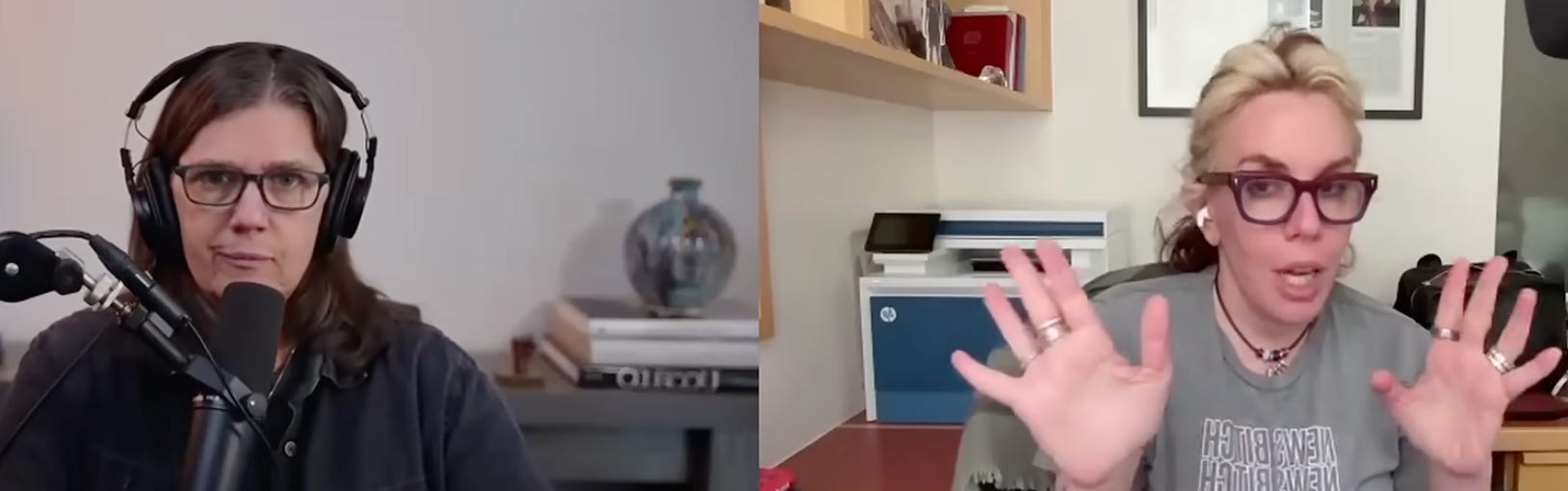
Mary Trump: I sat down with Molly Jong-Fast of Fast Politics to discuss Donald’s interesting comportment during Lindsey Graham’s funeral. We also discussed, among other things, why somebody as irreligious, bizarre, and inappropriate as Donald still has the backing of the Republican establishment. Check it out.
Molly Jong-Fast: Welcome, welcome, Mary Trump.
Mary Trump: Exactly.
Molly Jong-Fast: Lindsey Graham had what wasn’t technically a lying in state, but it was a very grand funeral. He was the last of the Three Amigos. First we saw McCain, then Lieberman, and now Graham, the last of the Three Amigos. You can argue about his legacy, and we will ad nauseam, but it was certainly a very grand sendoff. Donald Trump spoke at it.
Mary Trump: Is that a question?
Molly Jong-Fast: Discuss.
Mary Trump: Yes. Well, as is often the case, Donald carried himself with exactly the kind of comportment you would expect from a sitting president attending the funeral of somebody who was allegedly a close friend, because Lindsey Graham apparently really wanted to pass the SAVE Act.
Molly Jong-Fast: Perhaps the darkest part of all of this is the larger question Lindsey Graham seemed to ask throughout the latter part of his career. Is it worth staying in the room, playing golf with Donald Trump, trying to influence him on issues like national security and war, because Lindsey genuinely believed in a hawkish view of foreign policy? Donald Trump, of course, called him a warmonger, but that was how Lindsey Graham’s generation thought about national security. Whether we agree with it or not is another matter. The question is whether it’s better to stay inside the tent and try to influence policy or to leave the tent altogether and gum up the works from the outside.
Mary Trump: I think the idea of staying inside the tent in order to moderate Donald’s impulses or help pass better legislation has long since sailed. We know that simply isn’t possible. Secondly, in what meaningful way did Lindsey Graham actually accomplish that? Perhaps he managed to chip away around the edges on Ukraine, but beyond that, I don’t see much evidence.
What Lindsey Graham ultimately showed us is that he became the platonic ideal of somebody in the Republican Party who was so craven, so weak, and so needy that he was willing to sell his soul and completely destroy his own legacy simply to maintain proximity to power. I don’t see what difference Lindsey Graham made, even if he intended to make one. As far as I’m concerned, he completely destroyed whatever claim he once had to being a decent human being. He served as a JAG, but that doesn’t get you very far if, as a United States senator, you go on to do untold damage to the American people and to American national security, in large part by helping elevate somebody like Donald Trump.
Molly Jong-Fast: It’s interesting because, after all of that golfing with Donald Trump and the effort to remain relevant by staying close to him, Donald ultimately reduced Lindsey Graham’s legacy to one thing. He said Lindsey’s legacy was the SAVE Act.
Mary Trump: Which hasn’t passed the Senate.
Molly Jong-Fast: And won’t pass the Senate. So that’s very clearly not his legacy.
Mary Trump: No, it isn’t his legacy. What his legacy actually is may be a conversation for another time, but it’s certainly not a good one. He proved himself to be a very self interested, selfish, and ultimately destructive human being.
The other thing this reminds us of is just how transactional every single relationship Donald has ever had truly is. Lindsey Graham sold whatever was left of his soul in service to becoming one of Donald’s most devoted sycophants. He came remarkably close to declaring Donald a deity. If not God, then somebody almost as important as God. That is how depraved Lindsey Graham became.
In return, the only thing Donald had to say about him was that Lindsey really wanted the SAVE Act passed. Then, at his funeral, Donald couldn’t even bring himself to read the prepared remarks as written. He couldn’t simply say everyone loved Lindsey Graham because, in Donald’s mind, that wasn’t true. Plenty of people couldn’t stand him.
It shows, once again, that it doesn’t matter how desperately you want Donald to like you. It doesn’t matter how completely you debase yourself in an effort to gain his approval. The only thing that matters is whether you continue to be useful to him. Lindsey Graham is dead now, and that means, from Donald’s perspective, he is no longer useful at all.
Molly Jong-Fast: There was something else that struck me. Donald used to have a better sense of when to stop himself. At least he seemed capable of recognizing when something wasn’t landing. Do you think he used to be able to avoid saying the quiet part out loud?
Mary Trump: Yes, I do. Donald used to have a much better ability to read a room. He was always willing to push the envelope, but he could also recalibrate in real time when he realized something wasn’t working.
The clearest example I can think of happened shortly after the COVID vaccine became available. Donald spoke positively about the vaccine at one of his rallies and the crowd booed him. We never heard him praise the vaccine again. He immediately adjusted his behavior because he understood that particular audience wasn’t responding the way he expected.
Now we’re seeing that ability disappear. He’s losing impulse control, and I think that’s part of his overall cognitive decline. He no longer seems capable of recognizing when something isn’t working, nor can he adjust in response to the people in front of him.
Molly Jong-Fast: I wonder what was going through his mind when he walked over and knocked on Lindsey Graham’s coffin. What do you think that was about?
Mary Trump: Let’s see. I’m sure the white evangelicals will tell us it has some profound spiritual meaning, just as they found deep spiritual significance when he tried, unsuccessfully, to pop a Tic Tac into his mouth or when he couldn’t remember the words to the Lord’s Prayer. I’ve been an atheist since I was sixteen years old, and I still remember the Lord’s Prayer.
Honestly, take your pick. Maybe he’s superstitious and was knocking on wood to make sure Lindsey Graham was actually dead. Maybe he was checking the authenticity of the coffin. I don’t know. It’s weird. It’s deeply, deeply weird behavior.
The point isn’t that this, by itself, is the most important thing happening in the country. Obviously it isn’t. But taken together with everything else, it paints a picture. It reinforces a pattern of bizarre behavior, inappropriate conduct, and the reality that so much of what Donald does is performative. I saw somebody on Twitter recently say that nobody cares about the reflecting pool because, in the grand scheme of things, it isn’t even among the hundred worst things Donald has done. But that’s missing the point.
It’s not just about his incompetence or his corruption in awarding a no-bid contract. People are getting arrested. American citizens are facing consequences for conduct like that. We shouldn’t simply shrug our shoulders because something isn’t the single worst thing he’s ever done. In fact, the fact that people are willing to dismiss it because it doesn’t crack the top one hundred is itself part of the problem.
Molly Jong-Fast: I keep thinking about how there was an entire news cycle devoted to Joe Biden getting up a little too early after a Deadline: White House interview and walking out of the studio. Everyone acted as though that was an enormous scandal. These are similar situations involving unusual behavior, and while they may not deserve to dominate the news cycle forever, they probably deserve attention because this is the man who has the nuclear codes.
Mary Trump: What’s even worse is when something completely ordinary gets turned into a manufactured controversy. Barack Obama wore a tan suit in the Oval Office, and suddenly it was treated like a desecration. Hillary Clinton fainted after attending a September 11 memorial because she had the flu, it was extremely hot, and she was genuinely ill. That became evidence that she was dying.
Meanwhile, Donald’s repeated displays of bizarre behavior and obvious signs of cognitive decline receive comparatively little sustained attention. The man can’t stay awake in public. He fell asleep during Lindsey Graham’s funeral. Why? Because nobody was talking about him. They were talking about Lindsey Graham. Imagine how boring that must have seemed from Donald’s perspective.
Molly Jong-Fast: He also looks terrible. The swelling, the bruises on his hands, the sweating, everything about him seems different. At the same time, we’re less than one hundred days away from the midterm elections. There’s clearly anxiety inside the Republican Party, and yet Donald doesn’t seem capable of doing anything that would improve his political standing. The Iran situation isn’t getting any better. Every time he tries to change the subject, he ends up talking about things like the SAVE Act and making it harder for people to vote.
Mary Trump: Because I think even Donald understands that the only way Republicans win the midterms is by making it harder for people to vote. Ironically, measures like the SAVE Act would make voting more difficult for Republicans too. Married women who’ve changed their names are among the groups most directly affected.
It’s also an admission that Donald cannot change the way he behaves. As you pointed out, everything he’s doing is damaging his party’s chances in the midterms, yet he can’t stop himself. He desperately needs Republicans to retain control because, if they lose, I certainly hope Democrats make his life extraordinarily difficult through rigorous oversight and accountability.
Molly Jong-Fast: There will be hearings, investigations, and testimony. What’s striking to me is that all of the things many of us assumed would politically destroy him, the indictments, the criminal convictions, the judgments in the E. Jean Carroll cases, haven’t done what people expected. Yet what seems to be hurting him now is something much simpler: gas prices and the cost of living.
Mary Trump: Welcome to America.
You would think that if he were introduced every single time as “Ladies and gentlemen, Donald Trump, adjudicated rapist, convicted felon on thirty-four counts of fraud,” some of that might finally sink in. Instead, it’s almost as though those events never happened.
The fact that ICE, which I consider a fascist government agency, is killing people in American streets apparently isn’t enough. Millions of preventable deaths connected to the dismantling of USAID apparently aren’t enough either. But eggs becoming more expensive and higher gas prices matter because people experience those things directly.
I think that’s a sad commentary on how difficult it is for many Americans to look beyond their own immediate circumstances. At the same time, I understand why. Most people are working harder than ever simply to stay afloat, and Donald is making that even more difficult.
It’s one thing to gaslight people about subjects they don’t know much about. I’d venture that a large percentage of Donald’s supporters have never heard the details of the E. Jean Carroll cases because those stories simply aren’t covered on Fox News or Newsmax.
It’s much harder, however, to convince people not to believe their own lived experience. Americans know when their paychecks don’t stretch as far as they used to. They know how much it costs to fill their gas tanks. They know how much groceries cost.
That’s why, increasingly, it’s not working.
I also think something very important is happening. Donald is beginning to lose control of the narrative, and I honestly don’t know that that’s ever happened to him before. It may be entirely unique in his experience.
Molly Jong-Fast: You know what’s interesting about that, and I think you’re right, is that it feels as though Donald Trump has lost his grip not only on the narrative but also on people’s attention. For almost a decade, he dominated everyone’s attention.
Mary Trump: Sadly, yes.
Molly Jong-Fast: Maybe even longer.
Mary Trump: Being from New York, he dominated the conversation throughout the 1980s and 1990s.
Molly Jong-Fast: And being his niece, he probably dominated your life for much longer than that.
Mary Trump: Well, yes. He dominated every family conversation, which was really a great deal of fun, I have to say.
Now, because he’s in the Oval Office and still wields tremendous power while simultaneously causing so much destruction, the attention he receives is different. It’s not simply negative attention. Donald has never minded negative attention. One of my grandfather’s favorite sayings was that there is no such thing as bad publicity.
What’s different now is that the attention is focused on his incompetence and his decrepitude. That is a kind of attention Donald cannot tolerate because it exposes weakness. It makes him increasingly desperate to change the subject.
The problem for him is that every attempt he makes to change the subject only deepens the crisis he’s trying to escape. In an effort to divert attention away from Jeffrey Epstein, he launched an unconstitutional war of choice that has been disastrous from the very beginning. In reality, he lost that war on the first day, and here we are six months later still dealing with the consequences.
That has become the pattern of his presidency. Every attempt to distract from one failure simply creates an even larger one. He cannot stop because he cannot acknowledge failure, and as a result he keeps creating the very cycle that is destroying his ability to control the public narrative. He’s trapped in a vicious cycle entirely of his own making, and I don’t think that’s something he’s ever experienced before.
Molly Jong-Fast: It really does feel different this time. There was a period when Donald could dominate every news cycle simply by posting something outrageous or creating a new controversy. Now it feels like people are paying attention to something else entirely. They’re paying attention to the consequences of his decisions rather than the spectacle he creates.
Mary Trump: Exactly. That’s the difference.
For years, Donald was able to manipulate the media into focusing on whatever outrage he manufactured that day. It didn’t matter whether the attention was positive or negative because, as my grandfather believed, publicity itself had value.
Now, however, the attention is centered on things Donald cannot spin away. People see rising costs. They see the consequences of his policies. They see somebody who appears increasingly unable to control either himself or the events around him.
That’s extraordinarily dangerous for somebody whose entire identity depends on projecting strength.
The more he loses control, the more desperate he becomes to recover it. Unfortunately for him, the very strategies he’s using to regain control are making everything worse.
That’s why I think we’re witnessing something genuinely new. Donald isn’t simply losing popularity. He’s losing his ability to dictate the conversation.
For somebody who has spent his entire life manipulating narratives and creating myths about himself, that’s an existential threat.
Molly Jong-Fast: Mary Trump, thank you.
Mary Trump: Thanks, Molly. This was great. It’s always good to see you.



I can’t wait until he’s gone, either through the end of his term or death.
"warmonger, but that was how Lindsey Graham’s generation thought about national security" I'm in that generation and that's certainly not my way of thinking. He was a fucking warmonger and I'm happy he's gone.