


In the framing narrative of Emily Bronte’s novel Wuthering Heights, John Lockwood, having rented Thrushcross Grange from Heathcliff years after the main action of the novel, stops by the Heathcliff’s residence, the eponymous Wuthering Heights, to pay his respects. The visit does not go well. After Heathcliff’s dogs attack him, Lockwood grabs a lantern and leaves for Thrushcross Grange just as a blizzard is starting. Joseph, one of Heathcliff’s servants, thinking Lockwood has stolen the lantern, sets the dogs on him (again), and Lockwood winds up with a bloody nose.
The blizzard worsens and Lockwood is forced to stay the night at Wuthering Heights. Zillah, one of Heathcliff’s housekeepers, brings Lockwood to a bedroom that Heathcliff has expressly forbidden anyone from using. Exhausted from the drama of the day, Lockwood falls into a fitful sleep and has an unnerving nightmare:
I heard distinctly the gusty wind, and the driving of the snow; I heard, also, the fir-bough repeat its teasing sound, and ascribed it to the right cause: but it annoyed me so much, that I resolved to silence it, if possible; and, I thought, I rose and endeavoured to unhasp the casement. The hook was soldered into the staple: a circumstance observed by me when awake, but forgotten. ‘I must stop it, nevertheless!’ I muttered, knocking my knuckles through the glass, and stretching an arm out to seize the importunate branch; instead of which, my fingers closed on the fingers of a little, ice-cold hand! The intense horror of nightmare came over me: I tried to draw back my arm, but the hand clung to it, and a most melancholy voice sobbed, ‘Let me in — let me in!’ ‘Who are you?’ I asked, struggling meanwhile, to disengage myself. ‘Catherine Linton. . . . I’m come home: I’d lost my way on the moor!’ As it spoke, I discerned, obscurely, a child’s face looking through the window. Terror made me cruel; and, finding it useless to attempt shaking the creature off, I pulled its wrist on to the broken pane, and rubbed it to and fro till the blood ran down and soaked the bedclothes: still it wailed, ‘Let me in!’ and maintained its tenacious gripe, almost maddening me with fear. ‘How can I?’ I said at length. ‘Let me go, if you want me to let you in!’ The fingers relaxed, I snatched mine through the hole, hurriedly piled the books up in a pyramid against it, and stopped my ears to exclude the lamentable prayer.
“Terror made me cruel.” Indeed. Fear can make a person do a lot of irrational things. Anybody with a phobia knows this. And perhaps the less grounded in reality the fear is, the less rational the behavior it inspires.
Human evolution is not linear across all dimensions; like human development, it is multi-lateral and unfolds at varying rates.
While our capacity for empathy has increased, our evolutionary drive to survive remains as strong as it did when the threats we faced—as individuals and as a species—were almost constant and were often lethal. Once activated under any circumstances, our fear response makes empathy difficult and in extreme cases is short-circuited altogether.
The right long ago figured out how to use fear in general and our fear of annihilation in particular to manipulate people. That’s nothing new. But Donald has shown a willingness to do this, indeed an instinctive skill, that is unrivaled.
During the campaign, in order to rile up his base against immigrants, he said about the Haitian community in Springfield, Ohio, “They’re eating the dogs, the people that came in, they’re eating the cats. They’re eating the pets of the people that live there” he claimed falsely and defamatorily. And then he doubled down in an attempt to up the stakes: “These are people at the highest level of killing that cut your throat and won’t even think about it the next morning. They grab young girls and slice them up right in front of their parents.”
The more extreme the threats he warns us of, the more those of us who are paying attention, who understand the mechanism at work, understand how absurd it all is. Who in the world could take seriously his characterization of Haitian immigrants?
But we are not the intended audience for Donald’s rhetoric, so our reactions to and assessments of it are irrelevant. Those predisposed to believe him, those predisposed to hate the right people, those who crave permission to be their worst selves are those he seeks to activate.
Some of those most vulnerable to his rhetoric—those who are bombarded every day with the propaganda and disinformation spread by outlets like Fox and Newsmax, lost in the darkest corners of the internet, or who wallow in an ignorance and sense of grievance stoked by the likes of Donald—are incredibly vulnerable to this strongman certainty.
The problem with fear as a motivator, however, is that it can be debilitating and, in the extreme, paralyzing. On the other hand, rage can serve as a way to release tension, and that feels good in a way fear never can. What’s the best way to transform fear into something useful? Use power to control the situation that makes you afraid. Lockwood, at least the Lockwood in the dream, understands this instinctively.
It’s cynical, but it’s also incredibly effective.
After all, 74 million Americans chose to put Donald Trump back in the White House at least in part because he promised to be cruel to the immigrants he’s been spending years maligning, and he singled out trans people, because of his own discomfort with difference, as being unequal and therefore unworthy of protection. The Trump campaign slogan was effective not only because it made it seem as if the Democrats cared about the rights of trans people more than it cared about everybody else, but also by making it seem that a group that comprises less than one percent of the U.S. population, that is among the most vulnerable, is a threat to our way of life.
The fears ginned up were then and are now illusory, but they continue to take on an increasing role in the way in which the base is manipulated.
In response to the following chart:
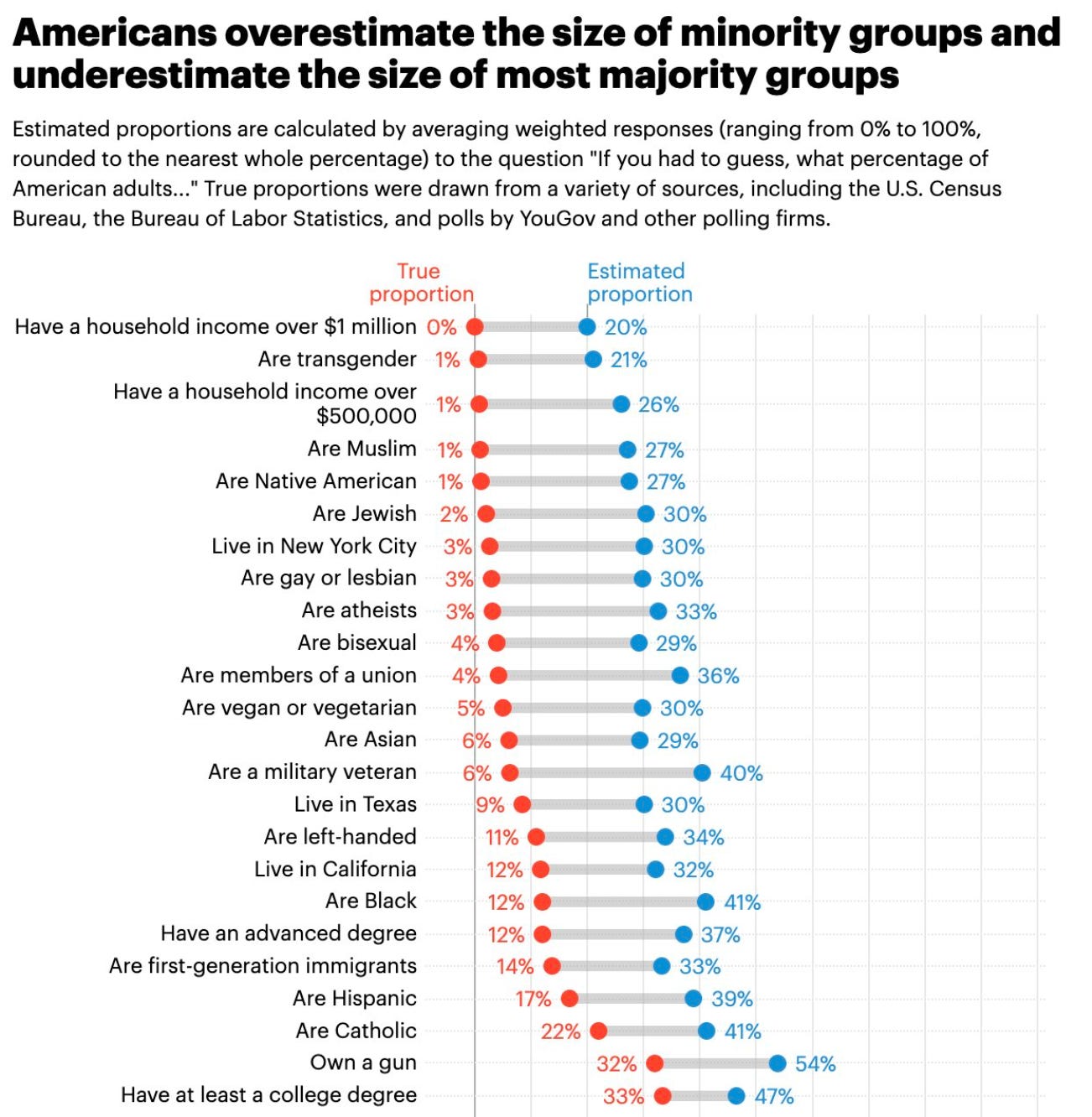
Statistician Dr. Kareem Carr wrote, “Beginning to understand why so many Americans are obsessed with trans issues and panicking about being replaced. They think there are 21x more trans people, 27x more muslims, 15x more jews, 5x more asians, 3x more black people, and 2x more immigrants than there actually are.”
This is deliberate. For Donald it is pure instinct, not strategy. But others in his orbit understand how effectively fear can be weaponized in service of controlling the weakest, most impressionable members of the base. In following his lead, the Republican Party’s weaponization of fear has become its primary and its most effective strategy. Because they know terror makes us cruel and therefore susceptible to our worst impulses.

I love the statistics chart of how we misunderstand the real numbers. While I know that the trans community is small, I was surprised at the other numbers. How interesting that Trump and republicans are twisting the truth and creating unreasonable, overblown fear. Thank you, Mary!
Makes me want to read Wuthering Heights again. Eighth grade was long long ago. But cruelty and fear—they’re with us still, and more damaging than ever.