

[Transcript edited for clarity, flow and length]
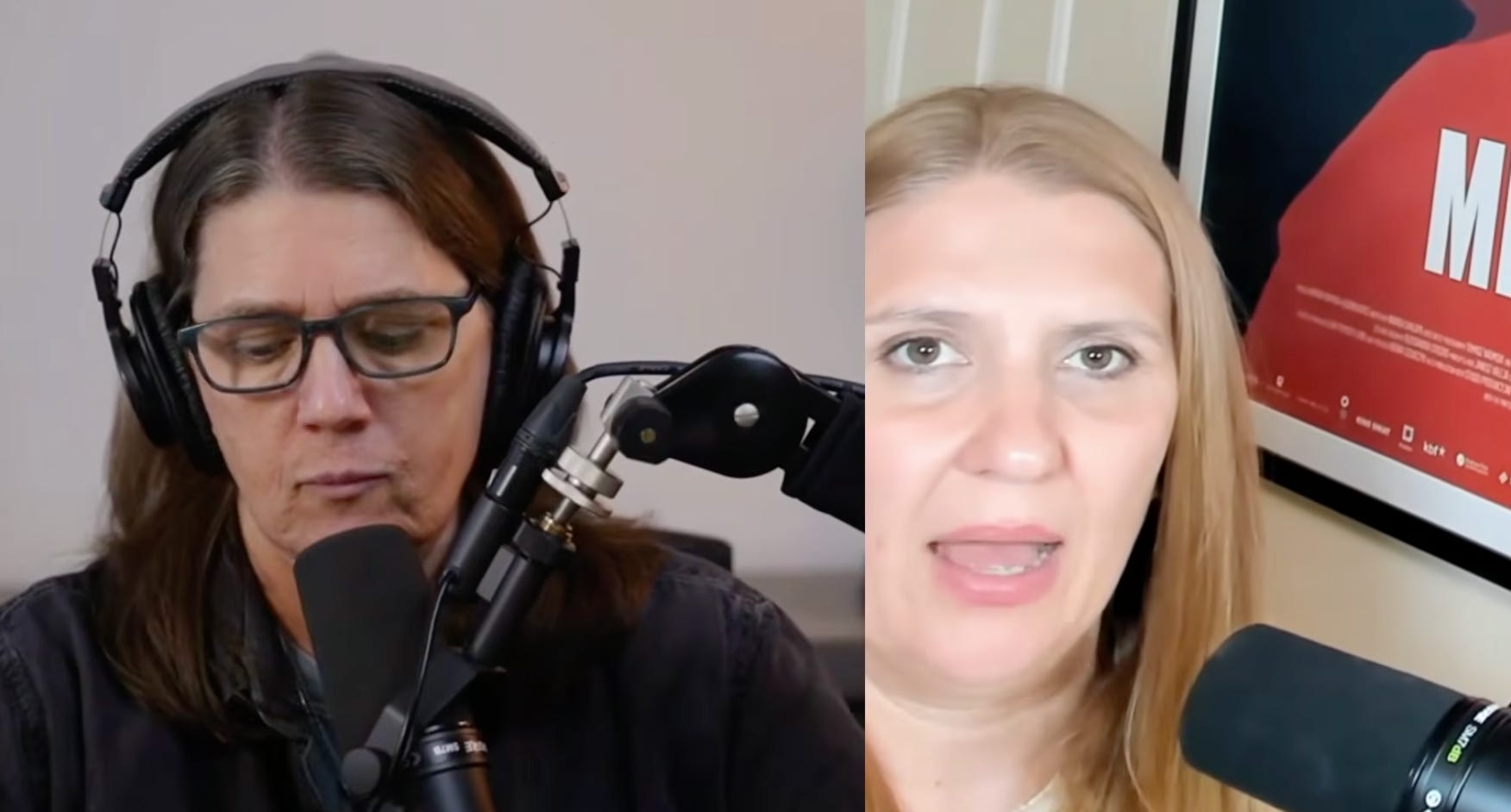
Mary Trump: I recently joined Andrea Chalupa on Gaslit Nation for a wide ranging conversation about authoritarianism, family dynamics, Donald’s psychology, and what it will take to protect democracy in one of the most perilous moments in our nation’s history. We discussed the roots of Donald’s worldview, why understanding trauma matters, and how hope, community, and creativity remain essential acts of resistance. Check it out.
Andrea Chalupa: Welcome to Gaslit Nation. I am Andrea Chalupa, a journalist and filmmaker and the writer and producer of the journalistic thriller Mr. Jones, the film the Kremlin doesn’t want you to see, so be sure to watch it. I’m also the author of the new book A Reasonable Guide for Unreasonable Women, which you can preorder today.
Joining us this week is the great Mary Trump, host of The Mary Trump Show podcast and the bestselling author of Too Much and Never Enough: How My Family Created the World’s Most Dangerous Man and The Reckoning: Our Nation’s Trauma and Finding a Way to Heal. I also have to apologize to all of my listeners because Mary and I just had the most incredible conversation about Tori Amos before we started recording, and I regret not recording it because everyone should have been part of it. It was incredibly healing.
Mary, it’s wonderful to have you here. How are you feeling right now?
Mary Trump: First of all, Andrea, it’s so wonderful to be here with you. As I said before we started, I honestly cannot believe we haven’t crossed paths before. I’ve been listening to your podcast probably since the very beginning, so it’s genuinely exciting to finally have this conversation.
As for how I’m feeling, I would say hopeful while also feeling overwhelmed, which I imagine is true for many people right now. We’re living through what I often call an onslaught of horrors, and in moments like these we have to hold on to hope because the alternative simply isn’t sustainable. One of the things that keeps me going is remembering that throughout human history, as much as I wish we could finally evolve beyond this pattern, it has often been during humanity’s darkest moments that we’ve found the greatest opportunities to create meaningful and lasting change for the better. That’s one of the ideas I’m holding on to every single day.
Andrea Chalupa: There is so much I want to talk with you about. Honestly, we should have done this years ago, and I suspect this won’t be the last conversation because we’re in this fight together for the long haul. There isn’t going to be one finish line where everything is suddenly fixed. It’s going to be one challenge after another, and we have to be prepared for that reality.
Right now, though, we’re living through an extraordinarily dangerous period, and people have to believe what they’re seeing with their own eyes and hearing with their own ears. As a therapist and someone who has spent so much of your career studying trauma, I’ve been watching the way Americans are responding to this moment.
On one hand, we’re seeing extraordinary courage. Ordinary people are putting themselves at risk for complete strangers because they believe in human rights, because they believe it’s their patriotic duty, and because they refuse to look away. At the same time, we’re also seeing something very different. Many people seem emotionally exhausted. They’re becoming beaten down and, in some cases, emotionally checking out altogether.
I even see it reflected in comedy and mainstream entertainment, where there’s an increasing desire to escape reality. It reminds me of The Matrix, where one of the characters decides he’d rather live inside the illusion than confront the painful truth. It feels as though some Americans have reached that point because reality has become so overwhelming.
As a therapist, how do you understand that response?
Mary Trump: I completely understand it because it’s fundamentally a defense mechanism. There are days when it genuinely feels almost masochistic to keep exposing ourselves to the relentless barrage of terrible news. At the same time, if we are members of a functioning society, we have to remain connected to what’s happening because that’s the only way we can respond in meaningful ways.
Numbing ourselves isn’t a solution. It isn’t healing. All it does is postpone the feelings we’re eventually going to have to confront anyway. That’s why I think it’s perfectly reasonable for somebody to say, “I need to step back for a little while because this is a marathon, not a sprint. I have to trust that other people are carrying the work while I recover.” What’s not acceptable is abandoning our responsibility altogether.
We’re members of communities. We’re members of a society. We owe something to one another. The people who care the most are almost always the people who suffer the deepest emotional wounds, which is why it’s so important to find ways to protect ourselves without disconnecting from reality.
One of the healthiest ways to do that is by becoming an active participant in a community. It doesn’t even have to be political. It simply needs to be a community that nourishes you and reminds you that you’re not facing these challenges alone.
I also think people underestimate the importance of creativity. Whether you’re creating art yourself or participating in it by visiting museums, reading books, attending concerts, or simply allowing yourself to experience beauty, those things nourish our humanity. Art reminds us why we’re fighting in the first place. It strengthens our resolve in ways that politics alone simply cannot.
So yes, I understand the impulse to look away because these are extraordinarily difficult times. We shouldn’t pretend otherwise. But we’re also doing ourselves and everyone around us a profound disservice if we ignore reality because that only gives the people causing harm even greater freedom to continue doing it.
Andrea Chalupa: One of the things that strikes me is how often the personal becomes political. When you look at your own family, where do you think Donald’s attitudes toward women originated? What was the dynamic in your family, and how did it shape the man he eventually became?
Mary Trump: It came directly from the top. My grandfather was a horrible human being. He was a misogynist, a sociopath, and an extraordinarily cold person who controlled every aspect of the family’s life. My grandmother had virtually no power in the family, and what made the situation even more unusual, especially for the 1940s and 1950s, was just how rigidly everything was divided along gender lines.
Of course, boys were preferred. That wasn’t uncommon for the time because it was assumed that only a son could eventually inherit the family business. But it went much further than that. My grandmother had very little involvement in raising the boys. She was originally from a small island in the Outer Hebrides, and every year she would take my aunts back there. To the best of my knowledge, she never took any of her sons. That separation existed throughout their childhoods.
Growing up in a household where women were constantly belittled, demeaned, and stripped of any meaningful authority affected almost everyone in the family. My father was really the only exception. He had close friendships with women, respected women, and treated them as equals. The rest of the siblings, including my two aunts, absorbed my grandfather’s worldview. So when people ask where Donald’s misogyny came from, the answer is that he comes by it honestly.
Andrea Chalupa: What kind of relationship did Donald have with his mother? Did she have any meaningful influence on him?
Mary Trump: Ironically, even though she had almost no influence within the family structure itself, she had a profound influence on Donald’s development, though not intentionally.
When Donald was about two and a half years old, my grandmother became critically ill. My Uncle Robert was still an infant, and she required emergency surgery. She nearly died and underwent several operations over a relatively short period of time. For roughly a year she was either physically absent or emotionally unavailable to both boys.
That period had lasting consequences for both of them, although it affected Donald in particularly significant ways because the only parent left to care for him was my grandfather. During one of the most critical stages of childhood development, Donald’s emotional needs simply weren’t met. He wasn’t nurtured. He wasn’t comforted. He wasn’t mirrored in the way young children need to be.
I’m not saying any of this because I think people should feel sympathy for the man Donald became. They shouldn’t. But I do think it’s appropriate to feel compassion for that frightened two and a half year old child because what happened during that period profoundly shaped the rest of his life.
Unfortunately, when my grandmother recovered physically, she never really repaired that relationship. As Donald grew older he became increasingly difficult. He acted out, treated people badly, and was especially disrespectful toward his mother. By the time he reached seventh grade, the school he attended, which ironically was the same school I eventually attended, told my grandfather that Donald could no longer remain there. He was sent away to military boarding school, which functioned much more like a reform school for wealthy children.
Perhaps most telling was my grandmother’s reaction. She wasn’t devastated that her son was leaving. She was relieved. That rejection hardened Donald’s attitudes even further and contributed significantly to the aggrieved, desperately needy person he eventually became.
Andrea Chalupa: It reminds me so much of Adolf Hitler’s childhood. Hitler also grew up with a brutal father, and obviously we’re not suggesting sympathy for Hitler himself. We’re talking about understanding what happens to children whose development is profoundly damaged.
Mary Trump: Exactly. There is certainly a scenario in which Donald’s life unfolds very differently if he had experienced even one stable, emotionally healthy parental relationship.
The psychoanalyst D. W. Winnicott famously talked about the importance of having a “good enough” mother. Children don’t need perfection. They simply need consistent love, stability, and emotional attunement. Donald didn’t have that. Instead, he had a sociopathic father and a mother who, for reasons both physical and psychological, simply wasn’t capable of meeting his emotional needs.
Later, when she intentionally distanced herself from him, the rejection only reinforced those early wounds.
Andrea Chalupa: Why do you think she rejected him? Was she simply overwhelmed by everything happening in her own life?
Mary Trump: Part of it was certainly that Donald had become an extraordinarily difficult child. But I also think we need to recognize that my grandmother never fully recovered psychologically. Physically she improved, but emotionally she remained deeply troubled. She had significant psychological issues of her own and simply lacked the emotional capacity to become the mother Donald needed.
As Donald grew older, he also became increasingly unpleasant to be around. He was loud, disrespectful, demanding, and openly rude to his mother. It may sound uncomfortable to say, but sometimes parents genuinely do not like their children. I think that was true here.
In fact, when I look back at my family, I’m honestly not sure very many people genuinely liked Donald at all. The only person who consistently valued him was my grandfather.
Andrea Chalupa: Was that because Fred Trump saw himself in Donald?
Mary Trump: I think that’s certainly part of it. More importantly, though, I think my grandfather recognized that Donald possessed qualities none of the other siblings had. By the time I was born, my grandfather was already well established in New York real estate. He owned dozens of properties throughout Queens and Brooklyn, but he’d never succeeded in Manhattan.
Donald had exactly the qualities my grandfather thought could accomplish what he never had. He was shameless. He was loud. He would say virtually anything to attract attention. My grandfather saw Donald less as a son than as an extension of his own ambitions.
It’s also important to remember that Donald accomplished virtually nothing independently during those early years. Before Atlantic City, nearly every major project he undertook in Manhattan was financed by my grandfather’s money, political influence, and business connections. Donald’s chauffeur, his apartment, his lifestyle, virtually everything was funded by my grandfather.
That’s why the myth that Donald was somehow self made has always been so absurd. It simply isn’t true.
Andrea Chalupa: One of the things I keep thinking about is what happens after Donald Trump. Dictators throughout history have struggled with succession because they simply cannot imagine a world that continues without them. Stalin couldn’t. Putin appears incapable of it. Donald jokes about running again, but I don’t think he’s joking. By 2028 he’ll be older, his physical decline will likely be even more obvious, and yet I still have a hard time imagining him willingly giving up power. What do you think that looks like?
Mary Trump: I honestly don’t think he’s interested in running another campaign as much as he’s interested in never leaving. The Supreme Court has effectively turned him into an imperial president, and there is nobody around him willing to tell him that his time is over. That’s why I wasn’t surprised that he refused to accept the results of the 2020 election. What surprised me was that he eventually left the White House at all.
Looking ahead to 2028, I don’t know how a Republican candidate is supposed to emerge when the incumbent president refuses to acknowledge that anyone else could possibly succeed him. Donald is psychologically incapable of endorsing a successor because doing so would require him to admit that somebody else could replace him. He simply cannot imagine that possibility. That’s why he’s openly refused to commit to supporting J.D. Vance, and it’s why he appears content to let ambitious Republicans compete with one another while he continues promoting only himself.
The fascinating question isn’t just who the Republican nominee might be. It’s whether Donald will ever acknowledge that anyone else deserves to lead. I don’t believe he can. His identity depends entirely on convincing himself that he’s indispensable.
Andrea Chalupa: If that’s true, what happens if he simply refuses to go? We’ve already seen January 6. We’ve already seen an attempted coup. What happens if he decides that the presidency belongs to him permanently?
Mary Trump: The uncomfortable truth is that January 6 wasn’t simply about disrupting one day’s certification. It was part of a much broader effort to undermine democracy itself, and in many ways that effort succeeded. We’re living with the consequences of that now.
As for what happens next, I honestly don’t know. Donald is in such obvious physical and cognitive decline that it’s difficult to imagine how long this continues. Republicans are expending enormous energy trying to conceal what’s happening. They insist everything is normal, just as they did with Mitch McConnell despite repeated public episodes that clearly suggested otherwise.
With Donald, however, the situation is even more complicated because the physical decline exists alongside long-standing psychiatric disorders that have gone untreated for decades. Add to that extraordinary stress, increasing public rejection, and growing ridicule, and you’ve created a perfect storm.
The irony is that all the money in the world cannot protect him from the reality that he’s losing control of the narrative. His approval numbers continue falling. More people are openly mocking him, including people who once supported him. Those are profound narcissistic injuries, and they are only becoming more severe.
The only reason those injuries haven’t completely overwhelmed him already is that he lives inside an environment specifically designed to shield him from reality. He’s surrounded by people who constantly reassure him that everyone loves him, that his poll numbers are tremendous, that inflation is down, prices are falling, and everything is better than ever. Every so often, though, reality breaks through that protective bubble, and when it does, you can see just how destabilizing it is for him.
That’s why it’s becoming increasingly difficult to imagine him remaining coherent enough to make a persuasive case for anything, including his own continued leadership.
Andrea Chalupa: It reminds me of Francisco Franco during the final years of his dictatorship in Spain. His inner circle reportedly constructed an elaborate illusion that allowed him to believe he was still fully governing while others exercised the real power. Sometimes I wonder whether Donald’s advisers are headed toward something similar, creating a political stage set while someone else actually runs the government.
Mary Trump: It’s funny you mention that because it reminds me of an old Star Trek episode. A historian attempts to stabilize a troubled planet by modeling it after Nazi Germany. Eventually he realizes what he’s created is monstrous and wants to stop it, but the people around him drug him, prop him up behind a microphone, and simply replay old recordings while pretending he’s still leading.
As absurd as that sounds, I can imagine something similar happening with Donald. Whether it’s a fake Oval Office, carefully staged appearances, or simply limiting his public exposure, the people around him have every incentive to preserve the illusion for as long as possible because their own power depends on maintaining it.
Andrea Chalupa: Given your family’s history and what you know about Donald’s health, how much longer do you think he can continue?
Mary Trump: I honestly don’t know. Physically, he’s a profoundly unhealthy man. The bruising on his hands suggests to me that he’s receiving some form of intravenous treatment, although I obviously don’t know for what. The swelling, his diet, his lack of sleep, his refusal to exercise, and everything else we can observe publicly all point toward somebody whose overall health is very poor.
The complicating factor is genetics. With the exception of my father, who died tragically young at forty-two, my family tends to live a very long time. My grandfather lived into his nineties. My grandmother lived into her late eighties. My great-aunt smoked and drank heavily for decades and still lived to ninety-eight.
Donald, however, is significantly less healthy than any of them ever were. So while he has access to the best medical care in the world, he’s also done tremendous damage to himself over many decades.
My hope is simply that he does not finish this term as president. The two most likely scenarios, in my view, are either that his decline becomes too severe to conceal or that Republicans eventually conclude he poses an existential threat to the future of their party. Frankly, I think the first possibility is much more likely than the second.
Andrea Chalupa: When you look at the Republicans who continue defending him, what do you see psychologically? Why do so many people continue enabling him?
Mary Trump: I think they fall into three broad categories.
The first group consists of cynical opportunists who care more about power than principle. Whether or not they personally believe in fascism almost becomes irrelevant because they’re perfectly willing to support it if doing so preserves their own influence.
The second group is made up of profoundly weak people. They’re terrified of being primaried, attacked on social media, or losing their positions, so they simply fall in line.
Then there’s a third group consisting of genuine true believers. They actually want a Christian nationalist, authoritarian state. They believe in the project and support it enthusiastically. That group is much larger today than it was a decade ago.
Andrea Chalupa: As we close, what would you say to parents raising children right now and to the young people inheriting this country? How do we keep ourselves from becoming hardened by all of this?
Mary Trump: First, we need to reject the lie that cruelty is strength and kindness is weakness. The opposite is true. It takes extraordinary strength to remain kind and empathetic in a culture increasingly rewarding cruelty.
We also need to start asking people honest questions instead of simply arguing with them. Is it really acceptable that government agents can act with impunity? Is it acceptable that religious extremism has such extraordinary influence over public education? Rather than telling people what they should think, ask them to explain why they’re comfortable with those realities.
Most importantly, we owe an enormous apology to younger generations. We have burdened them with crises they didn’t create, from mass shootings to pandemics to attacks on democracy itself. I understand why so many young people feel exhausted or tempted to disengage.
But I also believe they possess extraordinary power. If they participate, organize, vote, and remain engaged, they truly can reshape this country.
We can’t repair everything for them, but we can encourage them to claim their own power. And when they do, I hope they lead with kindness, empathy, and hope, because those are the qualities that ultimately make democracies worth saving.
Andrea Chalupa: Empathy is a consolidating force.
Mary Trump: Yes, it is.

Thank you for the transcript, of this conversation Mary. I got really angry when someone put out a text on my phone stating you were using an AIPAC. I went out to tend my garden and voted, my friend. I was really upset. What a fake thing to do to a good person who is trying to make a difference. Please becareful. Oh I voted for Progressive Democrat for Governor a, lady and Noah Taylor. I was pissed off at the fake text.
Excellent explanations, Mary. Great work.