

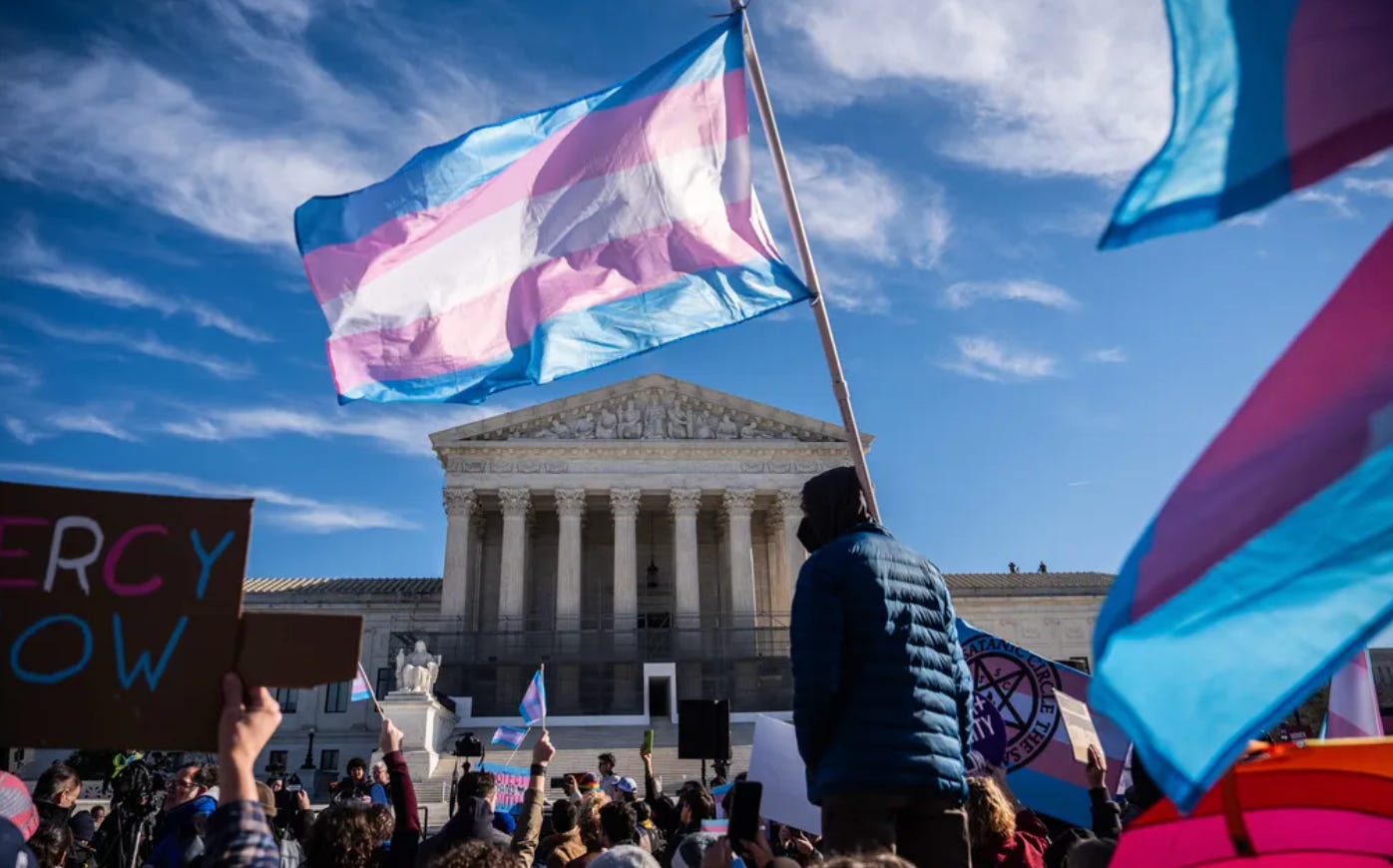
The Supreme Court closed out another miserable term this week, once again making it painfully clear that the corrupt, illegitimate supermajority has little interest in respecting or defending the Constitution of the United States. The rulings issued between June 25 and June 30 touched on immigration, elections, executive power, and civil rights. Although there were a handful of decisions that upheld constitutional protections, the overall picture remains deeply disturbing.
Donald, naturally, viewed the week very differently.
After the Court rejected his attempt to end birthright citizenship by executive order, he insisted that the real victory was not the Constitution, but presidential power.
Donald: Doesn’t have to accept it’s the Supreme Court. So accept. I think it’s very bad for our nation. We’re the only nation that does it. No other nation does that, birthright citizenship. No, not even close. Some did it. They ended it. It’s tremendously destructive. It’s extremely costly. I don’t know. .
That, of course, is the man whose own father benefited from birthright citizenship.
On June 30, the Supreme Court ruled in Trump v. Barbara that the Fourteenth Amendment continues to guarantee automatic citizenship to children born on American soil, striking down Donald’s Executive Order 15160. It is remarkable that the Court even had to answer such an obvious constitutional question. One person with a pen cannot erase a constitutional amendment simply because he wishes it away.
Donald responded on his failing social media platform by calling the ruling “too bad for our country.” He falsely claimed Congress could eliminate birthright citizenship through ordinary legislation instead of a constitutional amendment, yet another reminder that the man occupying the Oval Office appears to have only the vaguest understanding of how the government he supposedly runs actually functions.
He also falsely claimed that the United States is the only country that recognizes birthright citizenship. It does not. Roughly thirty countries recognize some form of birthright citizenship.
The Fourteenth Amendment was adopted after the Civil War for a reason. After eight generations of slavery, the nation sought to guarantee that formerly enslaved people and their children would finally be recognized as full citizens under the Constitution. That history is neither ambiguous nor accidental.
Yet only hours after the ruling, Deputy White House Chief of Staff Stephen Miller and Homeland Security Secretary Markwayne Mullin appeared on Fox to attack the decision.
This is what Stephen Miller said:
If you have birthright citizenship, it means if a person comes here nine months pregnant to go look around at some things in a couple of weeks, that is the mother of a lifetime American citizen and a direct line into American cash and welfare for the rest of that child’s life. This is absolutely a deep knife wound in the heart of the American Republic. Just physically being on US soil does not make you a citizen or qualified to carry on or capable of executing the inheritance of this country.
This is what Markwayne Mullin said:
I think the president was spot on on this and the court is absolutely dead wrong on this situation. If you look at the reason for the Fourteenth Amendment, this is way outside what has happened, especially with China and their tourist visas that they get to come into the United States simply to give birth.
None of that is true.
And frankly, any immigrant who comes to this country searching for a better life has demonstrated far more commitment to the American ideal than the two men making those arguments on television.
Yes, it is good that the Supreme Court upheld the Constitution. It is good that the Fourteenth Amendment survived. But it never should have been in jeopardy in the first place.
What is even more disturbing is that what should have been a unanimous decision became a five-to-four ruling.
Samuel Alito, Clarence Thomas, and Neil Gorsuch all concluded that Donald could effectively erase the protections of the Fourteenth Amendment through executive action. Brett Kavanaugh also ruled in Donald’s favor, although on statutory rather than constitutional grounds.
That distinction should not comfort anybody.
Four sitting justices of the Supreme Court were prepared to allow Donald Trump to dismantle one of the Constitution’s most important amendments.
That alone should chill every American.
Unfortunately, the attacks on constitutional protections did not end there.
Over the same week, the Court handed the Trump regime some of its most consequential legal victories yet, dramatically expanding executive authority while reshaping immigration policy in ways that will affect hundreds of thousands of people.
On June 25, the Court ruled six to three in Mullin v. Doe, consolidated with Trump v. Mayat, that federal courts cannot review the Department of Homeland Security’s decision to terminate Temporary Protected Status for approximately 350,000 Haitian nationals and 6,000 Syrian nationals.
The ruling clears the way for the deportation of roughly 356,000 people who had been granted humanitarian protection.
Stephen Miller wasted no time celebrating.
Miller: Under President Trump, the illegal alien Haitians are going back to Haiti. They can build their country there.
If anybody can listen to that kind of cruelty without feeling profoundly disturbed, it is worth asking yourself why.
There is nothing compassionate about celebrating the removal of hundreds of thousands of people whose lives have already been shaped by instability, violence, or disaster. There is nothing patriotic about weaponizing human suffering for political applause.
Unfortunately, immigration was only one of several areas in which the Court chose to side with the Trump regime.
The justices also weighed in on one of the Republican Party’s favorite manufactured culture wars: transgender children.
And that ruling may be one of the clearest examples yet that, for today’s Republican Party, cruelty is no longer an unfortunate byproduct.
It is the objective.
The Republican Party has become obsessed with one of the smallest minorities in the United States. Transgender people make up well under one percent of the population, yet Republicans have spent years convincing Americans that transgender children somehow represent an existential threat to the country. They have built an entire political movement around fear of a group of children who simply want to participate in the same activities as everybody else. It is difficult to think of a more cynical or more manufactured culture war.
On June 27, the Supreme Court added to that campaign when it ruled in Little v. Hecox that states may prohibit transgender girls from participating in girls’ school sports. Republicans celebrated the decision as a victory for fairness, but I continue to struggle to understand exactly what problem they believe they are solving. Transgender children are not asking for special treatment. They are asking for the opportunity to participate in school activities alongside their classmates, to make friends, and to experience something resembling a normal childhood. Instead, adults have decided to turn them into political targets.
This has never really been about sports. If Republicans were genuinely concerned about fairness in athletics, they would devote at least as much energy to ensuring children have adequate funding for schools, safe playing fields, qualified coaches, and access to healthcare. Instead, they have spent years legislating against an extraordinarily small group of vulnerable children while ignoring the problems affecting millions of others. That tells us everything we need to know about their priorities.
The decision also fits within a much broader pattern. The Trump regime has repeatedly targeted transgender Americans through executive orders, healthcare restrictions, military policies, educational directives, and attacks on civil rights protections. Each action has been justified as common sense or public safety, but collectively they amount to something much more troubling. They represent an organized effort to marginalize an already vulnerable population for political gain.
That is one of the reasons these cases matter so much. Governments rarely begin by targeting large, powerful groups. They almost always begin with those who have the fewest resources and the least political power to defend themselves. Transgender children have become the latest target because they are easy to caricature and even easier to exploit in campaign advertisements designed to manufacture fear rather than solve problems.
The Court also issued another decision that received less attention but may ultimately prove just as consequential. In a six-to-three ruling, the justices significantly limited the ability of lower federal courts to issue nationwide injunctions against executive actions. Donald immediately celebrated the decision, not because he cared about constitutional theory, but because he believed it expanded presidential power. That reaction alone should concern every American.
Donald has spent his entire political career demonstrating that he views constitutional limits as obstacles rather than safeguards. Every expansion of executive authority becomes another opportunity for him to test the boundaries of presidential power. He has repeatedly shown that if nobody stops him, he simply continues pushing further. That pattern has defined his entire public life, and there is no reason to believe it will suddenly change now.
Taken together, the Supreme Court’s decisions this week paint a deeply troubling picture. Yes, the justices upheld the Fourteenth Amendment and preserved birthright citizenship, preventing Donald from unilaterally rewriting one of the Constitution’s most important guarantees. That victory deserves recognition. But it should not blind us to everything else the Court did during the same week.
The same Court that protected birthright citizenship also cleared the way for the deportation of hundreds of thousands of people who had been living legally under Temporary Protected Status. It permitted states to exclude transgender children from school sports, further legitimizing a manufactured culture war against one of the country’s smallest minorities. It also narrowed the ability of federal courts to act as a meaningful check on executive overreach, making it easier for future presidents to implement potentially unconstitutional policies before those policies can be stopped.
That is why celebrating one correct decision is not enough. We should not have to applaud the Supreme Court for occasionally doing what the Constitution requires. Upholding constitutional rights is not extraordinary; it is the Court’s most fundamental responsibility. The fact that we now greet those moments with relief rather than expectation says everything about how much confidence the American people have lost in this institution.
The corrupt, illegitimate supermajority has repeatedly demonstrated that constitutional text, precedent, and long-established democratic principles are increasingly subordinate to ideology. That should alarm conservatives, liberals, and independents alike because the Constitution only functions if its protections apply equally regardless of who occupies the Oval Office. Once the judiciary begins deciding which constitutional guarantees remain meaningful and which can simply be ignored, every American’s rights become less secure.
That is why judicial reform can no longer be treated as a fringe issue or an uncomfortable political conversation. Democrats should be talking openly about enforceable ethics rules, term limits, changes to the confirmation process, and reforms that restore legitimacy to an institution that has drifted dangerously far from its constitutional role. Hoping that five justices will continue to reach the correct result every time Donald tests the limits of presidential power is not a strategy. It is wishful thinking.
The Fourteenth Amendment survived this week, and that is unquestionably worth celebrating. But hundreds of thousands of immigrants did not receive the same protection. Transgender children did not receive the same protection. The constitutional balance between the branches of government grew weaker. Those developments are not separate stories. They are part of the same story: an increasingly ideological Supreme Court deciding, case by case, whose rights deserve protection and whose do not.
That is the lesson of this term. The Constitution held this time, but democracy cannot depend on hoping it will continue to hold the next time.

Term limits, statement of ethics, expansion of the court to 13, one for every circuit court.
Why are they never concerned about trans boys playing boys' sports?
Why was it OK for Short Fingers to let wealthy Russian women stay at his properties some years back, so they could give birth to an American citizen?
When are they going to go after Sections 2, 3, and 4 of the 14th Amendment?