

Two months ago, before Donald launched his illegal, unconstitutional war of choice against Iran, the Strait of Hormuz was open. Tanker traffic flowed without incident. The global economy, while fragile, was functioning.
Today, the strait is closed by Iran. Donald put an additional blockade in place. And the Trump regime has triggered what the International Energy Agency is calling the largest oil supply disruption on record.
That is not a hypothetical consequence. It is not a distant geopolitical concern. It is happening now. And the proposed exit strategy risks leaving the world worse off than it was before the conflict even began.
According to Nobel Prize–winning economist Paul Krugman, Donald has led the United States into one of the worst strategic defeats in its history. Krugman attributes that failure to what he describes as the moral, intellectual, and emotional collapse of the Republican Party. I would also add a psychological collapse.
There is no moral compass left in the Republican party. The only compass they seem to have is Donald himself. That is very bad news for them. It is even worse news for the rest of us.
To understand the scale of this disaster, it helps to understand what the Strait of Hormuz represents. Before the war, roughly 20 percent of the world’s oil and about 20 percent of global liquefied natural gas trade moved through that narrow passage. Thousands of vessels transited the strait every month. It was one of the most critical arteries in the global economy.
Now, tanker traffic has fallen dramatically, with some estimates placing it at a fraction of pre-war levels. Reports suggest that thousands of ships are currently stranded in the Persian Gulf. Some analysts and former diplomats have described the situation as a potential strategic win for Iran. That alone should tell you everything you need to know.
Donald, however, has offered his own assessment. On his failing social media platform, he wrote:
Iran has just informed us that they are in a state of collapse. They want us to open the Hormuz Strait as soon as possible as they try to figure out their leadership situation, which I believe they will be able to do. Thank you for your attention to this matter.
Well, thank you, Donald, for the low hanging fruit.
Iran closed the strait. It did so because Donald handed it a strategic advantage it has never had before. Iran now controls one of the most important chokepoints in the global energy system. And even if this war ends, there is every reason to believe it will continue to exert that control. Which means Iran will be enriched by the very crisis Donald created.
As for Iran’s leadership, before the war began, the country was led by 86-year-old Ayatollah Ali Khamenei. After his death during the conflict, he was succeeded by his son, Mojtaba Khamenei, a 56-year-old cleric widely viewed as a hardline figure with close ties to Iran’s security apparatus.
But this transition has not consolidated power in the way Donald seems to believe. If anything, authority inside Iran has become more fragmented and more militarized, with increasing influence from the Revolutionary Guard. That is part of the chaos Donald has helped unleash.
Donald entered this conflict despite explicit warnings from experts that it would be a catastrophic mistake. The consequences were foreseeable to anyone paying attention. What is now being proposed as a way out of the war amounts to a reset to the status quo that existed before, except under far worse conditions. That is not strategy. That is failure.
And the economic consequences are already here. According to the Council on Foreign Relations, the United States economy was already shaky before the Iran war. Now it is in real trouble. Growth is slowing. Prices are rising across the board. The ripple effects are being felt across multiple continents, including here at home.
This is where the hypocrisy becomes impossible to ignore. During the 2024 campaign, Donald made the price of eggs a centerpiece of his messaging. He blamed rising grocery costs on his predecessor, despite the fact that those price increases were largely driven by a widespread outbreak of avian flu and the necessary culling of poultry. That did not stop him. He attacked daily. He simplified a complex issue into a political weapon. And he promised relief.
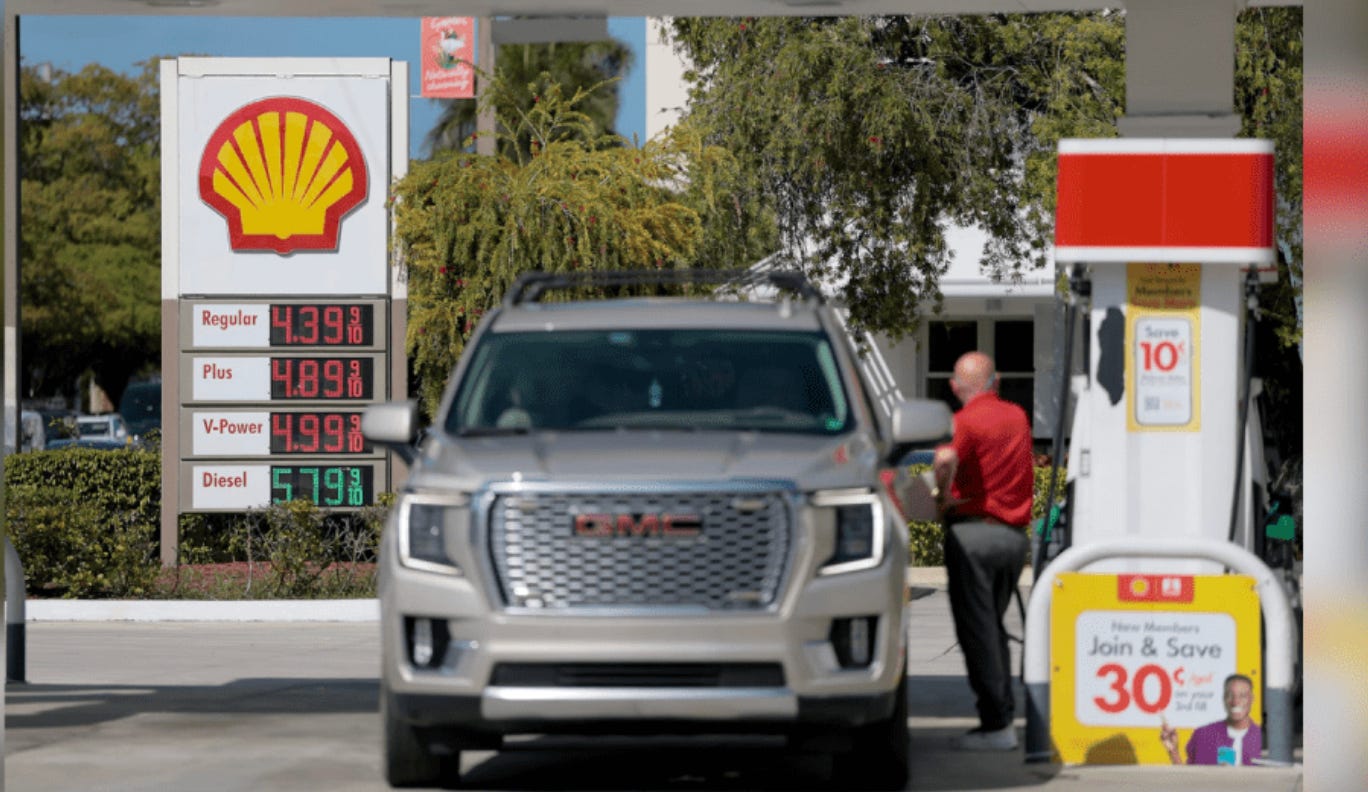
Today, the price of Brent crude oil is approximately $114 per barrel. That translates directly into higher gas prices. Higher gas prices drive up the cost of food, medicine, manufacturing, and shipping. Every part of the economy is affected.
Voters are noticing. Despite the Republican Party’s insistence otherwise, people can see what is happening. They can feel it every time they go to the grocery store or fill their tank. CNBC put it plainly this week, “Donald may now be facing even higher food prices heading into the midterm elections.”
And yet, members of the Trump regime continue to insist that once the Strait of Hormuz reopens, prices will return to pre-war levels. That is not how any of this works. Even if the strait reopens tomorrow, the damage has already been done. Supply chains have been disrupted. Markets have reacted. Prices will remain elevated for a considerable period of time, not just in the United States, but around the world.
The numbers are staggering. The Federal Reserve Bank of Dallas estimates a 2.9 percentage point drop in global GDP growth in the second quarter of 2026 if the disruption continues. If it lasts for a full year, global GDP could fall by 1.3 percentage points. Estimated global losses are already around $20 billion per day. If current trends continue, total losses could approach $5 trillion.
In the United States, the Department of Agriculture projects food prices will rise by 3.6 percent in 2026 as a direct result of higher oil costs. Globally, the impact is even more severe. The Philippines has declared an energy emergency. Pakistan has been forced to close schools temporarily to conserve fuel. These are not abstract consequences. These are real decisions affecting real people.
Americans are still feeling the strain after years of elevated inflation following the global pandemic and the first Trump administration’s egregious mishandling of that crisis. The concept of affordability is not theoretical. It is a top voter issue. Donald has dismissed it as a hoax and a line of nonsense.
But voters understand something he either cannot or refuses to grasp. They understand that when energy prices rise, everything else follows. They understand that instability abroad creates hardship at home. And they understand, increasingly, that this did not have to happen.
This is what it looks like when someone who knows nothing believes he knows everything. Donald did not anticipate Iran’s response. He did not understand the strategic importance of the Strait of Hormuz. He did not consider the economic consequences of disrupting a critical global supply route. And now the world is paying the price.
The question is not whether this was avoidable. It was. The question is how much worse it is going to get before there is any accountability. Because the pattern is clear. Donald creates a crisis. He denies responsibility. He offers simplistic explanations that do not hold up under scrutiny. And then he doubles down.
The difference this time is scale. This is not just about domestic policy or political rhetoric. This is a global economic shock with consequences that will be felt for years. The longer this continues, the harder it will be to reverse.
The midterm elections are approaching. Voters will have an opportunity to respond. But the damage being done now will not be undone overnight. It will take time. It will take stability. And it will take leadership that understands the world as it is, not as Donald imagines it to be.
Until then, we are left with the consequences of a war that never should have happened, fought for reasons that were never clear, and managed by people who were never prepared. That is the cost of chaos. And we are only beginning to pay it.
The Good in Us by Mary L. Trump is a reader-supported publication. To receive new posts and support my work, please consider becoming a free or paid subscriber.

Go wipe the floor with these clowns in November, American friends. We're rooting for you to find a way to push these losers out of power and put a stop to their omnishambolic nonsense.
- sincerely, a Brit.
Thank you for the article, Mary. Professor Krugman is one of the best economists, in fact. Gas has jumped 80 to 90 cents and I live in an Oil and gas producing region. It’s holding at 3. 89 per gallon. I wonder if the market is being manipulated? Businesses are struggling with inflation and some have closed their businesses, here in the Midwest. I think our voters go to the polls in August. If you like Independent Media, and honesty in reporting if you can please subscribe to Mary Trump Media.