

Donald’s poll numbers are collapsing. They are now sitting in the low thirties, the lowest of his second term, and the Republican Party understands exactly what that means. If this trend continues, they are heading toward a devastating loss in the midterm elections. The House of Representatives is almost certainly at risk, and even the Senate, which seemed untouchable just months ago, is now in play.
There is every reason to believe those numbers will continue to fall. The economy is struggling, driven largely by two policies Donald is directly responsible for: tariffs and his illegal and unconstitutional war of choice in Iran. Historically, the party in power tends to lose seats in midterm elections even under stable conditions. Voters shift, expectations change, and dissatisfaction accumulates. But this is not a typical environment. Americans are not simply restless. They are frustrated, and they have tangible reasons to be.
Donald returned to office with approval ratings above fifty percent, which in itself should have raised serious concerns. Just over a year later, those numbers have dropped dramatically, in some cases as low as thirty three percent. Even Republican strategists are warning that the party is facing a brutal electoral landscape.
Back in Donalds first term, support among independents who leaned Republican was around 73 percent at this point. Now it has dropped to just 53 percent.
That kind of drop is not subtle. It is a collapse, and it signals a problem that cannot be easily corrected in the short time before November. So the question becomes unavoidable. What does a party do when it knows it is likely to lose?
If it is committed to democratic principles, it adjusts its policies, reassesses its leadership, and makes a case to voters. But that is not the path we are seeing. Instead, we are watching a party that has shown repeatedly that it has no hesitation about manipulating the system in order to maintain power.
That manipulation is already underway.
The Supreme Court’s recent decision in Louisiana versus Callais, handed down on April 29, 2026, represents a turning point. In a six to three ruling, the Court struck down Louisiana’s second majority Black congressional district. In doing so, it effectively dismantled one of the last meaningful protections remaining under the Voting Rights Act.
To understand what this means, it is necessary to be clear about what gerrymandering is. At its most basic level, it is the process by which politicians draw electoral maps in ways that allow them to choose their voters, rather than allowing voters to choose them. In practice, it has long been a tool used to dilute the political power of marginalized communities, particularly Black voters.
Historically, this has been done in two primary ways. Voters are either packed into a single district, concentrating their influence so it cannot affect surrounding areas, or they are cracked apart, divided across multiple districts so they never form a majority anywhere. The result is the same. Their political power is weakened.
SCOTUS, has ruled on the erroneous assumption that America has somehow solved its racism problem, thereby opening the door to red states engaging in blatantly
and egregiously racist behavior.
This is not new. It is a continuation of practices that date back to Reconstruction, when states across the South began redrawing maps specifically to undermine the political gains Black Americans had made after the Civil War. What has changed is not the intent, but the level of restraint. The pretense has largely disappeared.
With the Louisiana ruling, the Court has made it significantly easier for that history to repeat itself. States no longer have to demonstrate that their maps are fair in any meaningful sense. They simply have to avoid explicitly stating discriminatory intent. The effect on voters, even when it is obvious, is no longer sufficient grounds for intervention.
That decision has immediate consequences. Louisiana Republicans were able to halt elections that were already in progress, even after more than one hundred thousand ballots had been cast. Florida moved forward with a new congressional map the same day. Republican controlled legislatures across the country began preparing new maps and special sessions.
The speed with which this unfolded was not accidental. The Supreme Court waived its own standard waiting period and finalized the decision in less than a week. That urgency speaks for itself.
Analysts estimate that these new maps could result in Republicans gaining up to eighteen additional House seats. That alone could determine control of Congress, regardless of how voters across the country actually vote.
This is what it looks like to shape an election before it happens.
Donald himself has made clear how much is at stake for him personally.
You have to win the midterms, because if we don’t, they will find a reason to impeach me.
That is the calculation. It is not about policy or governance. It is about maintaining power and avoiding accountability.
And the pressure is not limited to general elections. Within the Republican Party, those who resist are targeted. In Indiana, several state senators who opposed redistricting efforts were publicly attacked by Donald, labeled as disloyal, and faced well funded challengers. Most of them lost.
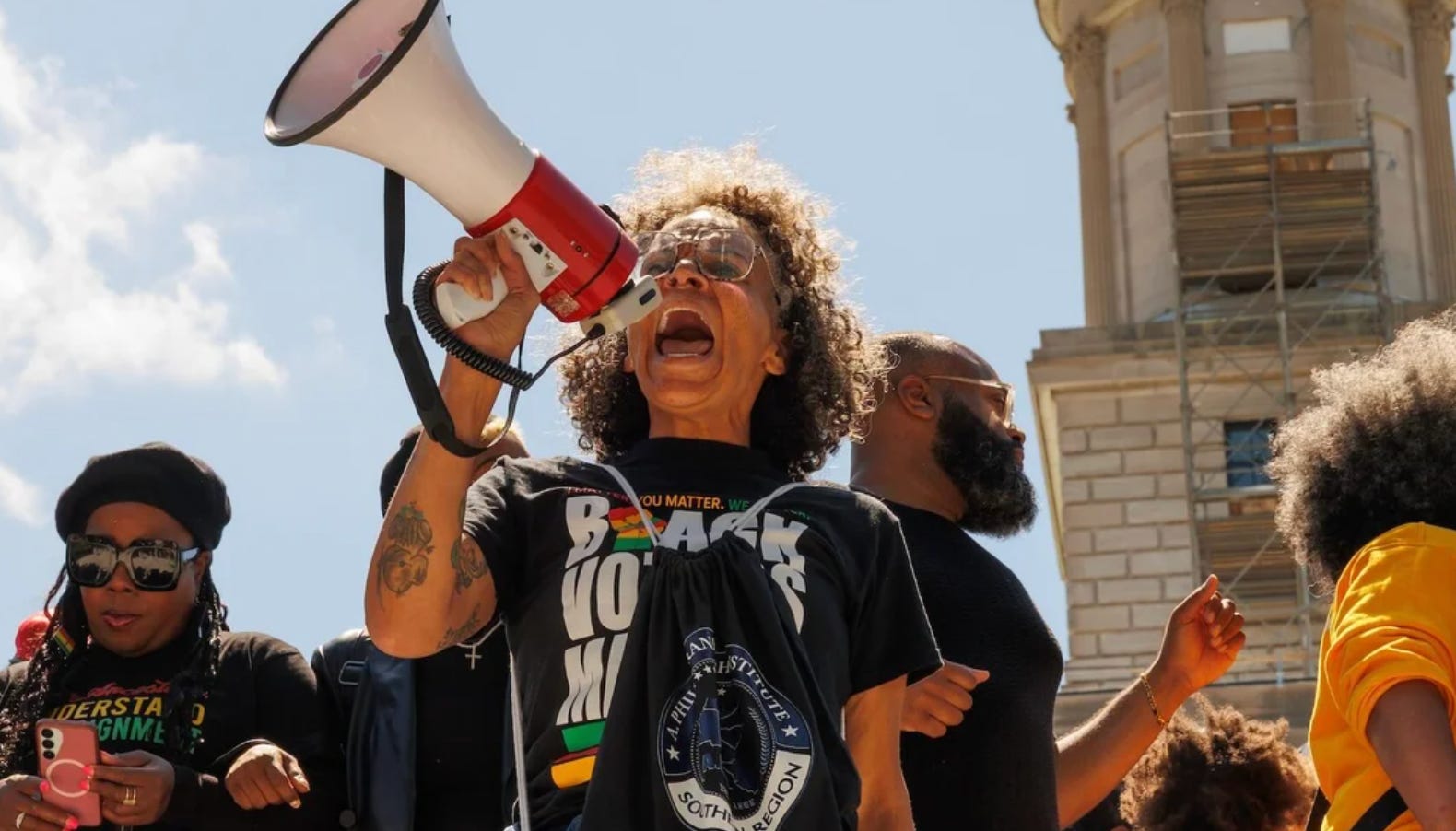
Consequences extend beyond political careers. A Democratic lawmaker who challenged gerrymandering efforts saw her offices raided. In Tennessee, tensions escalated as lawmakers moved to dismantle the state’s only majority Black district, prompting widespread protests.
All of this is happening in real time, in full view.
Chief Justice John Roberts has long sought to weaken the Voting Rights Act. With this ruling, that effort has largely succeeded. But the implications go beyond any single decision. What has been set in motion is a system in which electoral outcomes can be shaped well before voters have the opportunity to participate.
Republican led states are moving quickly to take advantage of that system. They recognize the opportunity, and they are acting on it. At the same time, Democratic led states are beginning to consider whether they must respond in kind simply to remain competitive.
States like New York, Illinois, Maryland, Colorado, and California are now confronting a difficult question. Can they afford to continue operating under rules that their opponents are no longer following.
This is where the situation becomes even more precarious. When one side abandons the rules and the other feels compelled to follow, the outcome is predictable. But when both sides begin to operate without constraints, the system itself begins to erode.
The reality is that Democrats are facing a structural disadvantage that has been deliberately created. Competing within that system requires decisions that carry their own risks. But failing to respond carries consequences as well.
The broader issue is not limited to one party or one election. It is about whether the fundamental principle of representative democracy remains intact. When electoral maps are drawn to predetermine outcomes, the connection between voters and representation is broken.
There is a great deal happening at once, and it can be difficult to track each individual development. But the pattern is clear. Rules are being rewritten. Safeguards are being removed. And the mechanisms that once ensured fair representation are being systematically weakened.
This is not something that can be ignored or dismissed as routine political maneuvering. It is a deliberate strategy.
And it is one that will shape the outcome of the next election before a single vote is cast.
The Good in Us by Mary L. Trump is a reader-supported publication. To receive new posts and support my work, please consider becoming a free or paid subscriber.

Marching to Gilead, where women have no power, and there are no brown people.
Why aren't the DEMS out in front of the cameras screaming their heads off? I'd be yelling to the press on a daily basis. Sheep. We are all nothing but a bunch of sheep...just sitting there taking it!